

Getting a drifting year back on track can feel harder than starting over, because a clean slate carries no record of failure. That record is the point. By the midpoint, real life has tested every goal you set in January, and some of them have slipped. What that testing produced is evidence, and evidence beats a clean slate.
The instinct when results slide is to try harder. That instinct treats a structural fault as a shortage of effort. More willpower does not repair a structure. You need to find which layer of the goal actually drifted, then repair it there. This post shows you how to get back on track that way.
Why Getting Back on Track Beats Starting Over
Waiting for January is an expensive habit. A fresh start throws away six months of effort and everything those months taught you about what works.
More than half the year still lies ahead, which is time enough to get a drifting goal back on track rather than restart it.
Drift also compounds. A missed week becomes a missed month, and a missed month becomes a written-off year. Acting now stops that slide while the repair is still small. If you are still weighing whether a goal deserves keeping at all, the earlier post on whether to persist or change direction covers that decision first.
What Getting Back on Track Really Means
Getting back on track is diagnosis, not effort. Recovery starts from where you stand today and finds the one layer that weakened.
That means resisting the common response. When results slip, the common response is to escalate effort. People work longer and push harder, and the drift continues, because effort cannot repair a fault in the structure.
This is course correction rather than punishment. A ship off course does not sail back to harbour and begin again. It adjusts heading from its current position. A year gets back on track the same way.
The Diagnostic Order That Gets a Year Back on Track
The Unchained Goals Framework works through a goal in a fixed order, starting with the smallest thing you control and moving up. You stop at the first layer that fails, and you repair it there.
Four parts of a goal are the ones that actually move it forward: the Outcome you want, the Performance standard that tells you whether you are getting there, the Process you repeat to produce that standard, and the Habit that keeps the process running. Diagnosis walks that chain from the bottom up.
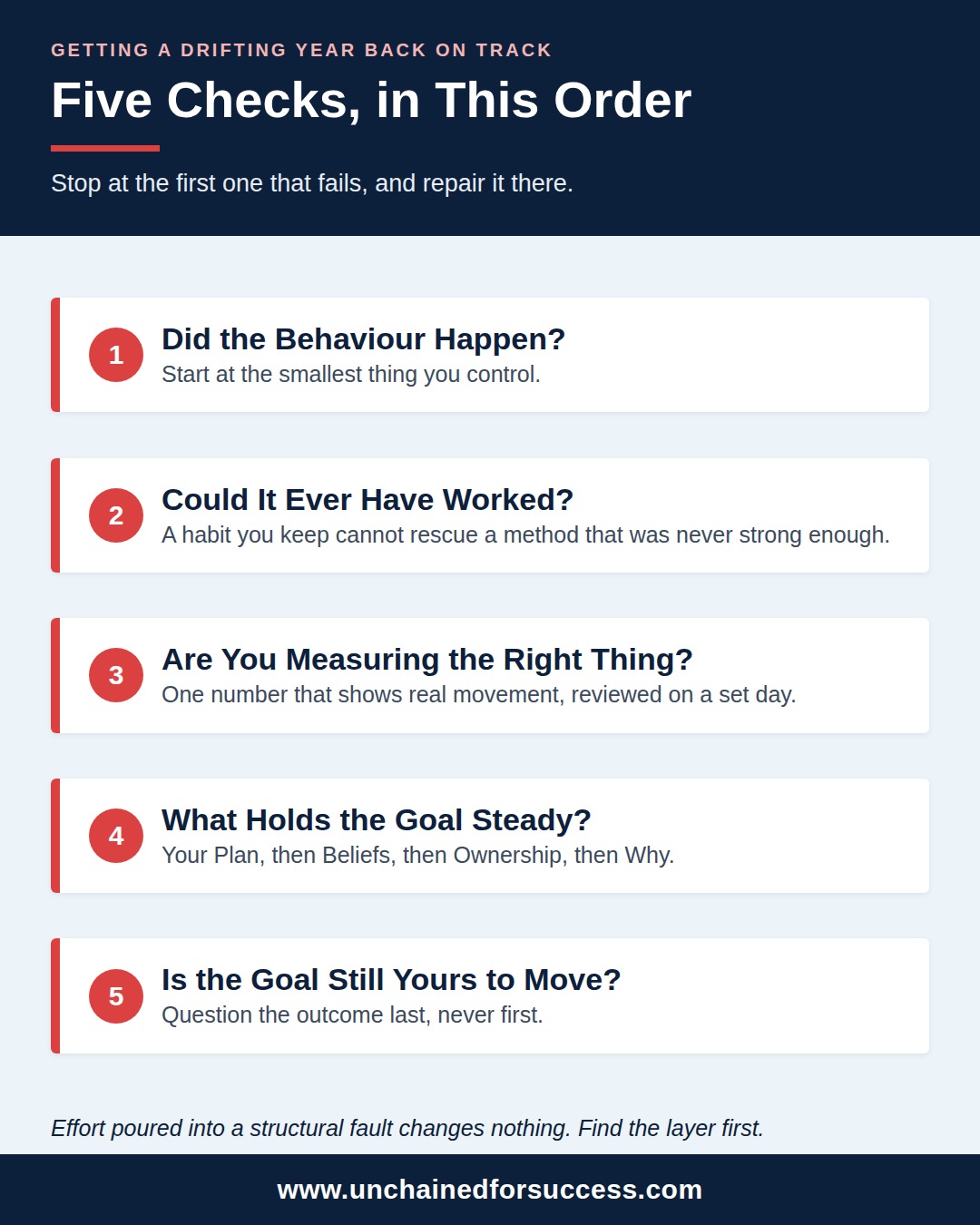
Start at the Habit
Begin at the smallest layer and ask one plain question. Did the behaviour actually happen, at the cadence you agreed?
This is the layer to rule out before the Outcome Goal comes into question, because most recoveries that get back on track start here. If the habit lapsed, you have your answer, and getting back on track means rebuilding one repeatable action rather than redesigning the year.
Implementation intentions help at this layer. A simple "when this happens, I will do that" plan hands control of the behaviour to an anticipated cue (Gollwitzer, 1999). Across 94 separate tests, a later review found that people who made that kind of plan reached their goals substantially more often than people who only intended to (Gollwitzer and Sheeran, 2006).
Test the Process
If the habit held, test the process next. A Process Goal is the repeatable, directly controllable behaviour meant to produce the Performance standard.
Ask whether it is capable of producing that standard at all. Sometimes the habit ran faithfully and the chosen action was never strong enough to move anything. If so, replace it with a controllable action capable of moving that standard, and say when you will do it. For more on closing the gap between plan and delivery, see mastering execution.
Check the Measure
Next, check the Performance measure. Performance Goals are the operating standards that show whether effort is converting into progress.
Track the wrong standard, or track it too rarely, and drift stays hidden until it is severe. Choose the one number that shows real movement, then review it at a set cadence so the next slip surfaces early.
Reviewing decides whether a recovery holds. Across 138 studies covering nearly twenty thousand people, those prompted to track their progress reached their goals more often than those left to get on with it (Harkin and colleagues, 2016). Two choices strengthened that, each tested on its own rather than in combination.
Writing progress down beat keeping it in your head. Telling someone else beat keeping it to yourself, and by the wider margin of the two.
So record the number. If it helps, tell someone who can act on what you find. Neither costs much, and the recording is what makes drift visible early enough to repair.
Check the Four Things That Hold a Goal Steady
If all four of those hold, turn to the ones that do not move a goal forward but stop it collapsing when the cost becomes real: your Why, your Ownership, your Beliefs and your Plan.
Check them in this order: Plan, then Beliefs, then Ownership, then Why. That order is deliberate. It runs from the easiest thing to adjust to the one everything else rests on.
Start with the Plan. Under pressure it tends to spread thin rather than concentrate on the constraining resource. Then look at Beliefs, where a quiet assumption may have turned against the goal by telling you it is already too late. Next comes Ownership, which turns conditional when you stop accepting the cost and the consequences of the goal as yours to carry. Finally your Why, which weakens when the cost grows and the reason stays the same.
Repair the weak layer directly. Cut the plan back to one or two priorities, challenge the belief with evidence, re-accept the cost and the consequences as yours, or restate what makes the price worth paying.
Check the Outcome Boundary
Only when every layer beneath is sound do you question the outcome itself.
Five properties make an Outcome Goal valid: Stretched, Specific, Measurable, Time-bound and Under your control. A goal that has quietly gone vague has lost the one that made it work, because specific and difficult goals drive performance in a way that general intentions do not, partly by keeping effort going for longer (Locke and Latham, 2002).
If the outcome has drifted beyond your influence, reset it to something you can actually move, as stretch goals require.
And if every layer holds yet the goal still feels wrong, the deeper question is whether it still serves your Vision and Purpose. If it does not, release it honestly rather than get it back on track.
The Control System Holds the Recovery
The Control System is not a step in the walk. It is the governance component that runs continuously and drives the walk.
The Control System reviews Performance at defined cadences, confirms the Outcome less often, and activates a response when an agreed trigger fires. That trigger is what starts this diagnosis in the first place, the moment results move outside the range you accepted.
Control theory describes self-regulation as exactly this loop: perceive the present state, compare it against a reference value, and act to close the gap (Carver and Scheier, 1982). The monitoring evidence above speaks to one step in it. Prompting people to see where they actually stand improves attainment, and the Control System makes that step non-optional.
During a recovery the Control System does two jobs. First, it holds the corrected goal steady. Second, it catches the next slip while the cost of fixing it stays small, which is how a goal stays back on track rather than drifting again.
Back on Track in Practice: Three Examples
Three short illustrations, one for each scale. None is a client case.
An individual. A finance manager planned two professional exams this year and has sat neither. Diagnosis starts at the habit, and the habit is the fault, because study time never survived a busy quarter. So the repair stays at that layer. She rebuilds one habit, a fixed ninety-minute block two evenings a week, which is what the last quarter shows she can actually hold.
She then names the Process Goal it serves, one past paper a week, against a Performance standard she reads monthly. That is the diagnosis complete: the habit was the broken layer, and the repair stops there.
One separate check follows, and it is not part of the diagnostic walk. Both sittings she had planned for have now gone by, so the original Time-bound condition cannot be met however well the habit runs from here. That is a feasibility fact rather than a diagnosed fault.
She books the next available sitting, moves the second exam to a later window, and leaves everything else as designed. Getting back on track sometimes means accepting what the calendar has already settled.
A business. A small agency aimed to lift recurring revenue by thirty per cent and has managed five per cent. The habit holds, so diagnosis moves up one layer. The process is the fault: scattered pilots, none capable of producing the standard. So the repair happens there. The owner drops the pilots, commits to one controllable weekly action on the single service that already converts, and names what goes to make room for it.
When the Fault Sits Higher Up
A project. A delivery programme is two months late and the team keeps adding scope. Recovery does not begin with more hours. It walks the structure in order: delivery habits, then process capability, then the measure and its cadence, then the four structural layers in reverse design order, Plan, Beliefs, Ownership, Why.
Ownership is where this one fails, because it has diffused across too many people. So the repair happens there. One named owner per workstream accepts the cost and the consequences of holding the scope line, and that owner gets a freeze they can defend.
That repairs the authority. It does not recover two months on its own, so the next step is a dated scope decision and a revised delivery forecast the owner can be held to. Whether the programme gets back on track is what the following two review cycles show.
Common Mistakes When Getting Back on Track
Three mistakes stall a recovery.
Trying harder before diagnosing. Effort poured into a structural fault drains energy and changes nothing. Find the broken layer first, then get back on track by repairing that one.
Recovering everything at once. Spreading thin effort across every goal rescues none. Make deliberate trade-offs and protect what still serves your Purpose.
Stopping at insight. A diagnosis that never becomes a changed behaviour changes nothing. Name the layer, rebuild the action, and let the Control System hold the recovery in place.
Frequently Asked Questions
What if more than one layer has failed? Repair the lowest one first, then re-run the check. Repair a higher layer while the one beneath it still fails and you get back on track for a fortnight, no longer.
Does this mean I should never abandon a goal? No. The outcome boundary check exists precisely so that you can release a goal honestly, on evidence, rather than through fatigue. The diagnostic order exists to stop you abandoning a sound goal because a single habit lapsed, which is how a sound goal gets talked away.
How often should I run this? You do not run it on a schedule. The Control System triggers it when measured performance moves outside the range you agreed. Reviewing how the whole goal is designed is a separate exercise, and zooming out to reassess direction covers when to do it.
So here is the question worth sitting with, and the comments are open if you want to answer it.
Which layer of your drifting goal have you actually checked, and which have you only assumed?
If you would like an outside view of how your goals are designed, executed and governed, the Goals Readiness Score scores each of the nine components separately and names the weakest one.
Sources on Getting Back on Track
- Locke, E. A., and Latham, G. P. (2002). Building a practically useful theory of goal setting and task motivation: a 35-year odyssey. American Psychologist, 57(9), 705 to 717. https://doi.org/10.1037/0003-066X.57.9.705 A review of goal setting theory rather than an empirical test, cited for the specificity and sustained effort findings it summarises.
- Gollwitzer, P. M. (1999). Implementation intentions: strong effects of simple plans. American Psychologist, 54(7), 493 to 503. https://doi.org/10.1037/0003-066X.54.7.493 A narrative review, cited here for the mechanism rather than an effect size.
- Gollwitzer, P. M., and Sheeran, P. (2006). Implementation intentions and goal achievement: a meta-analysis of effects and processes. Advances in Experimental Social Psychology, 38, 69 to 119. https://doi.org/10.1016/S0065-2601(06)38002-1 94 independent tests, d = 0.65.
- Harkin, B., Webb, T. L., Chang, B. P. I., Prestwich, A., Conner, M., Kellar, I., Benn, Y., and Sheeran, P. (2016). Does monitoring goal progress promote goal attainment? A meta-analysis of the experimental evidence. Psychological Bulletin, 142(2), 198 to 229. https://doi.org/10.1037/bul0000025 138 studies, 19,951 participants. Pooled d+ = 0.40, 95 per cent confidence interval 0.32 to 0.48. Physically recording progress 0.43 against 0.29; reporting publicly 0.55 and 0.47 against 0.19, each moderator tested separately rather than in combination.
- Carver, C. S., and Scheier, M. F. (1982). Control theory: a useful conceptual framework for personality-social, clinical, and health psychology. Psychological Bulletin, 92(1), 111 to 135. https://doi.org/10.1037/0033-2909.92.1.111 A conceptual paper reporting no new empirical work.
- Kwegyir-Afful, C. (2023). Unchained: Success Unlocked: A Proven Framework for Achieving Your Goals.
Continue Your Journey
Explore more resources from the Unchained Goals Framework: