

You can feel when a year has begun to drift. The signals are quiet at first. A goal slips by a week, then by a month. Effort continues, yet progress thins. A mid-year reset is the honest pause that turns vague unease into clear evidence, and clear evidence into a stronger second half.
Here is the uncomfortable part. The mid-year reset is easy to avoid on purpose, because running it forces you to see what you would rather not name. This post is about that avoidance: why it happens, what it quietly costs, and how to face the evidence with courage instead of guilt.
Why a Mid-Year Reset Matters Once Real Life Tests Your Goals
If you have followed this June series, you have already seen how to review your goals mid-year and how to weigh whether to persist or change direction. This post turns to the harder question underneath both: why people avoid the reset in the first place. For the step-by-step of running one, see Mid-Year Reset: How to Reflect, Refocus and Recharge Your Goals. This post is about something earlier: the decision to look at all.
By June, the goals you set in January have been tested by real life. Some have moved well. Others have stalled. As a result, the gap between intention and result is now visible, for anyone willing to look.
A mid-year reset matters because drift compounds. The cost does not need to be dramatic. Like the hidden cost of saying yes to too much, it builds up quietly, until six months of small avoidances can add up to a lost year.
The Research Behind Why a Mid-Year Reset Feels Hard
There is a deeper reason the reset feels hard. Golman, Hagmann and Loewenstein reviewed the research on information avoidance for the Journal of Economic Literature. The review finds that people often decline information that is useful and free when receiving it would be painful, for instance when it threatens their view of their own ability or the optimism they are trying to hold on to.
On that reading, a mid-year reset is precisely that kind of information. It is free, it is useful, and it can sting.
Avoidance Is Not Laziness: What a Mid-Year Reset Exposes
It is tempting to read avoidance as laziness or weak willpower. Calling avoidance laziness does not identify what is happening. Avoidance is an understandable response to expected pain, a way the mind protects itself from information that feels threatening, even when that information would help.
The same review gives a vivid example. Karlsson, Loewenstein and Seppi found that investors looked up their portfolios more often when markets were rising than when they were flat or falling, a pattern known as the ostrich effect. The same instinct shapes the reset you keep postponing. When you suspect the news is poor, looking feels worse than not looking.
Jackman and Strober make the point at work in the Harvard Business Review. In their account, fear of feedback shows up as procrastination, denial, brooding, jealousy and self-sabotage, and at least half the executives they had worked with had never asked for feedback at all. That is their observation from practice rather than a survey.
So what does a mid-year reset actually expose? Four things in particular: a goal that was never structured to be achieved, a reason too weak to justify the sacrifice, a belief quietly steering your choices, and a process that was never going to deliver. None of these is a verdict on your worth. Each is simply evidence you can act on.
The full review of every framework component belongs to the first post in this series. This article stays with the harder question: why capable people can reach December without running that review at all.
How the Framework Explains the Mid-Year Reset You Avoid
The Unchained Goals Framework treats a mid-year reset as a built-in function rather than an emergency. Three of its components explain both the avoidance and the way through it: Ownership, Beliefs and the Control System.
Ownership: Why the Mid-Year Reset Feels Like a Threat
Ownership is the conscious acceptance of what a goal will cost, and of the consequences of pursuing it within your authority. That final phrase carries the weight. Honest mid-year evidence makes the cost visible, and a visible cost demands a response.
Avoidance is the moment that acceptance turns conditional. You keep the intention, yet you step back from the responsibility, because responsibility now has a price. A reset revisits the acceptance. It asks you to own both the evidence and the next move, cost included.
Beliefs: The Assumptions That Make You Avoid the Mid-Year Reset
Beliefs are the assumptions you hold about what is possible, permissible or safe. They quietly expand or restrict what you are willing to attempt. A limiting belief rarely announces itself. It simply makes the reset feel pointless, premature or too painful to attempt. "I have left it too late." "I am just not a disciplined person." "If I look, I will only feel worse."
Each belief hands you a reason to avoid the evidence. Naming the belief is what loosens its grip, which is why an honest reset examines beliefs, not behaviour alone. An earlier post covers the hidden beliefs that undermine your goals.
The Control System: A Mid-Year Reset Is Governance, Not Guilt
The Control System is the governance component of the framework. It compares your agreed measures with their operating range at a set rhythm, and it opens a diagnosis when a result falls below that range and meets the trigger you agreed in advance.
Seen this way, a mid-year reset is not a confession. It is a scheduled review the framework builds in. The Control System shows where Performance and the Outcome Goal stand. A periodic structural check, which the framework calls the Architectural Audit, then asks whether each component still holds. Governance strips out the emotional charge, because a scheduled review is something you do, not something you failed into. The reset stops being a judgement and becomes a mechanism.
A Mid-Year Reset in Practice: Individual, Business and Project
The people in these examples are illustrations, not clients.
A Mid-Year Reset That Restored a Weakened Why
A marketing lead set out to publish a book this year and has written almost nothing since March. Avoidance tells her the goal was beyond her. A reset tells a truer story.
Her Purpose, the problem in her field she has taken responsibility for, still holds firmly. The writing routine stopped in March, and the reset asks why. Her Why, the reason the goal is worth its cost, had weakened, because she never weighed the cost of weekly writing against everything competing for her evenings.
The reset restores that cost justification and sets one Process Goal, a controllable weekly writing behaviour she can actually keep, reviewed every week.
A Mid-Year Reset That Exposed a Capacity Gap
A founder planned to enter two new markets by year end and has entered neither. The team has stayed busy, yet the market work keeps sliding. The reset exposes the avoided truth: the Plan, the route from here to the result, assumed capacity the business does not have. Ownership here means accepting the trade-off and its consequences rather than blaming the calendar. The second half targets one market, properly resourced, instead of two in name only.
A Mid-Year Reset That Became the Project Retrospective
A delivery team is three sprints behind, and no one has said so plainly. The reset is the retrospective they have been avoiding. The Control System turns an awkward admission into a normal checkpoint. Once the slippage is named, the team can re-plan around where the work actually stands, not the original wish. Before replanning, the team checks what caused the slippage so the revised plan does not repeat it.
How to Run the Mid-Year Reset You Have Been Avoiding
A mid-year reset works best as a short, deliberate review, not a vague worry you carry around for weeks. These five questions help you stop avoiding the evidence and prepare for a fuller review. Answer them honestly, in one sitting.
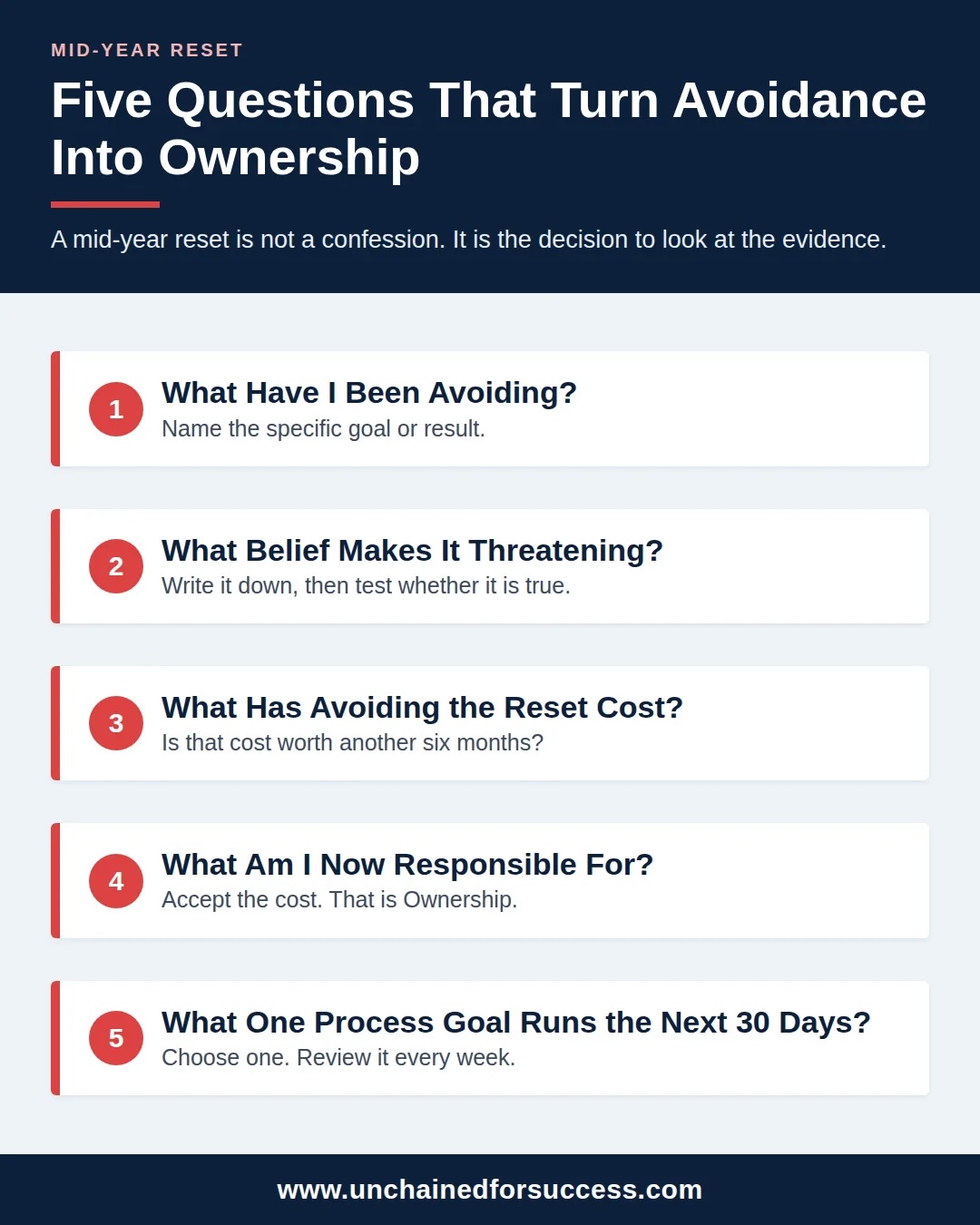
1. What Have I Been Avoiding?
Name the specific goal or result, not a general feeling. The reset needs a subject, and vagueness is where avoidance hides.
2. What Belief Makes It Threatening?
Write it in plain words, then test whether it is actually true. A belief you can see is a belief you can examine.
3. What Has Avoiding the Mid-Year Reset Cost Me?
Is that cost worth paying for another six months? Then revisit your Why: is this goal still worth the time, effort and trade-offs required to pursue it?
4. What Am I Now Responsible For?
This is Ownership, the point where intention becomes accepted responsibility. Say what you accept, what accepting it will cost, and what follows if you do not.
5. What One Process Goal Runs the Next 30 Days?
Choose one, make it specific, and review it every week. Notice what the exercise does not ask. It does not ask you to rebuild the entire year in one afternoon. It asks you to face the evidence and commit to one governed step. Recovering a year that has already drifted is a task of its own, and the next post in this series, Back on Track, covers it.
Common Mistakes in a Mid-Year Reset
Three mistakes are worth watching for. The first is turning the reset into self-criticism. Evidence is data, not a character reference, and harsh self-talk only deepens the avoidance next time.
The second mistake is resetting everything at once. People who finally look can over-correct, scrapping sound goals alongside weak ones. The wiser move is to make deliberate trade-offs, keeping the goals that still serve your Purpose.
A third mistake is stopping at insight. A reset that ends in reflection changes nothing. Ownership needs a committed next step, governed and reviewed, or the same drift quietly resumes by July.
Mid-Year Reset: Frequently Asked Questions
Is a mid-year reset the same as a mid-year review? The review is the full check of every framework component, covered in the first post of this series. The reset is the decision to look at all, and the one governed step that follows. Its five questions prepare you for the review; they do not replace it. If you have been putting the review off, the reset comes first.
What if the evidence shows the goal should be dropped? Then dropping it is a decision, not a failure. Test it against your Purpose first: a goal that no longer serves the problem you have taken responsibility for has done its job by revealing that. The post on whether to persist or change direction walks through that call.
How often should I run one? The Control System reviews Performance at the cadence you set when you designed the goal, often weekly for an individual, and confirms the Outcome Goal less often. The framework also builds in a periodic structural check of every component, the Architectural Audit, at a rhythm you choose.
A mid-year reset is not that full check. It is the decision to stop avoiding the evidence, and the first governed step towards it, taken with six months of runway left.
Turn the Mid-Year Reset From Avoidance Into Ownership
A mid-year reset is not about feeling bad over what has not worked. It is about finding the courage to face the evidence, own the next move and govern the second half before the year is lost. Finishing strong does not require a year without drift. It requires looking sooner. The people who finish strong converted avoidance into Ownership, and a stalled six months into a governed plan.
So run the mid-year reset you have been avoiding. Answer the five questions in one sitting this week, and put the thirty-day Process Goal in your calendar. If you want an outside view of how your goals are designed, executed and governed, the Goals Readiness Score is an optional next step: 18 questions, under five minutes.
Share the one thing you have been avoiding looking at, and the step you will take, in the comments.
What is the evidence you have been avoiding, and what would change if you looked at it today?
Sources
• Information Avoidance by Russell Golman, David Hagmann and George Loewenstein, Journal of Economic Literature, 55(1), 96 to 135, 2017. Full text at Carnegie Mellon University
• The ostrich effect: Selective attention to information by Niklas Karlsson, George Loewenstein and Duane Seppi, Journal of Risk and Uncertainty, 38(2), 95 to 115, 2009
• Fear of Feedback by Jay M. Jackman and Myra H. Strober, Harvard Business Review, April 2003
Continue Your Journey
Explore more resources from the Unchained Goals Framework: