
The goal made sense when you set it. Months later, you are still working hard on it. Yet the world that made it the right goal has quietly changed. Nobody chose to keep going. The question simply never came up. That is how sound plans outlive their use: not through a bad choice, but through no choice at all. Knowing when to zoom out and reassess direction is what stops it.
Timing, it turns out, matters as much as the review itself. Zooming out does not mean doubting your direction each time progress slows. It means reviewing your goal system at the right level, in the right order. Direction changes only when the evidence reaches that far. Before you change direction, find out what needs attention.
Is the work happening (the Habit)? Does the method work (the Process)? Are you tracking the right thing (the Performance measure)? Does the Plan still fit your capacity? Do the Beliefs, Ownership and Why beneath it still hold? And does the Outcome Goal still sit within your authority?
Look at Vision, the long-term position all of these serve, only when the problem is systemic, repeated or part of a formal recovery.
The short answer: zoom out at booked reviews, at meaningful landmarks and whenever you cross a warning line you agreed in advance. Reassess direction itself only when careful review shows the problem lies with your long-term position, not with the plan or effort serving it. This post unpacks that answer for people, teams and projects.
The direction in question might be a career, a business, a project or a personal ambition. Either way, stepping back should happen by design, not by crisis.
What It Means to Zoom Out and Reassess Direction
In the Unchained Goals Framework, Vision is Direction. It is the long-term position you have committed to holding within your Purpose, the problem or domain you have accepted responsibility for. Goals and Habits move you towards that position, and the Plan organises that movement, but none of them is Direction itself. Changing a Plan, a route or a pace is course management. Changing Vision is a change of Direction, and that is a rarer and more serious step.
To zoom out, then, is to step out of the work and review the goal system at the right level. Sometimes the evidence calls for a better Habit, Process or Plan, and sometimes for a redesigned Outcome Goal. To reassess direction is the deepest step of all: testing whether the long-term position set by Vision is still right. An earlier post made the case for a long-term perspective; this one shows when, and at what level, to act on it.
A Running Example: One Coach, One Course
Imagine a coach whose Purpose is helping people and teams achieve meaningful goals. She is an example, not a client. Her Vision, the long-term position through which she serves that Purpose, is to build a nationally recognised coaching business that sells direct to the public. This year's Outcome Goal is to create and launch a six-module online course by 30 November.
Her Performance Goal is to finish one module every fortnight, each approved against a quality checklist.
Beneath it, a Process Goal covers course-development sessions every Monday, Wednesday and Friday, with the script, video and worksheet submitted by alternate Fridays. Her Plan sets out the order, the capacity and the resources needed to research, draft, test, record and launch the course. A Habit of starting each session at 9.00 am with the task list open and distractions removed makes the Process consistent.
Her agreed operating range, the band of results she treats as normal, is one to two finished modules per fortnight. One fortnight with no finished module is a warning sign. Two fortnights in a row with none is the trigger she has agreed in advance for a proper investigation.
That picture rests on three ideas.
Reassessment is a discipline, not an emergency response. If you only step back when something breaks, you are late. The most useful reviews happen while things still look fine.
A poor result is information, not a verdict. The diagnostic sequence finds and fixes problems below the level of Direction. It reaches Direction only when every lower layer has been checked and found sound.
Reassessing is not the same as changing course. A review that ends in informed recommitment has done its job: carrying on becomes a deliberate choice made with current facts.
Why Timing Matters When You Reassess Direction
Does it really matter when you reassess direction? Research and practice point to three reasons.
A Fresh Start Is a Natural Moment to Reassess Direction
People are more likely to act on their goals just after a meaningful landmark in time. Dai, Milkman and Riis tracked gym visits, Google searches for "diet" and new goal commitments, and reported the results in Management Science.
All three rose after the start of a new week, a new month and a new year. Gym visits and goal commitments also rose after birthdays. The researchers called this the "fresh start effect". They suggested that a landmark pushes past slip-ups into a closed period and prompts a bigger-picture view of life.
One caution applies. The study measured aspirational activity, not the quality of direction choices. Landmarks are natural moments to step back, not a guarantee of a good review. And if you rely only on the landmarks that happen to arrive, your goals may drift for months between them. The fix is to put your own landmarks in the calendar.
Organisations That Redirect Resources Show Higher Returns
Companies show the cost of failing to review in their capital. McKinsey research tracked more than 1,600 US companies from 1990 to 2005. In a third of them, the money went to almost exactly the same places year after year. Meanwhile, the third most willing to move resources did far better. On average, they earned 30 per cent higher total returns to shareholders per year than the least willing third.
The research shows a link rather than proof of cause. Even so, in our reading, money that goes to the same places every year is unlikely to be a fresh judgement each time; it looks like last year's choice repeated without review. One distinction matters here. Moving resources usually changes Goals, Plans and portfolio priorities rather than the company's Vision. The finding supports timely review at the levels below Direction, not frequent changes of Direction itself.
Projects Struggle to Reassess Direction Once Work Is Under Way
Projects reveal the third problem: once work is under way, carrying on feels like the neutral option. It is not. In a study presented through the Project Management Institute, 482 people involved in projects faced a scenario in which a project was running four months late and a third over budget. Sixty-four per cent chose to keep investing in it anyway. Researchers call this pattern escalation of commitment.
It is the pull to persist with a losing course because so much has already gone in.
The source was a conference paper that put a scenario to respondents rather than a study of live projects, and the 64 per cent is the total across five versions of that scenario, so treat it as a pattern rather than a proof. A project that never books a moment to reassess its case has, in effect, already answered the question. The work simply carries on until the money, the sponsor or the team runs out.
Why We Wait Too Long to Reassess Direction
If the case for timely review is this strong, why do so many of us wait too long to reassess direction? Three reasons do most of the work.
First, sunk costs argue for one more push. Everything you have put in feels like a reason to carry on. Yet past investment is gone either way. The only real question is whether the next month of effort serves the Vision better than any other use of it.
Second, review has no deadline. The work arrives with dates attached; governance does not. A task missed today is visible tonight. A structural review missed this quarter is invisible until the drift it would have caught becomes expensive.
Third, momentum feels like evidence. When the team is busy and the numbers are moving, questioning the set-up can feel disloyal, even self-indulgent. So the harder everyone works, the less anyone asks why.
None of these reasons stands up to a Vision measured in years. A goal on that scale deserves booked reviews, with the response matched to the evidence.
How the Unchained Goals Framework Helps You Reassess Direction
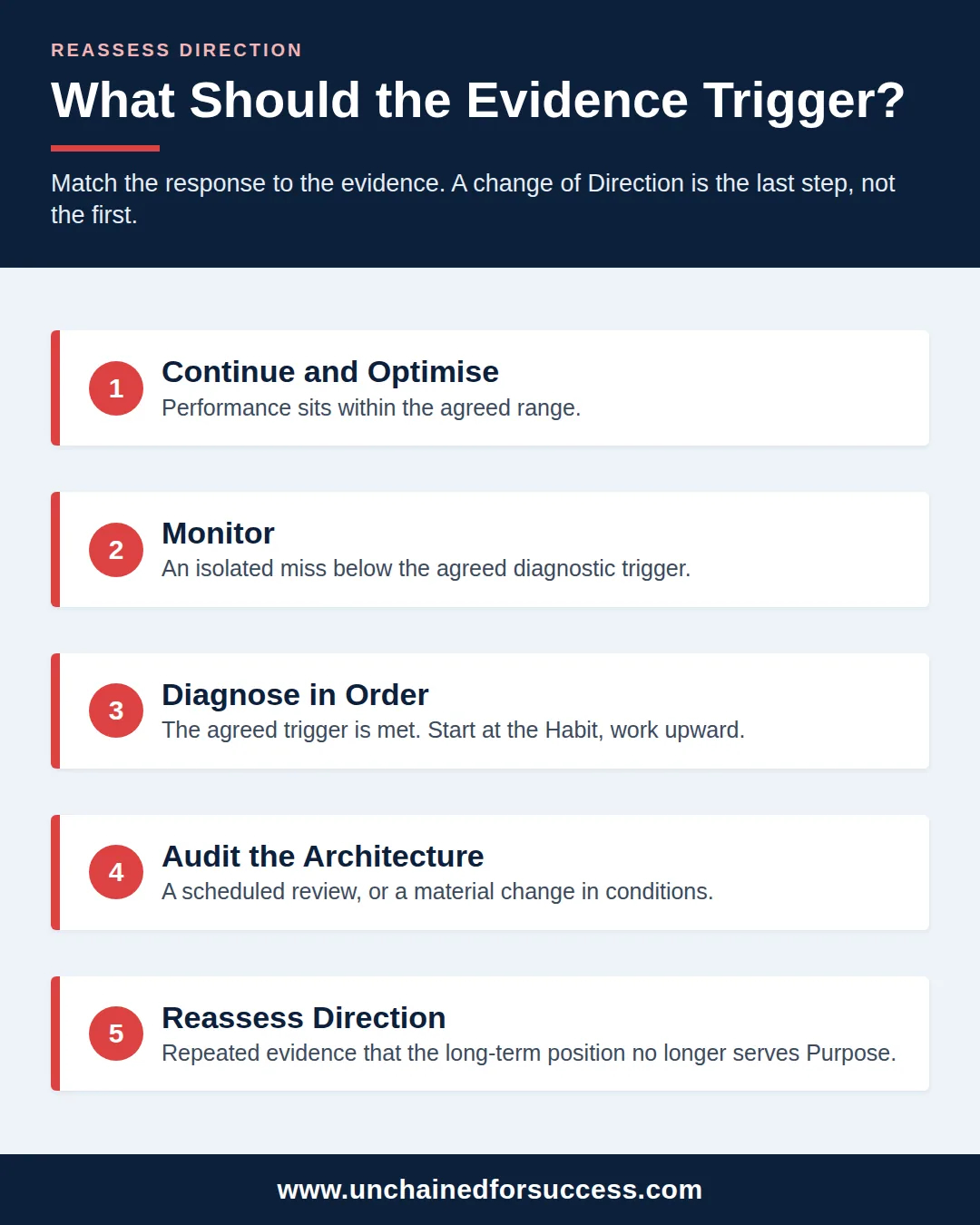
In the Unchained Goals Framework, the split between normal diagnosis and reassessing Direction is built into the design. The Control System checks whether Performance stays within the agreed range and whether the Outcome Goal is moving as intended. One result outside the range is a warning sign, not an automatic reason to redesign the Goal.
When the signal meets the trigger you agreed in advance, Diagnose Mode begins. It starts with the most immediate question: did the Habit happen consistently? Then it asks whether the Process can produce the required standard, and whether the Performance measure tracks real progress.
After that come the four supporting layers, in reverse design order. Does the Plan still match the capacity you actually have? Are Beliefs quietly resisting committed action? Under Ownership, do you still accept the cost of the goal and its consequences? And does your Why still make that cost worth paying? Finally, does the Outcome Goal still sit within your Control Boundary: do you have enough authority to act on its main causes and correct drift?
When the Evidence Says Reassess Direction
Normal diagnosis stops there. It does not begin by doubting Vision. Vision and Purpose come under review only when the breakdown is systemic, repeated or part of formal recovery.
Booked reviews serve a different purpose. The Architectural Audit scores the health of all nine components, from Purpose to the Control System, and names the weakest one as the first candidate for design attention.
An audit that confirms the Direction and finds smaller corrections beneath it is the expected result, not a wasted one. A booked audit might find, for instance, that customer research now favours live workshops, so an online course no longer serves the Vision as well as a live programme would. That is a Goal redesign beneath an unchanged Direction.
The Sequence in Action Before You Reassess Direction
Watch how this plays out for our coach. One fortnight passes with no finished module: a below-range signal, noted and monitored. A second fortnight in a row passes with none. That meets her agreed trigger, and Diagnose Mode begins.
The first question is execution: did the Monday, Wednesday and Friday sessions actually happen, starting on time? If not, the response is to restore the Habit. Where the Habit was consistent but no modules emerged, she tests the Process of writing, reviewing and testing content. If the Process worked but "approved modules" turns out to be a misleading measure, she corrects the Performance measure.
When none of those checks explains the shortfall, the review moves up through the supporting layers. If the Plan assumed more capacity than she has, or put the work in the wrong order, she changes the Plan, perhaps by outsourcing the editing or changing the build order.
If the Plan holds, she asks whether a Belief is quietly resisting the work, whether she still accepts the cost and consequences of the goal, and whether her Why still makes that cost worth paying. Last of all, she checks that the Outcome Goal still sits within her authority to govern. Only a change there, or repeated evidence that the layers beneath it no longer hold the Goal up, would send her back to redesign the Outcome Goal itself.
Her Vision stays exactly where it was. Only repeated, material evidence that this long-term position no longer serves her Purpose would make her reassess Direction. A later post on handling setbacks works the same sequence when the result has already failed.
What Would Justify a Change of Direction?
What would earn that final step? Suppose repeated audits and market evidence showed that a coaching business selling direct to the public was no longer a viable way to serve her Purpose. The evidence instead supported a long-term position as a capability partner delivering company-wide programmes. She would then return to Design Mode, the framework's build sequence, and redefine her Vision deliberately, rather than letting a series of Goal and Plan changes disguise a change of Direction.
Five Practices That Tell You When to Reassess Direction
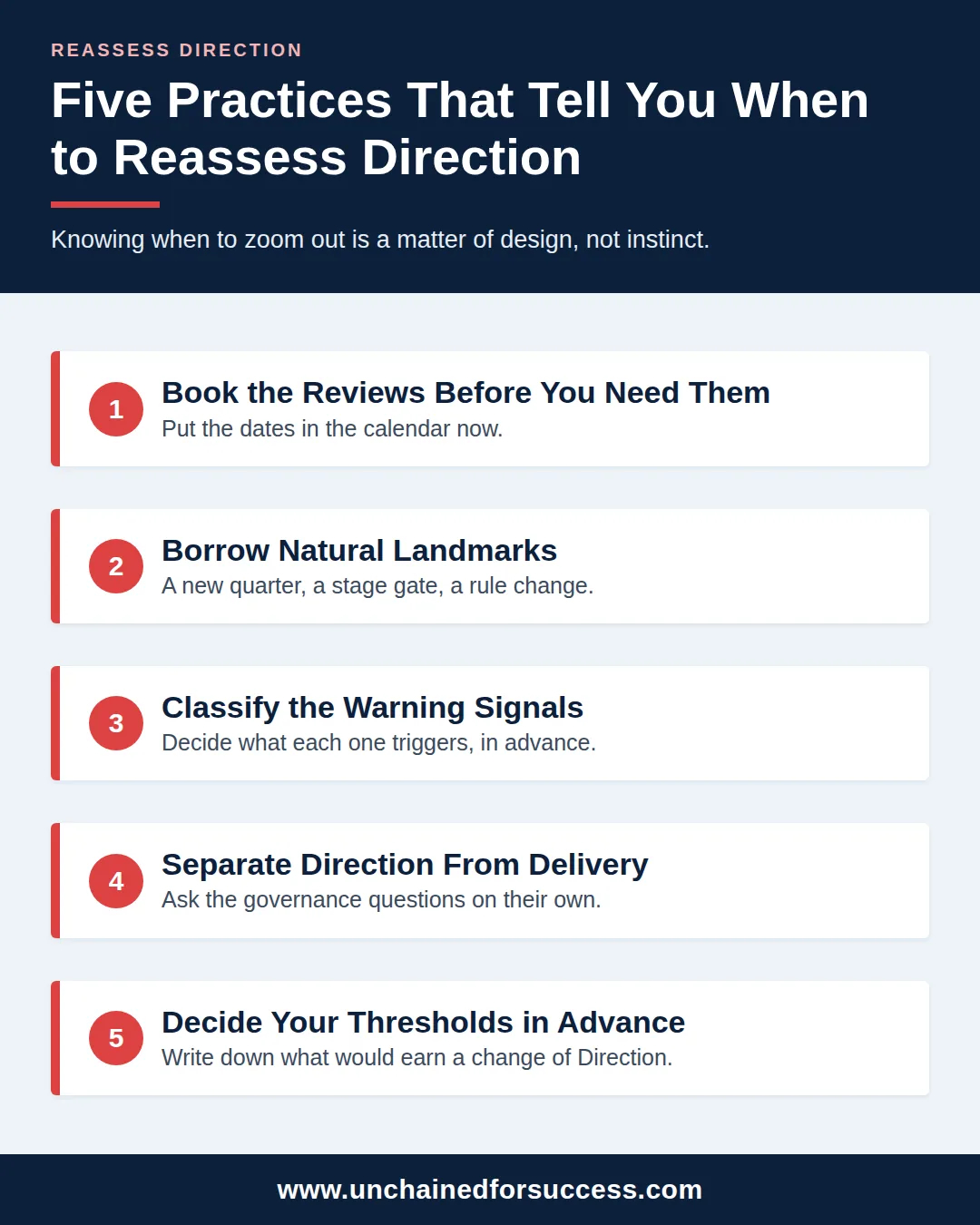
The good news: knowing when to zoom out, and what the evidence should trigger, is a matter of design rather than instinct. Here are five practices you can start this week. If your goal has never had this kind of structure, begin with practices 1 and 5; they need nothing more than a calendar and a page of honest notes.
1. Book the Reviews Before You Need Them
Match the review rhythm to the goal's horizon, its uncertainty and the cost of being wrong. A one-year Outcome Goal might earn a quarterly structural review. A long-term Vision may need only a yearly check, plus an extra review when a major assumption or outside condition changes. Put the dates in the calendar now; a review booked in advance needs no case made for it in the moment.
Expect a review to confirm your Direction unless the evidence says otherwise.
2. Borrow Natural Landmarks to Reassess Direction
Landmarks in time such as a new quarter, a new year or a birthday are ready-made moments to step back. For teams and projects, landmarks in the work do the same job. Think of stage gates, funding choices, the end of a project phase, a change in the rules, a big shift in customer demand or a change to a critical assumption.
Our coach might pair a personal review each new year with a structural review at the end of each course-building phase.
3. Classify Warning Signals Before You Reassess Direction
Not every signal deserves the same reaction. One isolated poor result calls for closer monitoring, unless it is severe enough to demand action at once. A poor result that persists to your agreed threshold calls for Diagnose Mode. When the Habit and Process behaviours look consistent but Performance stays below the required path, test the Process first and then the Performance measure, rather than blaming the person.
An unsustainable pace points to the Plan, above all its capacity assumptions, once the execution checks are done. If the expected benefit no longer covers the full cost of carrying on, examine Why. A Goal that no longer advances the Vision calls for a wider Architectural Audit.
Only repeated, material evidence that the Vision no longer serves Purpose calls for reassessing Direction. Decide these classes in advance, and treat crossing a line as a trigger, not a talking point.
4. Reassess Direction Separately From the Work
A delivery discussion asks two things: are we executing consistently, and is the Process producing the required Performance? A governance discussion asks three more. Is the Plan still viable? Does the Goal still advance the Vision? And is the Vision itself still the right Direction? Both matter; treat them as separate questions even when the same meeting covers both.
When a booked review does reach the decision point on a single goal, run a structured persist-or-change review rather than deciding by mood. That post covers the decision itself; the practices here tell you when a deeper review has been earned.
5. Decide What Would Make You Reassess Direction
Before the next review, write down four thresholds. What triggers closer monitoring? When does Diagnose Mode begin? When are the Architectural Audits booked, and what event would bring one forward? And what evidence could justify a change of Direction itself?
For our coach: one blank fortnight means monitor, and two means diagnose. Her booked review means she audits the design at the end of each course-building phase. A big market change would earn an extra audit. If Performance stays below range even after Diagnose Mode has run and the corrections have been applied, that repeated evidence may call for formal recovery and a wider review.
Only repeated, material evidence that her Vision no longer serves her Purpose would earn a change of Direction. Pre-set criteria are a strong defence against sunk-cost thinking. And if a review reveals that drift has already taken hold, here is how to diagnose and recover a drifting year.
Reassess Direction as a Team
For teams and projects, the same five practices apply; the review simply becomes shared. Agree the schedule, the landmarks, the thresholds and the responses together. Record what would change the team's mind while everyone is still calm. A team that has already agreed what each signal triggers can reassess direction without anyone having to be the lone voice who questions the plan.
Reassess Direction: Frequently Asked Questions
How often should you reassess your goals? A working pattern: check execution weekly and the structure of a one-year goal quarterly. Confirm a long-term Vision yearly, or when a major assumption changes. A review that confirms the Direction has still done its job.
Does poor performance mean your direction is wrong? Not by itself. A poor result is information, not proof. First find out whether the problem lies in the Habit, the Process, the measure, the Plan, the supporting layers beneath it, or the Goal's Control Boundary. You should reassess direction only when careful review shows the problem is the long-term position itself, not the machinery beneath it.
What is the difference between changing a Plan and changing Direction? A Plan sets out the order, resources and capacity used to reach an Outcome Goal. Outsourcing video production or changing the module order changes the Plan. Replacing the online course with live workshops changes the Outcome Goal. Moving from a coaching business serving individuals directly to a capability partner serving companies changes the committed long-term position, so it changes Direction.
Reassess Direction by Design, Not by Crisis
Every meaningful goal benefits from planned moments when the right question is not "how do we go faster?" but "is this still the way?" You cannot predict every big change, but you can make sure you are standing somewhere with a view when one arrives.
Booked reviews, natural landmarks and pre-agreed responses turn the question of when to reassess direction into routine good management rather than an act of courage. A poor result is information, not proof that your Direction is wrong.
So decide now when you will next zoom out, and what evidence would make you reassess direction rather than simply adjust the Plan. Then get back to the work, knowing the direction question has a date. If you want an outside view of how your goals are designed, executed and governed, the Goals Readiness Score is an optional next step: 18 questions, under five minutes.
Share the review date you have just set, and the threshold that would open a deeper review, in the comments.
When is your next booked review, and what evidence would justify extending it as far as Direction?
Sources
• The Fresh Start Effect: Temporal Landmarks Motivate Aspirational Behavior by Dai, Milkman and Riis, Management Science, 60(10), 2014
• How to put your money where your strategy is by Hall, Lovallo and Musters, McKinsey Quarterly, 2012
• The psychology of project termination: the decision maker by Werner G. Meyer, PMI Global Congress, 2013
Continue Your Journey
Explore more resources from the Unchained Goals Framework: