You planned this year with care. In January, the calendar looked ordered and the goals looked reachable. Now it is July, and the same plan feels heavier than it should. Halfway through the year, look at energy management before you look at the schedule. The hours may still be there. The energy to use them may not.
You can still hold the time slot in your diary and arrive at it with nothing useful left to give. That is why energy management, not time management, is the question to ask about whether your goals survive the second half of the year. This post explains why energy matters, how it affects execution, where it sits in the Unchained Goals Framework, and how to protect the energy your goals actually run on.
Why Energy Management Matters More at Mid-Year
At the start of a year, motivation covers a lot of gaps. By July, that early charge has drained, and the calendar alone cannot replace it. You can still find the time slot for a goal, yet arrive at it with nothing left to give. This is the quiet failure behind a stalled plan. The hours were there, but the capacity was not.
Energy management addresses the resource that time management assumes but never provides. A schedule tells you when to act. It says nothing about whether you can act well when the moment comes. As a result, a full calendar can hide an empty tank, and the goal pays the price. Before you redesign your week, it helps to take the mid-year reset most people avoid, so you know which goals still deserve your energy.
A schedule can promise the hour. Only your energy can deliver the effort inside it.
Energy Management Versus Time Management
Time is fixed and finite. Everyone receives the same twenty-four hours, and no method adds more. Energy behaves differently. It rises and falls across the day and, crucially, you can renew it. That single difference is why energy management is the stronger lever for long goals. Time management sorts tasks into slots. Energy management governs the capacity that fills those slots with real work.
This distinction is not new. Tony Schwartz and Catherine McCarthy made the case in the Harvard Business Review: time is a finite resource, energy can be expanded and renewed, and organisations should shift from getting more out of people to investing more in them.
They reported a pilot at Wachovia Bank in which 106 employees at 12 regional banks went through their energy programme. During the first three months, measured against the same period a year earlier, the participants' loan revenue grew 13 percentage points more than a control group's, and deposit revenue 20 points more. It was the authors' own programme, not an independent trial, so treat the figures as an illustration rather than a proof.
The Recovery Evidence Behind Energy Management
Research on recovery points the same way. Sabine Sonnentag followed 147 employees from six public service organisations through a five-day diary study and reported it in the Journal of Applied Psychology. Feeling recovered after the previous evening's leisure time predicted higher work engagement and more proactive behaviour, such as taking initiative and pursuing learning, during the work day that followed.
It is a diary study of one group over one week, so it shows a day-to-day link rather than a cause. Even so, the pattern is useful. When you manage energy, you stop treating yourself as a machine that runs at one speed. Instead, you work with your natural peaks, protect your recovery, and spend your best hours on the work that moves the goal.
How Energy Management Fits the Unchained Goals Framework
Every goal moves forward through four steps. The Outcome Goal states the result you want. Beneath it, the Performance Goal defines the standard it takes to get there, and the Process Goal names the controllable work you repeat. And Habit Conversion makes that work consistent, so it runs with less deciding each time.
Those four are the engine of any goal. In the Unchained Goals Framework they have a collective name, the Directional Execution Spine, and together they are the only part of the system that produces measurable movement.
Energy is what powers those four steps. Planned work does not repeat itself. You have to bring the capacity to keep showing up until the behaviour becomes routine, and that capacity is energy. When your energy stays low for too long, the planned work slips, it does not settle into a Habit, and the goal falls back on motivation and willpower, which fatigue wears down.
So energy is not one more part to bolt on to the framework. It is the condition that lets every part run.
Energy Management and the Control System
The framework also builds in a way to keep watch. Its Control System compares your agreed measures with their operating range, at a set rhythm, so that drift shows early rather than at the end of the year. It only sees what you put on the scorecard, so if energy matters to a goal, make it a measure: a weekly energy score with a range you treat as normal and a trigger that opens a proper look.
Read your own energy that way. If it keeps falling on a goal, that is not a character flaw. It is a signal, telling you the load may be too high, the rest too low, or the work scheduled at the wrong time. When the signal meets your trigger, diagnose in order, starting with whether the planned work actually happened, and adjust before the goal stalls.
Energy Management in Practice: Three Examples
The people in these examples are illustrations, not clients.
An Individual Who Moved the Work to the Peak
A consultant's Process Goal is to write during a protected weekly session, blocked every Saturday morning. Her Performance standard is one completed draft each week that passes her quality checklist.
By July she keeps the slot but the drafts miss the standard, because she arrives exhausted from the week. She moves the writing to a Thursday peak and guards her Wednesday evening for rest. The drafts start passing the checklist again, because the slot matches her real energy rather than her leftover time.
A Sales Team That Protected Its Mornings
A sales team measures activity by hours logged, which counts effort rather than the calls that drive conversion. The numbers look healthy, yet results fade after June. The manager protects mornings for live calls and moves admin to low-energy afternoons. Nobody works longer. The team moves the hardest work into the hours when people have the most capacity, and conversion climbs.
A Project That Chose Energy Management Over Long Days
A delivery team runs long days to hit a deadline. Progress looks fast, then stumbles as errors mount and people burn out. The lead cuts the day to a sustainable length and adds real recovery. As a result, the team reduces rework, protects decision quality and steadies delivery. The project finishes on time, without the errors the long days had been producing.
How to Apply Energy Management to Your Goals
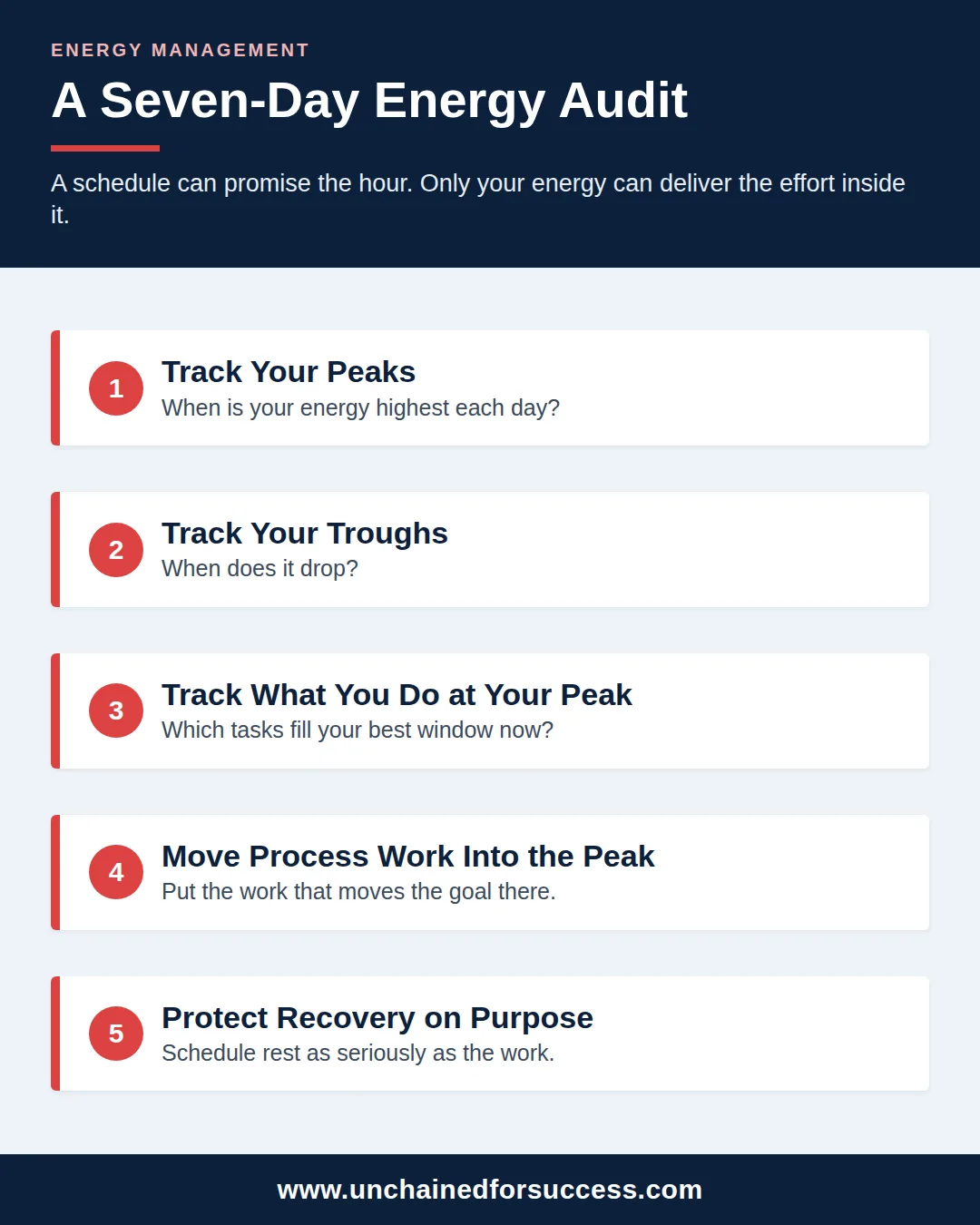
Energy management starts with a seven-day audit of your own rhythm. Three moves follow.
1. Start Energy Management With a Seven-Day Audit
This is not a new part of the framework. It is a simple way to gather the evidence your Plan needs about the capacity you can sustain, which the framework asks you to design around rather than assume. For the next seven days, track three things: when your energy is highest, when it drops, and which tasks you keep doing during your best window. Then judge the evidence, not the intention.
2. Match the Work to the Energy
Put Process work, the repeatable work that drives your goal, into your peak hours. Push low-value tasks into the troughs where they do less harm. Do not redesign your whole week. Protect one high-energy window, and put your most important goal action inside it.
3. Protect Recovery on Purpose
Rest is not a reward for finishing. It is the input that makes the next repetition possible, so schedule it as seriously as you schedule the work. This is how you pursue growth without burnout rather than trading your health for short-term output. The next two posts in this series show how to protect your health and how to design recovery habits.
4. Bring Energy Management Into Your Weekly Review
When your energy for a goal falls week after week and meets the trigger you set, read it through your Control System as data. Check whether the planned work happened, whether it can produce the required standard, and whether the measure is valid before changing the Plan. Only then reassess the load the Plan assumed. If a goal has already slipped, use the same logic to diagnose and recover a drifting year.
Common Energy Management Mistakes
Treating a full calendar as proof of progress. Booked hours are not the same as effective effort, and confusing the two hides the real problem. A related post explains why being busy does not mean progress.
Spending peak energy on easy wins. Answering email at your sharpest hour feels productive, yet it wastes the very capacity your goal needs most.
Cutting recovery to buy time. Skipping rest borrows energy from tomorrow at a punishing rate of interest, and the debt comes due.
Energy Management: Frequently Asked Questions
Is energy management just time management with a different name? No. Time management decides when you will act. Energy management decides whether you can act well when the time comes. The first sorts tasks into slots; the second governs the capacity that fills them.
How do I find my peak hours if every day is different? Run the seven-day audit and look for the pattern rather than the exception. Look for the window that is better than the rest on more days than not. Protect that one window first; refine later.
Is energy a component of the Unchained Goals Framework? No. The nine components are Purpose, Vision, Goals, Why, Ownership, Beliefs, Plan, Habits and the Control System. Energy is the condition that lets the planned work happen. It enters the design through the Plan, which must rest on sustainable capacity; through Habit design, which builds in recovery and a minimum version for hard weeks; and through any energy measure you put on the scorecard.
Energy Management Is the Year's Real Advantage
Time management will always have its place, because the calendar still matters. Even so, the calendar cannot supply the effort that goals demand. Energy can, and good energy management renews it when you act with intent. This is why energy management is not a productivity trick. It is a goal-protection discipline.
Protect your energy, aim it at the work that moves the goal, and let the Control System keep it honest. Do that, and your January goals will still be alive in December. Manage your time, and you fill the year. Manage your energy, and you finish it.
This week, track your energy for seven days, then move one piece of Process work into your best window. If you want an outside view of how your goals are designed, executed and governed, the Goals Readiness Score is an optional next step: 18 questions, under five minutes.
Share the hour of the day when your energy is highest, and what you will put in it, in the comments.
Which piece of work that matters most is currently sitting in your worst hour?
Sources
• Manage Your Energy, Not Your Time by Tony Schwartz and Catherine McCarthy, Harvard Business Review, October 2007
• Recovery, work engagement, and proactive behavior: A new look at the interface between nonwork and work by Sabine Sonnentag, Journal of Applied Psychology, 88(3), 518 to 528, 2003. Full text at the University of Konstanz repository
Continue Your Journey
Explore more resources from the Unchained Goals Framework: