A full week and a productive week are not the same thing. That gap is the whole argument for why focus drives results and busyness does not. Busyness fills the diary. Focus decides what the diary is for.
This post sets out what focus means in practice, what the research does and does not show, and how to turn a decision about priorities into something you can run every week. It leads into The Hidden Cost of Yes, which prices the commitments that crowd a week out.
What It Means When Focus Drives Results
Focus is easy to read as concentration alone. Concentration matters, but it is the smaller half. The larger half is choosing.
To say that focus drives results is to say that a defined result, with your attention pointed at it, is more likely to produce progress than the same hours spread across five competing demands. Nothing here suggests you should work more. The point is to be more selective about what you carry at the same level of priority.
That choice has an edge to it. Choosing one thing means leaving other things undone, and some of them will be good ideas. So focus is not a mood or a personality trait. It is a decision you make in advance, and then defend when the week pushes back.
Your responsibilities belong in that decision too. Caring for a parent, meeting a paid duty, filing a tax return and getting enough sleep are commitments before anything new arrives. Focus is not the art of ignoring them. It is the art of choosing what else you take on, given that they already exist.
Why Busyness Feels Like Progress
Activity gives you immediate feedback. An inbox gets shorter. A meeting ends. A message gets answered. Each of those moments feels like movement, and the feeling arrives within minutes.
Real progress does not report back that fast. A month of steady work on one result may produce nothing visible until the end of it. So activity offers a dependable sense of reward and progress does not, and the diary fills accordingly. That gap is where focus drives results and a full week does not.
There is a second reason. Deciding what not to do is uncomfortable, because it means naming the loss. Answering everything avoids that discomfort. The cost simply arrives later, spread thinly across the quarter, where it is harder to trace back.
What the Evidence Shows, and What It Does Not
Two findings are worth knowing before anything else, and both have limits worth stating.
First, people cannot always name the priority they are working to. Donald Sull, Rebecca Homkes and Charles Sull surveyed 7,600 managers in 262 companies across 30 industries. They report that "only 55% of the middle managers we have surveyed can name even one of their company's top five priorities". That is a management survey of what people say, not peer-reviewed research, and it shows no causal link to results.
Our own reading is that focus drives results more readily once the priority has been named, because a priority you cannot state is hard to work towards.
Second, planning for several goals at once can backfire. Amy Dalton and Stephen Spiller tested detailed planning against one goal and against several. Planning helped a single goal. Across a set, it "draws attention to the difficulty of executing multiple goals", which reduced commitment and success.
Their own remedy was to frame the set as manageable. This is consumer research on everyday personal goals, so read it as a caution rather than a rule. Our own reading is that focus drives results partly by keeping the set small.
Why Focus Drives Results More Reliably Than Effort
The third finding sits here, because it is the evidence for the claim. Defined goals outperform vague ones. Edwin Locke and Gary Latham's 35-year review draws on more than 100 different tasks and over 40,000 participants, and across that body of work, specific and difficult goals beat "do your best" instructions.
Their explanation is that "do your best" goals "have no external referent and thus are defined idiosyncratically". It is a synthesis of earlier work rather than a new study, and the effect is smaller on complex tasks. Our own reading is that this is part of why focus drives results: a defined goal gives attention something precise to point at.
Locke and Latham name four things a defined goal does. It directs attention to work that counts. Effort rises. Persistence lasts longer. And a defined goal prompts you to look for a better method.
Effort alone does none of those. Effort with no target raises the volume of work without changing its direction.
Their review also names the conditions. Ability sets a ceiling. Commitment matters, and the goal has to be one you genuinely hold. Feedback matters, because goals plus feedback beat goals alone. On complex work, chasing an outcome too hard can crowd out the thinking that would have solved it.
Where Focus Drives Results Sits in the Framework
The Unchained Goals Framework treats the reason focus drives results as structural rather than personal. Four of its ideas do the work in an ordinary week.
Choose a result you can actually govern. The test is whether you hold enough authority over the main causes to steer the result and correct it when it drifts. Certainty is not required.
Where the result turns on a decision you do not hold, the framework calls it a dream rather than a goal, and asks you to translate it into something you can govern. A dream is not discarded. It shapes the direction you are heading in.
Name the standard the result needs. This is where focus drives results week by week rather than only at the deadline. The standard is what has to be true each week or month for the dated result to arrive. It is your early warning, long before the result itself confirms anything.
Schedule the behaviour that produces the standard. The framework runs this as a chain: the dated result, the standard, the behaviour, the habit. Each step down puts more of it inside your own hands, which is where focus drives results in practice.
Decide in advance what gives. A plan, in the framework's words, "is not a list of everything that must happen. It is a decision about what to protect first". Settle the ranges and the review points while the week is calm.
Above all of this sit the problem you have taken responsibility for and the long-term position you are building within it. The framework calls those Purpose and Vision, and the overview and glossary carry them.
Four Steps to Direct Your Week
These four steps are where focus drives results in an ordinary week. You can work through them in one sitting, then revisit them weekly.
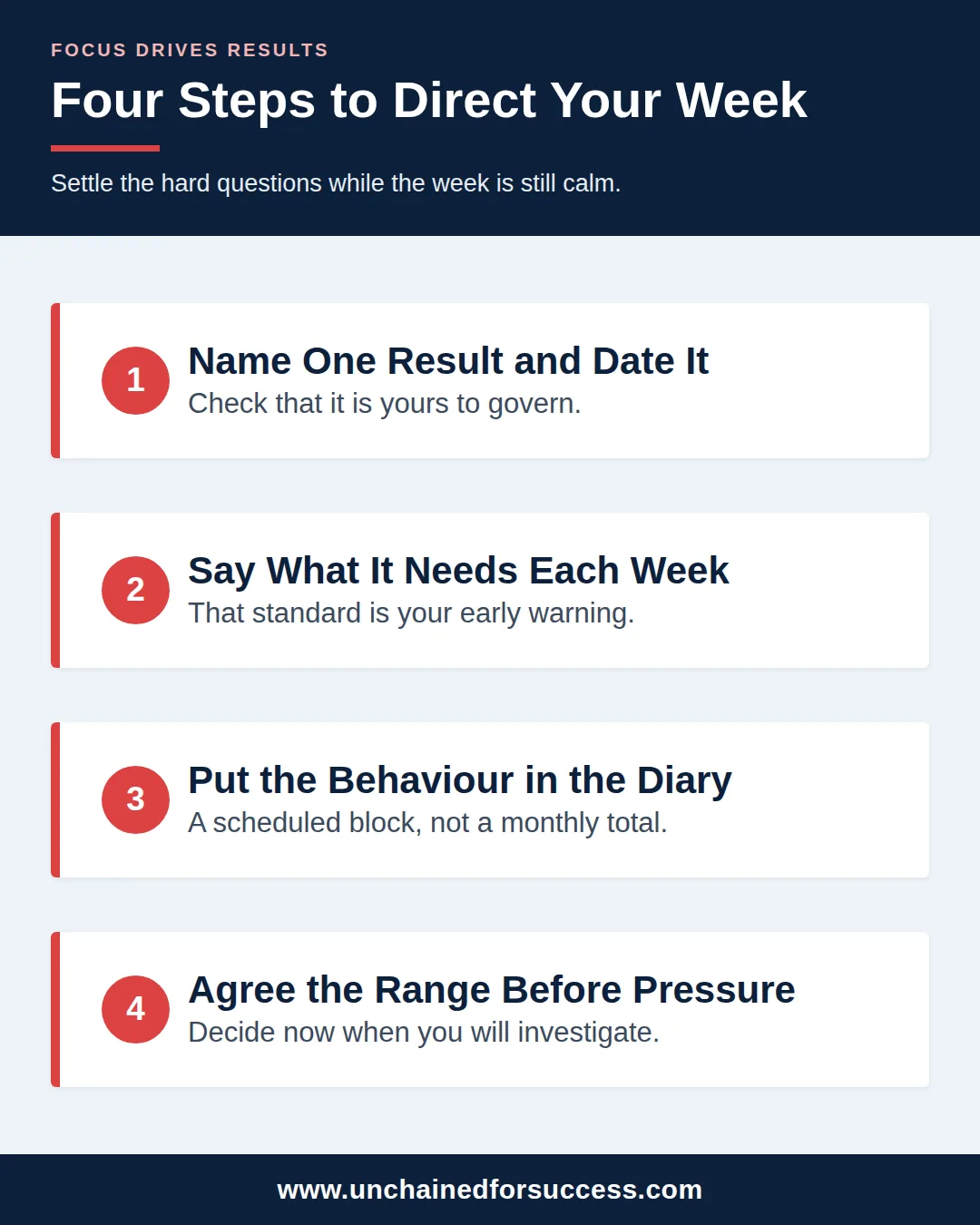
1. Name one result and date it. Write the result you want, with the date it must exist, and check that you hold the authority to govern it. "Submit three assignments by 31 July" passes. "Get promoted" does not, because someone else decides.
2. Say what the result needs each week. That is the standard. If three assignments are due by 31 July, one finished assignment every three weeks is the standard, checked against the published marking criteria rather than a tutor's availability.
3. Put the behaviour in the diary. A Process Goal is a scheduled behaviour, not a quantity. "Two hours of drafting on Tuesday and Thursday mornings" is a Process Goal. "Twelve hours a month" is arithmetic, and arithmetic does not appear in a calendar.
4. Agree the range and the check before pressure. Decide now what counts as on track, when you will look, and what would make you investigate rather than simply try harder. Agreeing that under calm conditions is the point.
Focus Drives Results in Practice
The people and organisations below are illustrations, not clients. Each one shows where focus drives results: a dated goal, a standard, and a behaviour in the diary.
An Individual Studying Alongside Full-Time Work
Daniel works full time and spends Tuesday and Thursday evenings with his mother, who needs help after a fall. He is also six months into a part-time qualification, and the study keeps losing.
His Outcome Goal is to submit all three assignments by 31 July. The standard he holds himself to is one finished assignment every three weeks, judged against the published marking criteria. His Process Goal is 90 minutes of writing on Monday and Wednesday evenings and two hours on Saturday mornings. The evenings with his mother are fixed first, and the study fits around them rather than competing with them.
He also declares what gives. His reading for a professional network drops to one article a month until August. That is the loss he chose, named out loud, instead of the one the calendar would have chosen for him.
A Design Studio With Too Many Offers
A three-partner studio sells branding, website builds, packaging and training. Each line brings in work and none of them grows.
The partners agree a dated Outcome Goal inside their authority: raise average project value to £18,000 across engagements started between 1 October and 31 March. That sits inside their authority because they hold the decisions that drive it: what they offer, what they charge, which enquiries they pursue and which they decline.
Their standard is two qualified proposals a week, each priced at £18,000 or above, against a scope they have already discussed with the client. Proposal volume alone would not move an average project value, so the price floor and the qualifying test are part of the standard rather than an afterthought. Issuing a proposal is theirs to decide; signing one is not.
Their Process Goal is a three-hour Monday morning block in which one partner writes proposals and nothing else, working from a standing template and a scoping call already held. Two proposals in that block is a rate they have hit before, which is why the standard is two and not four.
Then they declare the trade-off. Training stops taking new bookings for two quarters. That decision is written down with a date, so the first attractive enquiry does not quietly overturn it.
A Programme Where Nobody Agreed What Came First
A programme team lists 14 workstreams and treats them all as critical. Asked separately, five managers name five different top priorities.
The sponsor picks three, writes them down and tells everyone which they are. Each one gets a named owner and a dated result inside that owner's authority. The first is to have the new payments interface running in live service by 30 September.
That owner holds the build team, the test environment and the release decision, which are the main causes of the date. Two things sit outside her hands: the security sign-off and the partner bank's connection window. Both are named as assumptions, each with a date by which it must land and an agreed fallback if it does not.
Her standard is that every agreed build item meets the written test-entry criteria in full before it is submitted, a check her own team makes and records. To hold it, she and the test lead meet every Thursday morning and clear the open items before anything goes to test.
The other eleven workstreams continue. Each keeps its lead, moves from a weekly review to a monthly one, and escalates by exception, so they no longer draw on the same senior attention week by week.
Nothing was added. Somebody finally ranked the work.
Four Mistakes That Undo Focus
Four habits pull a week where focus drives results back towards a busy one, and each is easy to miss while it is happening.
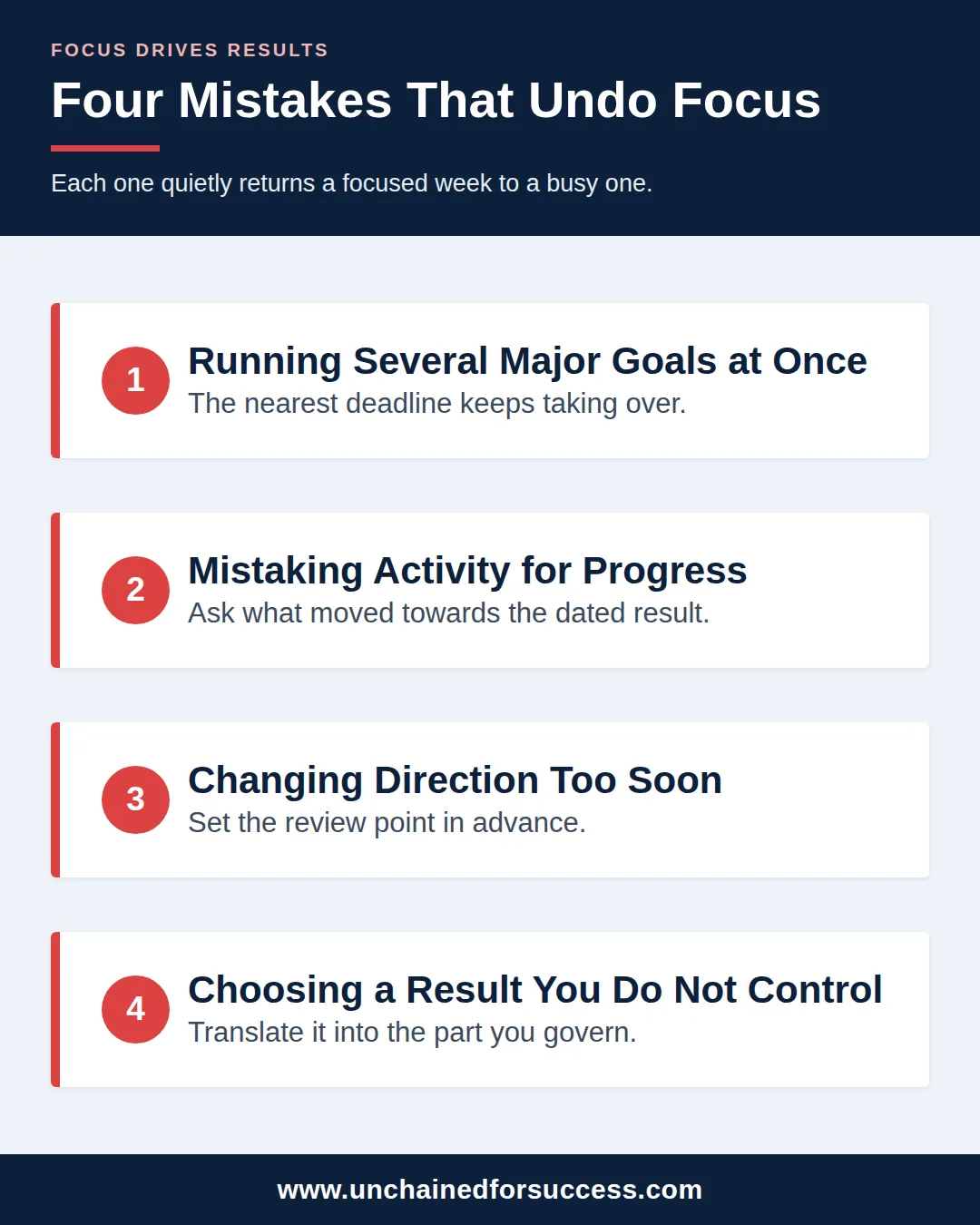
Running several major goals at once. Each one looks affordable in isolation. Together they compete for the same hours, and the nearest deadline keeps taking over. Switching between them carries its own cost. Sophie Leroy's laboratory experiments on attention residue found that switching away from unfinished work can leave part of your attention on the first task, which reduces how well you do the next one.
Mistaking activity for progress. A full day is easy to report and easy to feel. Ask instead what moved towards the dated result.
Changing direction before the evidence arrives. A new approach every few weeks prevents anything compounding. Set the review point in advance and hold to it.
Choosing a result you do not control. If someone else decides, you are governing a dream. Translate it into the part you can govern, and let the rest follow.
Frequently Asked Questions About Why Focus Drives Results
Does focus mean working on only one thing? No. It means one result carries the weight, with your responsibilities protected around it. Other work continues at a lower standard, deliberately, rather than by accident.
What if my manager keeps adding priorities? Show the trade-off rather than refusing. Name what the new request would displace and ask which matters more. That turns a workload problem into a priorities decision, and it gives your manager information they do not otherwise have.
How long before focus shows in the results? That depends on the result. What shows sooner is the standard you wrote in step two. Well before the dated outcome confirms anything, it tells you whether focus drives results.
Where Focus Drives Results Starts for You
Focus drives results because it settles the hard questions early, while you are calm, rather than each morning under pressure. Busyness postpones those questions, and the week answers them for you.
Pick one result this week. Date it, check it is yours to govern, write the standard it needs, and put the behaviour in the diary. Then name the one thing you are letting go to make room. Focus drives results from that decision onward.
For the full method, read the Unchained Goals Framework overview, and the glossary explains the individual terms. The Goals Readiness Score is a short self-assessment if you want one: 18 questions, under five minutes. Why Being Busy Doesn't Mean Progress covers the warning signs, and How Trade-Offs Create Progress covers how to make the choice stick.
Which result would you protect if you could protect only one? Share it in the comments.
Sources
• Why Strategy Execution Unravels and What to Do About It by Donald Sull, Rebecca Homkes and Charles Sull, Harvard Business Review, March 2015
• Too Much of a Good Thing: The Benefits of Implementation Intentions Depend on the Number of Goals by Amy N. Dalton and Stephen A. Spiller, Journal of Consumer Research, 39(3), 600 to 614, 2012
• Building a Practically Useful Theory of Goal Setting and Task Motivation: A 35-Year Odyssey by Edwin A. Locke and Gary P. Latham, American Psychologist, 57(9), 705 to 717, 2002
• Why Is It So Hard to Do My Work? The Challenge of Attention Residue When Switching Between Work Tasks by Sophie Leroy, Organizational Behavior and Human Decision Processes, 109(2), 168 to 181, 2009
Continue Your Journey
Explore more resources from the Unchained Goals Framework: