You can probably name what matters to you in about ten seconds. Family. Health. Doing work that is worth doing. Being someone their children would describe accurately and kindly. The list comes easily, which is why it is strange that it so seldom decides a week, let alone a meaningful life.
Knowing what you value is not the difficult part. Your values live in one place and your week lives in another, and nothing connects them. This article is about that connection, and about what the research genuinely supports. You build a meaningful life in the gap between the two.
Why a Meaningful Life Does Not Show Up in Your Diary
Values sit at a high altitude. Days do not. A day holds a school run, a queue, an inbox, a meeting that overran and forty minutes nobody planned for.
Nothing in that day announces itself as connected to what you care about, which is how being busy comes to feel like progress. So attention goes to whatever is loudest, and loudness is a poor guide to importance.
Over a week this is barely noticeable. Over a year it becomes the thing people describe as being busy without knowing quite what they are building. A meaningful life does not usually collapse. Things that were merely urgent crowd it out, quietly.
What the Evidence Says About a Meaningful Life, and What It Does Not
Purpose has better evidence behind it than most ideas in this area, and people usually overstate it anyway. Both halves of that matter.
Researchers followed 7,304 adults aged fifty and over in England, asking how worthwhile they felt the things they do are (Steptoe and Fancourt, 2019). Four years later, those who rated their activities as more worthwhile had stronger relationships, less loneliness, better sleep and better biological markers.
Now the caveat the authors themselves insist on. This runs both ways. Good health and good relationships make it easier to find your days worthwhile, not only the reverse. So read what follows as a pattern rather than a mechanism: the group also walked measurably faster, which is an association in an observational study and not an effect of purpose.
A larger review pooled 66 studies covering 73,546 people (Czekierda, Banik, Park and Luszczynska, 2017). The association between meaning and physical health was real but modest, and stronger for how people rated their own health than for objective measures.
So meaning is worth building. It is not a lever that moves your life on its own, and a dramatic claim about it is worth treating with suspicion.
Why a Meaningful Life Needs Goals You Chose Yourself
There is one finding here that changes how you should set goals, and it is not about ambition.
Work on life crafting argues that goals support wellbeing when they are self-concordant, meaning they genuinely belong to you rather than being borrowed or imposed (Schippers and Ziegler, 2019). A goal that came from a colleague's expectations, or from a comparison you never chose, has less to draw on in a hard month, however well it is written.
So you cannot answer the meaningful life question by working harder on someone else's list. Effort is not the variable here. Whether the goal is actually yours is.
The Translation That Gets Skipped
Here is the practical core. A value is not actionable. A week is.
Take "I value my health". That cannot go in a diary. Nothing about it tells you what happens on Wednesday. Now take "I walk for thirty minutes after lunch on weekdays". That is the same value, translated far enough down to actually occur.
This is the same translation that turns a standard into an outcome. Do the same with "I value my relationship with my daughter". Translated: "we cook together on Sunday, phones in the drawer." It sounds smaller than the value. It is the only version of the value that will ever show up.
The test is simple. If you cannot tell from the sentence what you would do on a given morning, you have not yet translated far enough down. A result can be well set and still not tell you that, which is why the translation has to keep going until it reaches a behaviour.
Reflection tells you what matters. Translation puts it in the week, and weeks are what a meaningful life runs on.
Three Different Questions Hiding in One Word
There is a distinction here that ordinary language blurs, and it matters more than it sounds.
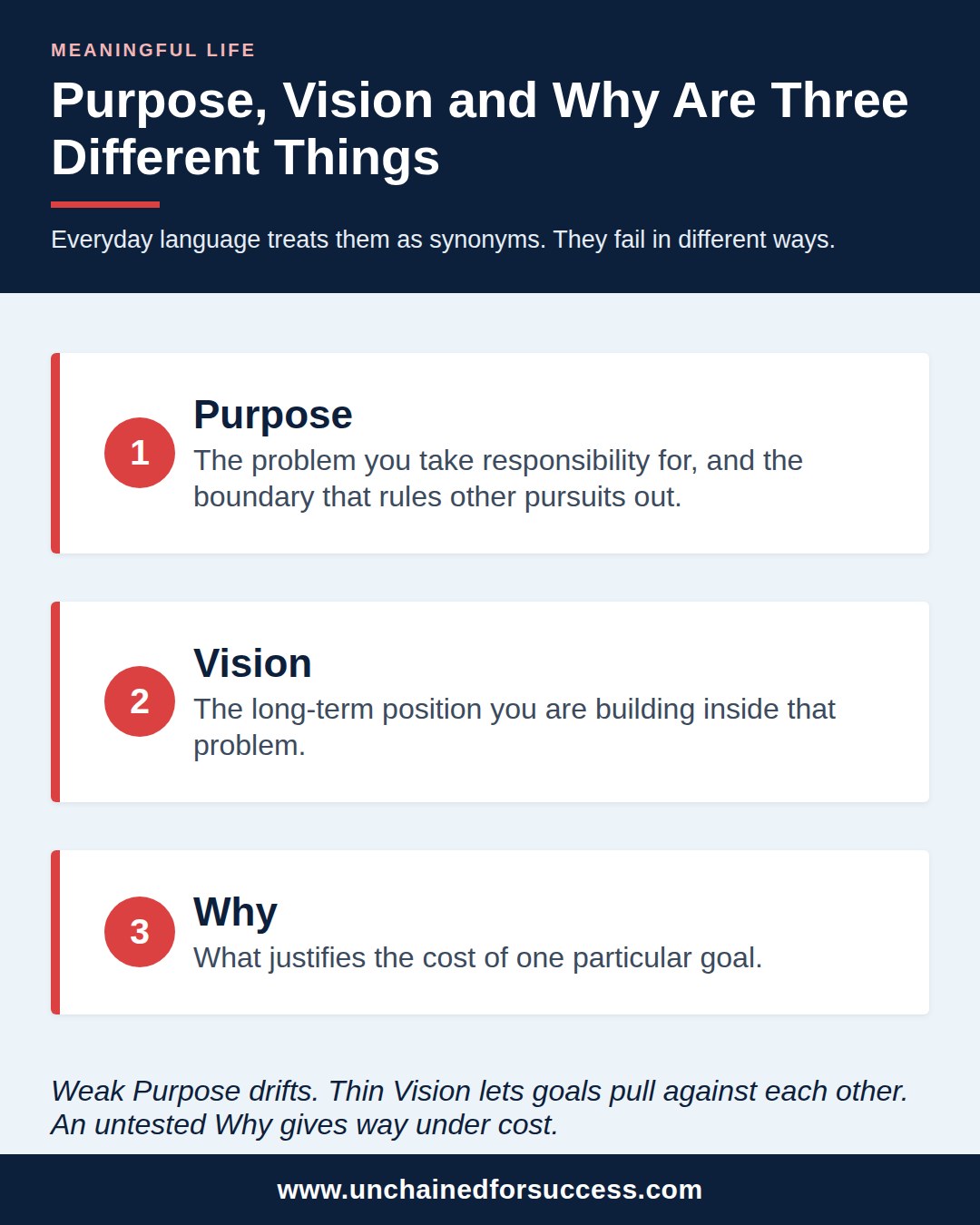
There is a problem you keep returning to, and a boundary that quietly rules other pursuits out. That is what the framework means by Purpose. It is not a description of who you are, and it is not your reason for doing any particular thing.
Then there is the long-term place you are building towards inside that problem. That is Vision, and you know it is real when it makes you refuse something otherwise attractive.
And there is the thing that answers you at six in the morning when the work is not fun. That is your Why, and it justifies the cost of one specific goal rather than describing your life.
Everyday language treats these three as synonyms. The Unchained Goals Framework keeps them apart because they fail differently. Weak purpose lets you drift towards whatever is convenient. Sound goals pull against each other when the vision is thin. And a why that was never tested collapses the first time something costs more than expected.
Building a Meaningful Life in Ordinary Conditions
None of this requires a clear run at life. You are probably doing it alongside a job, people who depend on you, and a fortnight in every quarter that simply goes wrong.
That is the argument for translating values down to something small. A thirty-minute walk survives most bad weeks. An hour at the gym before work is usually the first thing to go. The smaller version is not a compromise on the value; it is the version that keeps the value alive while conditions are poor.
It also matters that responsibilities count, and that taking responsibility is itself part of the work. Caring for a parent, covering a colleague's work, keeping a promise made last year: those are not obstacles to a meaningful life. For many people they are a substantial part of what makes it one.
A Worked Example
Take a teacher who has said for three years that she wants to write.
Her value is clear and has never moved. What was missing was every step beneath it. So she designs downwards. The result is twelve finished pieces by the end of the year. Beneath it sits a standard: one finished piece a month, complete enough to show someone. Underneath that sits the behaviour, twenty-five minutes at the kitchen table before anyone is up, on Tuesdays and Thursdays.
Note the two directions. She designed from the result down to the Tuesday, so that each level serves the one above it. She then executes from the Tuesday up, because that is the part she can act on without waiting on anyone.
Note also what she did not do. She did not wait to feel ready, and she did not resign to write full time. She is a composite drawn to illustrate the order, not a client.
What to Do This Week
Pick one value you would defend in public and have not acted on this month. One is enough. Nobody assembles a meaningful life in a single afternoon of planning.
Then work down, the way the teacher did. Name the result you want from that value by the end of the year, then the standard that would tell you each month whether you are getting there.
Only then write the behaviour, as a sentence a stranger could follow: what you will do, when, and where. Tie it to a moment that already exists in your day, so it does not depend on remembering. That last level is where a meaningful life actually gets built.
You can look up any of these terms in the framework glossary. Finally, ask one uncomfortable question about it. Did you choose this, or did you inherit it from someone whose approval you were hoping for? A goal that is not yours will not hold, and it is better to find that out in week one.
Frequently Asked Questions
Do I need to know my purpose before I can set goals? No, and waiting for certainty is how years pass. A rough sense of the problem you care about is enough to start, so long as it already rules something out. Purpose tends to sharpen through action rather than before it. Wide edges are normal early on, and a statement that excludes nothing at all is the one still to be fixed.
Is a meaningful life the same as a happy one? Not quite. Things that add meaning, such as raising children or caring for someone, can cost day-to-day pleasure while adding to the sense that life is worthwhile. If you optimise only for how a week feels, you will tend to avoid exactly the commitments that make a life feel like it added up.
What if my work is not meaningful? Then it may be worth separating the question of what your job is from the question of what your life is for. Some people find meaning inside the work. Others fund a life outside it that carries the meaning instead. Both are legitimate, and deciding which one you are doing removes a lot of quiet frustration.
Share one value you are going to translate into a specific behaviour this week, in the comments.
For an outside view of how your goals hold up, the Goals Readiness Score scores each of the nine components separately and names the weakest.
If someone read only your calendar, what would they conclude you care about?
Sources on Building a Meaningful Life
- Steptoe, A., and Fancourt, D. (2019). Leading a meaningful life at older ages and its relationship with social engagement, prosperity, health, biology, and time use. PNAS, 116(4), 1207 to 1212. https://doi.org/10.1073/pnas.1814723116
- Czekierda, K., Banik, A., Park, C. L., and Luszczynska, A. (2017). Meaning in life and physical health: systematic review and meta-analysis. Health Psychology Review, 11(4), 387 to 418. https://doi.org/10.1080/17437199.2017.1327325
- Schippers, M. C., and Ziegler, N. (2019). Life crafting as a way to find purpose and meaning in life. Frontiers in Psychology, 10, 2778. https://doi.org/10.3389/fpsyg.2019.02778
Continue Your Journey
Explore more resources from the Unchained Goals Framework: