

By the first week of February, something has often shifted. The goals written in January still look sensible on the page, but they have stopped moving. The easy explanation is fading motivation. A more useful one is that some of those goals were never yours to deliver, and that is the reason SMART goals fail so early in the year. SMART goals fail on structure at least as often as on effort.
This article looks at what the research on controllability actually shows, including the parts that cut against the popular version, and what to change before February gets away from you.
What SMART Does Well
SMART earned its place, and standards still define outcomes. It turns vague ambition into something specific, measurable and dated. It stops a plan being a mood.
What it does not do is ask a separate question: does the person carrying this objective have the authority to make it happen? Clarity and authority are different tests, and SMART only applies the first.
So an objective can be specific, measurable, achievable, relevant and time-bound, and still be something the owner can only hope for. That is the gap where SMART goals fail, and no amount of rewriting the objective closes it.
Why SMART Goals Fail When Responsibility Outruns Authority
The framework's word for this is the control boundary: the line between outcomes you hold enough authority to govern and correct, and outcomes you can only influence.
Note what that does not say. It does not say you must control every factor. Nothing worth doing is free of external factors, and a test that strict would rule out every serious goal. The question is whether you hold sufficient authority over the main causes, and over the corrective decisions when things drift.
Hand out responsibility without that authority and people answer for results they cannot govern. Effort goes into the part they can reach, which is rarely the part that decides the result. This is a common way SMART goals fail inside organisations.
What the Research Says, Including the Part That Disagrees
Here the honest answer is more interesting than the confident one.
The strongest evidence for the principle comes from a survey of 440 managers (Burkert, Fischer and Schäffer, 2011). Managers held accountable mainly for what they could influence reported less role ambiguity and less role conflict, and rated their own performance higher. This was a survey taken at one point in time, so it shows a pattern rather than proof that one causes the other. The link ran entirely through those role perceptions.
One detail in that study matters for anyone leading a team. The benefit did not reach significance for top-level managers, who absorb outside factors more easily. Lower and middle managers felt it most.
A second study asked 265 managers what they actually wanted (Giraud, Langevin and Mendoza, 2008). Their answers split. They wanted internal uncontrollables removed, such as decisions made by colleagues and superiors, on grounds of fairness. They did not want external risk removed, because they saw carrying it as part of the job.
The Counter-Argument
Other evidence points the other way, and a counter-argument runs under the title "The (un)controllability principle: the benefits of holding employees accountable for uncontrollable factors" (Zureich, 2023). Separately, across 102 field studies, only 15 per cent of organisations aligned accountability with control, while 70 per cent made it deliberately wider, which the author argues drives exploration rather than efficiency alone (Simons, 2010, a working paper rather than a peer-reviewed article).
So "research shows you should only ever be accountable for what you control" is too strong. The narrower claim has better support behind it. When the person doing the work carries responsibility without authority, role ambiguity and role conflict rise, and people rate their own performance lower. That bites hardest below the top.
A Project Example Where SMART Goals Fail
A client contracts a supplier to design and build an asset. The client must then complete its own documentation and win regulatory approval before anyone can commission it.
Now imagine the client sets the supplier this objective: achieve regulatory approval by September. It looks specific, measurable and dated. Yet client submissions, internal governance and a regulator's timetable decide it, and the supplier directs none of them.
This is where SMART goals fail on real projects, and missed dates are the least of it. Exposure without authority invites defensiveness. Reporting tends to soften, problems can surface late, and the client loses the early warning it needed.
Translation repairs this. Softening does not. So the supplier owns a compliant asset and a complete documentation pack by an agreed date. The client owns a complete and compliant submission by its own date, and a reply to every regulator query inside an agreed turnaround.
Now notice what nobody owns. The regulator still decides, so approval stays an outside result. Both parties track it and work towards it. Neither of them promises it. Moving it from the supplier to the client would just repeat the fault one level up. Both goals beneath it stay hard, and both now sit with someone who can move them.
The client and supplier here are an illustration, not an account of a real contract.
The Same Problem in Ordinary Life
This is not only a workplace fault. Consider someone aiming for promotion by the end of the year, which is the kind of ambition that rewards long-term thinking.
This is how SMART goals fail outside work as well. The promotion itself depends on a panel, a budget, a vacancy and a comparison with other candidates. It is a worthwhile thing to want, and it is not something the person can deliver by deciding to.
Underneath it, though, sit things that are theirs alone. Completing the coursework and sitting the exam. Leading the project the panel will look at. Asking their manager, directly, what the gap actually is. Each of those fits in a diary, and a bad month need not sink any of them.
Nobody abandons the ambition. It still shapes direction. What changes is what the person holds themselves to. That person is an illustration too, not a client.
That is the move in one line. SMART goals fail when you hold yourself to the panel's decision. They hold when you hold yourself to the work.
Why SMART Goals Fail for Some People and Not Others
This explains something that otherwise looks like a difference in character.
SMART goals fail unevenly, and the reason is structural. Two people set similar goals in January. One is a director with budget authority, a team, and the standing to reschedule other work. The other depends on three colleagues, a sign-off, and a process they cannot see into.
By February the second person looks less disciplined. In truth they took on a harder structural problem. The research above points the same way: the cost showed up among lower and middle managers, and did not reach significance at the top. It is a common reason SMART goals fail for one person and hold for another.
So before you decide someone lacked follow-through, ask what they could actually govern. Character is the last explanation to reach for, not the first. Structure is worth testing before willpower.
The Condition SMART Leaves Out
The framework answers with a five-part test, applied to a proposed result before you commit to it. SSMTC stands for Stretched, Specific, Measurable, Time-bound and Under your control.
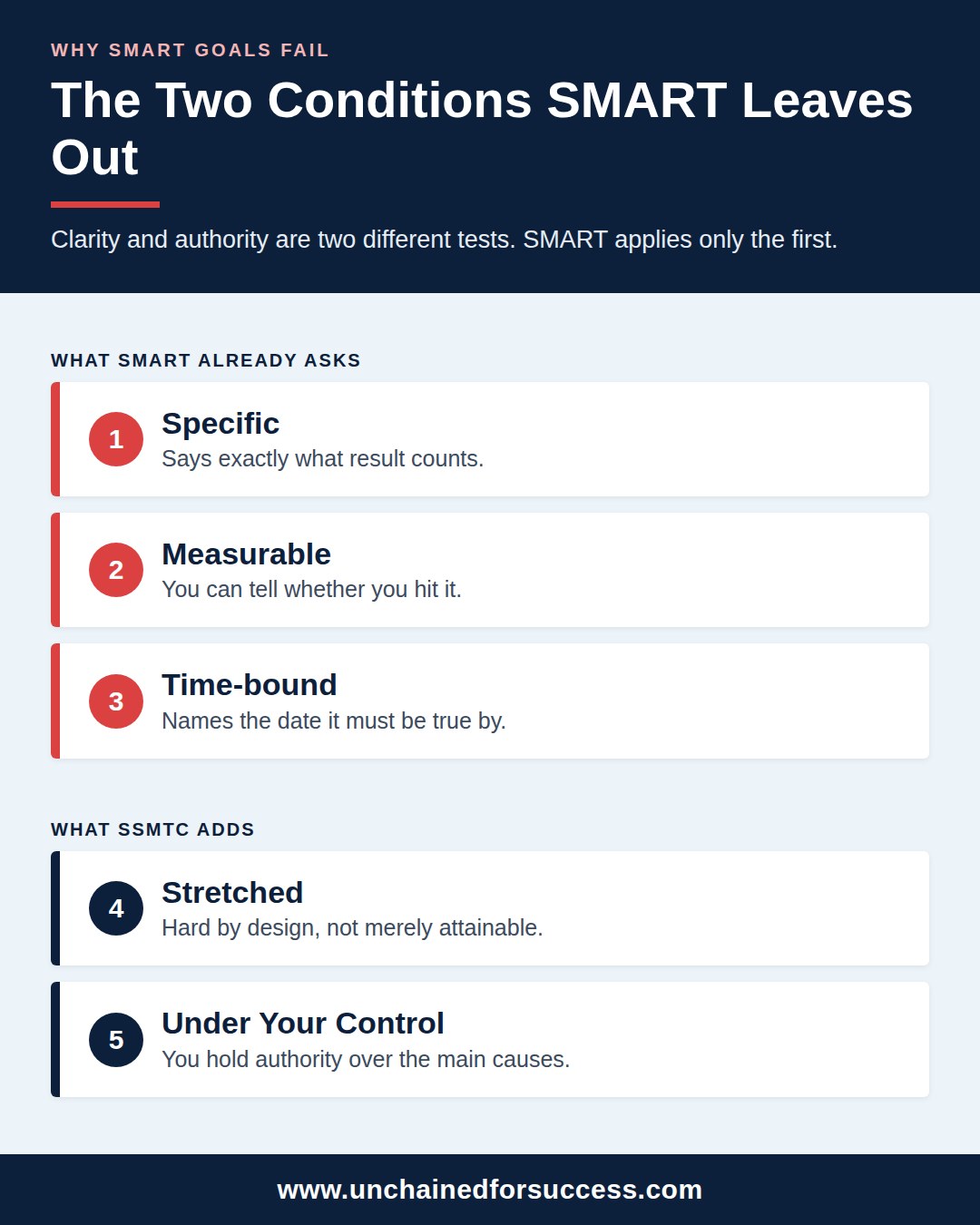
Three of those five will be familiar from SMART. Stretched and Under your control are what SMART leaves out, and the second of those is the reason a well-formed objective can still be the wrong thing to hold someone to.
The Unchained Goals Framework calls an outcome outside your control a dream. That is not a dismissal. Dreams are worth having, and they shape where you are going. You simply translate one, before execution starts, into the largest result beneath it that you can actually govern.
What to Do When SMART Goals Fail in February
Where SMART goals fail, three questions usually find the reason. Take the goals you wrote in January and run them through these.
First, for each one, name who has to act for it to happen. Then ask whether you hold enough authority over those actions, and over the corrections when it drifts. Where you do not, you are holding a dream rather than a goal.
Second, translate rather than delete. Ask what the largest part of it is that you hold enough authority to deliver and to correct when it drifts, and write that down as the thing you are accountable for.
Third, check who set it, because taking responsibility cuts both ways. If you assigned a goal to someone else, ask whether they hold the authority to deliver it. If they do not, you have handed them exposure and called it ownership. The framework glossary sets out the difference.
Then look at the year again. Not many January goals need abandoning. The repair is to move the responsibility to where the authority already sits, which is cheaper than starting again.
Frequently Asked Questions
Does this mean stretch goals are a mistake? No. SMART goals fail on control, not on ambition, and a hard goal inside your authority is exactly what the framework asks for. Stretch is one of the five conditions, not an exception to them. The test is not how hard the result is, but whether you hold sufficient authority over the main causes and over the corrective decisions.
What if my job genuinely depends on other people? Most jobs do. The question is not whether other people are involved, but whether you can act on the main causes and correct course when it drifts. Where you cannot, name the piece you can deliver and hold yourself to that, while keeping the wider ambition visible as direction.
Is it unfair to hold anyone accountable for something outside their control? The evidence is mixed, and managers themselves separate one kind of outside factor from another. The better-supported part is narrower. Responsibility without authority goes with more role ambiguity and conflict for the people doing the work, and with lower self-rated performance. The effect did not reach significance for top-level managers.
Share one January goal you have realised is not yours to deliver, and what you are going to hold yourself to instead, in the comments.
For an outside view of how your goals hold up, the Goals Readiness Score scores each of the nine components separately and names the weakest one.
Which of your goals this year depends on a decision you will never be in the room for?
Sources on Why SMART Goals Fail
- Burkert, M., Fischer, F. M., and Schäffer, U. (2011). Application of the controllability principle and managerial performance: the role of role perceptions. Management Accounting Research, 22(3), 143 to 159. https://doi.org/10.1016/j.mar.2011.03.002
- Giraud, F., Langevin, P., and Mendoza, C. (2008). Justice as a rationale for the controllability principle: a study of managers' opinions. Management Accounting Research, 19(1), 32 to 44. https://doi.org/10.1016/j.mar.2007.09.002
- Zureich, J. (2023). The (un)controllability principle: the benefits of holding employees accountable for uncontrollable factors. Journal of Accounting Research, 61(2), 653 to 690. https://doi.org/10.1111/1475-679X.12467
- Simons, R. (2010). Accountability and control as catalysts for strategic exploration and exploitation: field study results. Harvard Business School Working Paper 10-051. https://www.hbs.edu/ris/Publication%20Files/10-051_0be1c2b5-7d61-41f7-98c0-45b349ef5854.pdf
Continue Your Journey
Explore more resources from the Unchained Goals Framework: