

You hit the target. You told the people who needed telling. And then, within about a week, the feeling drained away and you started looking for the next thing. That hollow gap after an achievement is one of the plainest signs of goals without purpose, and it is rarely discussed honestly.
I know this from my own experience. I set goals, chased them hard and reached them. Still I felt empty. One day I broke down, not because anything had failed, but because I could not explain why I was pushing so relentlessly. It was the start of writing down my purpose and defining a vision for my life, and of aligning what I do with both. That took a good deal longer than a day.
Why Goals without Purpose Leave You Flat
Goals and purpose do different jobs, and swapping one for the other is the mistake.
A goal measures. Goals without purpose measure just as accurately as any other kind. It tells you where you are, whether you have arrived, and how far is left. That is genuinely useful, and it is all a goal can do. Goals without purpose still measure perfectly well.
Purpose decides which game is worth scoring at all. It names the problem you have accepted responsibility for, and that is what makes one result worth counting and another not. Without it you keep score in a game nobody explained to you. The score still climbs. It simply stops meaning anything. That is the whole problem with goals without purpose, stated as plainly as it can be.
The Arrival Problem Nobody Warns You About
Here is the pattern, and it is easy to recognise once you look for it.
You expect the achievement to deliver a feeling. It delivers a smaller one than expected, and a shorter one. Rather than question the design, you conclude the goal was too small, so you set a bigger one. It is the same trap as mistaking activity for progress. The cycle repeats, each round costing more and returning about the same.
This is what goals without purpose actually feel like from inside. Not failure. Relief, then flatness, then restlessness, then a new target.
The trap is that the cycle looks like ambition. From outside, goals without purpose are hard to tell apart from drive, which is why it often goes unchallenged. Colleagues admire the output. Few ask what it is for.
What the Research Says About Purpose
There is more evidence here than the subject usually gets credit for, and it is worth reading carefully.
A study of 6,985 American adults over fifty compared people by how strongly they reported a sense of purpose (Alimujiang and colleagues, 2019). Those in the lowest group died at more than twice the rate of those in the highest over the follow-up period.
A separate analysis followed a different sample of adults over fourteen years, during which 569 participants died (Hill and Turiano, 2014). Purpose predicted living longer, and it held even after accounting for other measures of wellbeing.
Read those carefully. Both are observational, so neither proves that purpose causes the outcome. People in poor health may well find it harder to feel purposeful. What you can fairly say is that the association is large, that it survives serious statistical controls, and that it is not easily explained away as chance.
Why Motivation Cannot Fix Goals without Purpose
The usual response to flatness is to look for more motivation, which is why excellence is a decision rather than a trait. That is treating a structural problem as an energy problem.
A review of 183 studies covering more than 200,000 people found that internal motivation predicts performance across a wide range of settings, including ones where external rewards are also in play (Cerasoli, Nicklin and Ford, 2014). Interestingly, the two are not rivals. Internal motivation predicted the quality of what people produced; incentives predicted the quantity.
There is a caution attached, and it is narrower than most summaries of it. Where rewards tie tightly and directly to performance, internal motivation predicted performance less strongly than where the rewards sat further in the background. That weakens the link between the two. It does not show that the internal reasons went anywhere.
So more pressure is not the answer to goals without purpose. It may well raise output for a time. What it cannot do is answer the question the flatness is asking, and treating that flatness as a discipline problem sends you further in the wrong direction.
One Correction Worth Making
You will often see it said that the three things sustaining motivation are autonomy, competence and meaning. The third one is wrong.
In the original theory the three basic needs are autonomy, competence and relatedness, meaning connection to other people (Ryan and Deci, 2000). Quietly swapping relatedness for meaning removes the social need sitting at the centre of the theory.
That matters here, because it points at something people chasing goals without purpose often miss. Part of what makes an achievement feel worthwhile is who it connects you to, not only what it signifies. An achievement that connected you to nobody has one less thing holding it up.
Signs You Are Chasing Goals without Purpose
None of these is proof on its own. Together they are worth taking seriously, because goals without purpose rarely announce themselves directly.
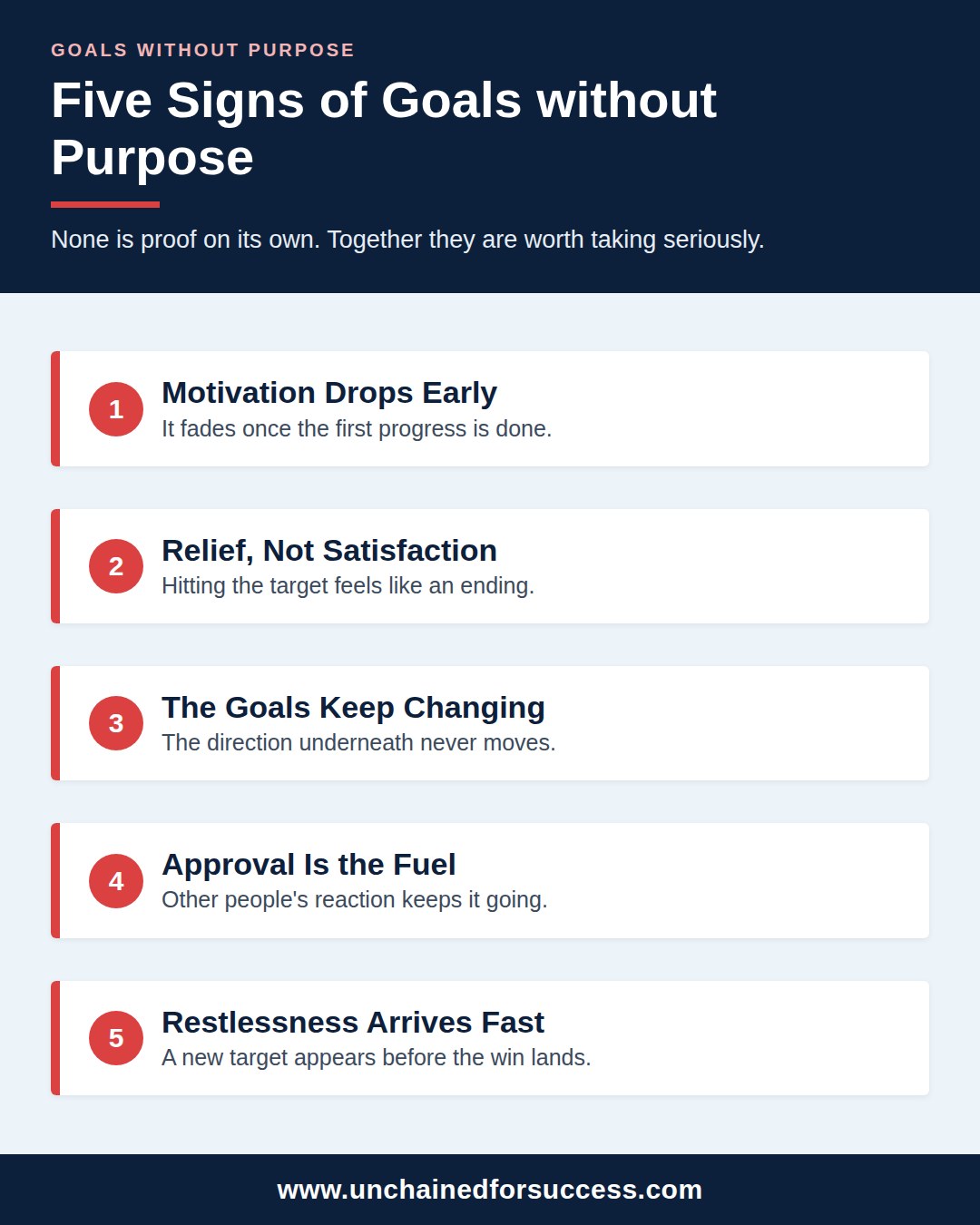
Motivation drops sharply once the early progress is done. Success brings relief rather than satisfaction. Your goals change often without the direction underneath them changing. Other people's approval has quietly become the main fuel. And after a genuine win, restlessness arrives faster than it should.
One study caught this at close range. Researchers tracked 84 people over two weeks, recording daily effort towards a personal purpose (Kashdan and McKnight, 2013). Wellbeing, self-esteem and meaning all rose on the days people put real effort towards that purpose.
Note what that study is and is not. It is small, it was conducted partly with people who have social anxiety disorder, and it tracked daily changes rather than the shape of a life. It is a reason to take the idea seriously rather than proof of anything sweeping.
The Question That Decides Which Goals Are Yours
There is a distinction here that ordinary usage blurs, and it is the one that does the work.
Purpose defines the domain. It is the problem you accept responsibility for addressing, and the boundary that rules other pursuits out. A purpose that rules nothing out is not yet doing its job. Vision then defines direction and position within that domain: Purpose says which problem is yours, and Vision says what you are building inside it. Why is different again. It justifies the cost of one particular goal, and it answers a specific price rather than describing your life.
The Unchained Goals Framework builds these in that order, and it does so deliberately. Purpose comes first because it governs selection, and the framework glossary sets out each component in turn. Get it wrong and you will pursue perfectly well-designed goals in a direction you never chose.
Notice one thing in particular. Purpose is not your reason for being, and it is not a description of who you are. It names what you have taken responsibility for.
What to Do Before You Set Your Next Goal
Do not start another goal cycle looking for a feeling that the last one failed to deliver. Do this instead.
Ask one question about the goal you are considering: if I achieve this, what meaningful problem does it solve, and why does that matter to me? Write the answer down in a sentence. If the sentence only describes how the achievement would look to other people, you have found something useful.
Then check one more thing. Name what this goal will cost you, across time, money, energy and the things you will not do instead. If the reason you wrote down does not comfortably cover that cost, you have found the place the goal is most likely to give way.
This also takes long-term thinking rather than a single decision. You do not need a finished purpose to start. A rough one, honestly held, gives you something to test. Another year of waiting for clarity does not. Goals without purpose are not repaired by thinking harder. They are repaired by naming what the work is for and then testing that against a real decision.
Frequently Asked Questions
Can a goal be worth pursuing without a purpose behind it? It depends which sense you mean. Plenty of goals are simply practical, and none of them has to feel profound. Those still sit inside your purpose, because they protect the domain you took on. Goals without purpose in the stronger sense are different. They answer to no domain at all, and they spend the capacity your other goals need.
How do I find my purpose if I have never had one? Usually through action rather than reflection. Look at where you have spent effort willingly, what problems annoy you enough to want fixing, and what you find yourself returning to. Write a rough sentence, then test it against real decisions for a few months. It sharpens by being used.
Is it too late to change direction? The studies here cover adults from early middle age into later life, and the association did not disappear in the older groups. That proves nothing about your own case. It also offers no support for the idea that there is an age past which this stops being worth doing.
Share one goal you achieved that did not feel the way you expected, and what you think was missing, in the comments.
If you want an outside view of how your goals are designed, executed and governed, the Goals Readiness Score scores each of the nine components separately and names the weakest one.
If you reached every goal on your current list, what would you want it to have added up to?
Sources on Goals without Purpose
- Alimujiang, A., Wiensch, A., Boss, J., Fleischer, N. L., Mondul, A. M., McLean, K., Mukherjee, B., and Pearce, C. L. (2019). Association between life purpose and mortality among US adults older than 50 years. JAMA Network Open, 2(5), e194270. https://doi.org/10.1001/jamanetworkopen.2019.4270
- Hill, P. L., and Turiano, N. A. (2014). Purpose in life as a predictor of mortality across adulthood. Psychological Science, 25(7), 1482 to 1486. https://doi.org/10.1177/0956797614531799
- Kashdan, T. B., and McKnight, P. E. (2013). Commitment to a purpose in life: an antidote to the suffering by individuals with social anxiety disorder. Emotion, 13(6), 1150 to 1159. https://doi.org/10.1037/a0033278
- Cerasoli, C. P., Nicklin, J. M., and Ford, M. T. (2014). Intrinsic motivation and extrinsic incentives jointly predict performance: a 40-year meta-analysis. Psychological Bulletin, 140(4), 980 to 1008. https://doi.org/10.1037/a0035661
- Ryan, R. M., and Deci, E. L. (2000). Self-determination theory and the facilitation of intrinsic motivation, social development, and well-being. American Psychologist, 55(1), 68 to 78. https://doi.org/10.1037/0003-066X.55.1.68
Continue Your Journey
Explore more resources from the Unchained Goals Framework: