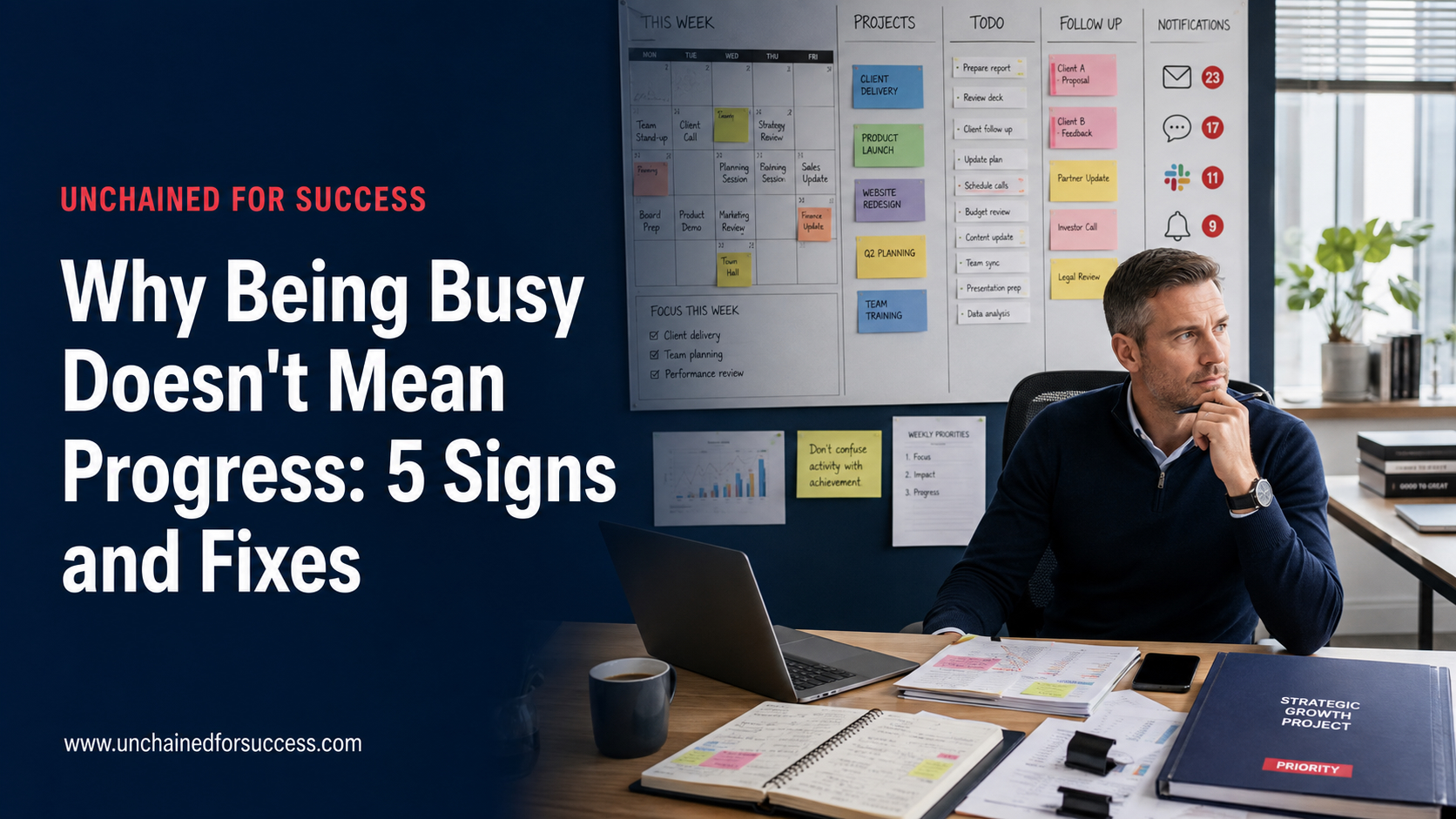

A project is running late. The team is working hard, the plan has not changed, and everyone agrees the answer is more effort. Six weeks later it is later still. This is the moment creative problem-solving is actually for, and it is the moment it is least likely to be used, because stepping back feels like stopping.
What follows is what the evidence supports, including the parts that cut against the popular version, and where this kind of thinking belongs in a goal structure. Some of it is less flattering than the usual account.
Why Pushing Harder Stops Working
Effort is the first thing anyone reaches for, and it is the cheapest thing to increase.
The trouble is that effort only helps when the work is capable of producing the result. Where the method is wrong, more of it produces more of the wrong thing, faster. That is how a team stays fully occupied and still goes nowhere, which is the same trap as mistaking busyness for progress.
So the question is not how to work harder. It is how to tell whether the approach itself needs redesigning. That is the question creative problem-solving exists to answer, and it is worth more than any technique.
Where Creative Problem-Solving Actually Came From
Most accounts get this history wrong. Getting it right matters more than it sounds.
Alex Osborn set out the first version in the 1950s, and Sidney Parnes developed it with him into a five-stage process: fact-finding, problem-finding, idea-finding, solution-finding and acceptance-finding. That is the model properly called Osborn-Parnes.
The four-stage version you will see everywhere, Clarify, Ideate, Develop and Implement, is a later thing. It is the Creative Education Foundation's learner's model, based on Osborn-Parnes and credited to Puccio, Mance, Murdock and colleagues in 2011.
Both are useful. Attributing the modern one to two men who wrote something different is the kind of small inaccuracy that costs a reader's trust when they check.
Does Creative Problem-Solving Training Work?
Here the honest answer beats the confident one. You will rarely see it stated.
The largest review of the field pooled 169 studies, 844 effect sizes and 18,486 people, and deliberately included 48 unpublished studies (Sio and Lortie-Forgues, 2024). Training did improve creative performance, by about half a standard deviation before adjustment.
Then the authors looked for publication bias and found strong evidence of it. Every correction method they applied brought the effect down to roughly 0.29 to 0.32 standard deviations, a little over half the headline.
They are equally blunt about study quality. Only 11 per cent of the studies did all three of the basics: randomise people, use an active control group, and run a pretest. Worse, they found little sign of improvement over five decades.
Read plainly, that means this. You can teach creative problem-solving and the gain is real. It is also about half the size of the uncorrected figure, so check which one a source is quoting before you rely on it.
The Brainstorming Finding That Changes How You Run the Room
One result here is old, large and inconvenient.
Researchers pooled the studies comparing groups brainstorming together against the same number of people working alone and pooling afterwards (Mullen, Johnson and Salas, 1991). Across 34 tests covering 2,577 people, the separate individuals produced more ideas, and better ones. The differences were large.
The losses grew with bigger groups. They also grew when someone watched, and when a recorder took down every contribution.
Two cautions belong here. The analysis is 35 years old, and it drew a published rebuttal in the same issue arguing it over-read correlational evidence. Electronic and asynchronous methods also behave differently.
The practical instruction survives both. Have people generate alone first, then bring the ideas together to develop them. The meeting is for building on ideas, not for producing them.
Where Creative Problem-Solving Fits in a Diagnosis
This is where the framework earns its place, because it tells you when to reach for this and when not to.
One thing first. Creative problem-solving has a use during design as well, when you are working out what to build, or translating an ambition into a result you can actually govern. What follows is narrower. It is about where the method belongs once a goal is already running and not moving.
The Unchained Goals Framework runs a fixed diagnostic order in that situation: did the behaviour happen, was the work itself capable of producing the standard, did the measure tell you anything, and so on upwards.
Within that sequence, creative problem-solving belongs at the second step. Suppose the behaviour is happening faithfully and the standard still is not moving. Then the work itself needs redesigning, and no amount of discipline touches that.
Reach for it too early and you redesign a process nobody ran. Reach for it too late and you spend a year staying consistent at the wrong thing.
A Governance Example From My Own Work
Some years ago I supported an organisation whose programme was several weeks behind, and the instinct in the room was to compress the schedule.
We stepped back instead and looked at how the programme actually made decisions. Several governance processes ran purely for compliance. Teams completed steps without anyone asking whether each step still served a purpose at that stage.
So we revisited the intent behind each one. Some were genuinely load-bearing. Others existed because they had existed at an earlier stage and nobody had retired them.
Tailoring the governance to what the programme actually needed removed a set of unnecessary barriers, sped up decisions and put ownership back where it belonged. The programme moved from being weeks behind to meeting its delivery milestones.
Note what changed. Not the target, and not how hard anyone worked. The process between them.
How to Apply Creative Problem-Solving This Week
Take one thing that is stuck, and run it in this order.
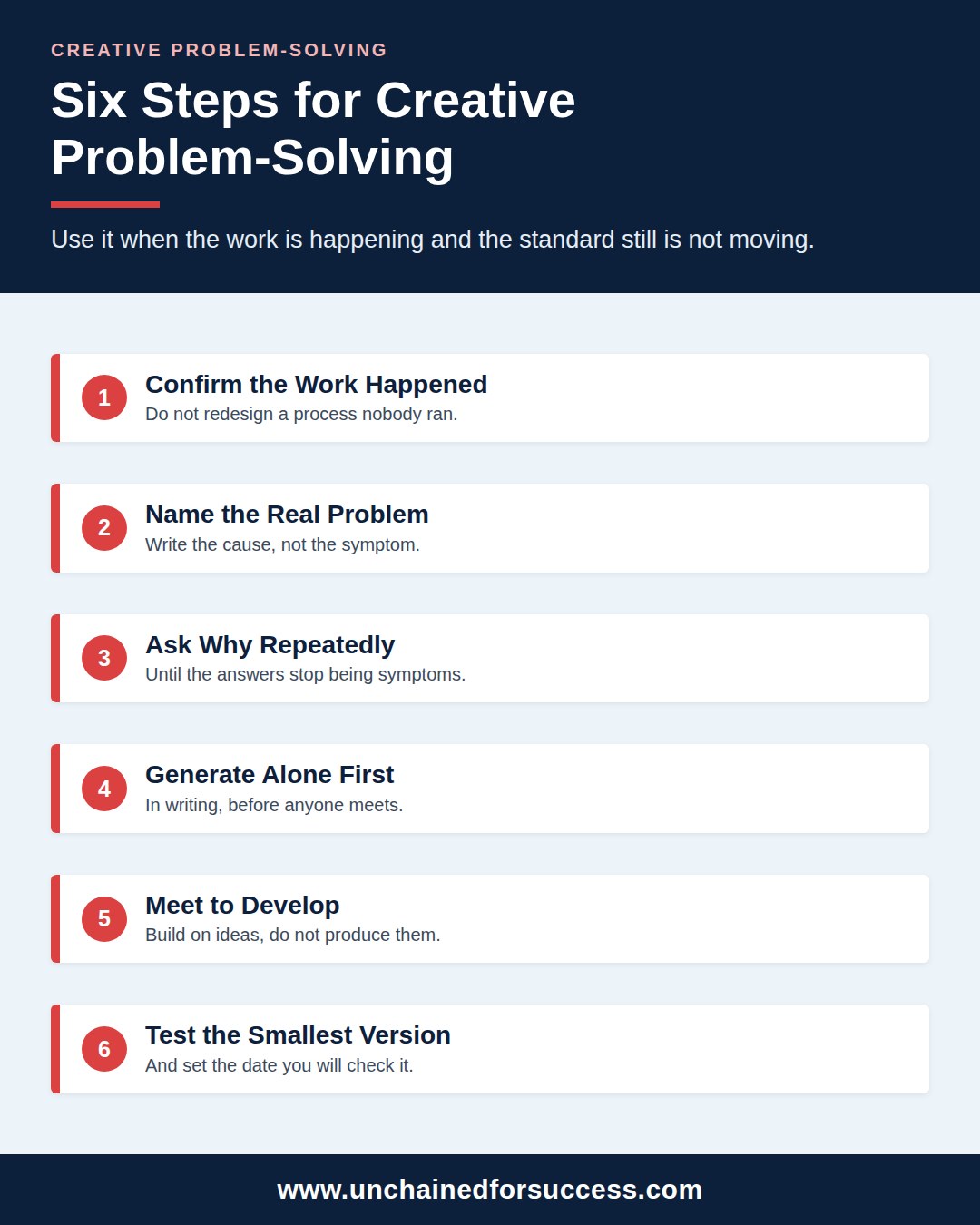
1. Confirm the work is happening at the agreed cadence.
2. Write the problem as a question about cause, not symptoms.
3. Ask why repeatedly, until the answers stop being symptoms.
4. Have each person generate options alone, in writing, first.
5. Meet to combine and develop, not to produce.
6. Test the smallest version, and set the date you will check it.
Step three has a pedigree. It began with Sakichi Toyoda, and Taiichi Ohno, who built the Toyota Production System, called repeating why five times the basis of Toyota's scientific approach. The point is to get past the first plausible answer, which is usually a symptom wearing a cause's clothes.
Step six is what separates creative problem-solving from a workshop. A redesign with no scheduled check is simply a new untested assumption. It needs a standard and a date, because a standard nobody looks at cannot warn you of anything.
The Reframe That Built a Company
A short example of creative problem-solving, because reframing is easier to recognise than to define.
In October 2007 two designers in San Francisco could not cover a rent bill of 1,150 dollars. A large design conference had filled the city's hotels that week. They put three air mattresses on their floor and charged 80 dollars a head.
The obstacle they reframed was a cash shortfall. What they noticed was that the room they already had was worth something to somebody. That company is now Airbnb.
The move is not creativity in the artistic sense. It is asking what the situation contains that you have been treating as fixed.
Most of the constraints on any stuck problem are real. A few are habits of thought wearing the costume of constraints. Telling the two apart is most of the skill.
Two Barriers Worth Naming
Method is rarely the thing standing in the way. Two others come up often, in my experience.
The first is time. Stepping back costs a day you do not have, and the day you do not have is exactly the symptom of the problem. That circle is why late programmes stay late.
The second is safety. Creative problem-solving needs someone to say the current approach is not working. In many rooms that reads as criticism of whoever designed it.
Neither barrier yields to encouragement. Both yield to a small, scheduled, low-stakes redesign that somebody has already agreed to run. Make the first one cheap enough that nobody has to defend it.
Frequently Asked Questions
Is creative problem-solving just brainstorming? No. Brainstorming is one step of several, and the research above concerns how you run that step rather than how it compares with the others. Defining the real problem and testing the chosen option matter at least as much, and the idea-generation step works better when people start alone.
How do I do this when the culture punishes ideas that fail? Then the constraint is not method, it is what people can safely say. Start with a small, low-stakes redesign that you can run and report honestly, because one visible example changes more than an instruction to be more open.
When should I not use creative problem-solving? When nobody has actually done the agreed work. Redesigning a process nobody followed is a reliable way to turn this into an expensive distraction, so taking responsibility for checking that first is the cheaper move.
Share one thing you have been pushing harder on that might need redesigning instead, in the comments.
If you want an outside view of how your goals are designed, executed and governed, the Goals Readiness Score scores each of the nine components separately and names the weakest one.
What are you treating as fixed in this problem that is not actually fixed?
Sources on Creative Problem-Solving
- Sio, U. N., and Lortie-Forgues, H. (2024). The impact of creativity training on creative performance: a meta-analytic review and critical evaluation of 5 decades of creativity training studies. Psychological Bulletin, 150(5), 554 to 585. https://doi.org/10.1037/bul0000432
- Mullen, B., Johnson, C., and Salas, E. (1991). Productivity loss in brainstorming groups: a meta-analytic integration. Basic and Applied Social Psychology, 12(1), 3 to 23. https://doi.org/10.1207/s15324834basp1201_1
- Isaksen, S. G., and Treffinger, D. J. (2004). Celebrating 50 years of reflective practice: versions of Creative Problem Solving. The Journal of Creative Behavior, 38(2), 75 to 101. https://doi.org/10.1002/j.2162-6057.2004.tb01234.x
- Creative Education Foundation. What is CPS? https://www.creativeeducationfoundation.org/what-is-cps/
Continue Your Journey
Explore more resources from the Unchained Goals Framework: