
Everyone tells you to keep learning. Almost nobody tells you what to learn, or how to know whether it worked. Future-proofing your skills arrives as an instruction with no method attached. That produces anxiety rather than progress.
This article does the opposite. It starts with what the evidence shows, including one widely repeated claim that turns out to be the reverse of the truth. Then it ends with a way to hold yourself to something you can govern.
What the Latest Jobs Data Actually Says
Begin with the number everyone quotes, because the version in circulation is out of date.
Employers surveyed for the World Economic Forum expect 39 per cent of workers' core skills to change by 2030 (World Economic Forum, 2025). Read that carefully: it means 39 per cent of the skill set, not 39 per cent of workers. The widely quoted 44 per cent figure comes from the 2023 edition, so the number has fallen rather than risen.
Workers are counted separately. Out of every 100, the report expects 41 to need no significant training by 2030. A further 29 are upskilled inside their current role. Nineteen are reskilled and redeployed to different work within their organisation. Eleven need training that they are unlikely to receive.
One caution matters here. These are employer expectations gathered by survey, not measured outcomes, and the same organisation revised its own figure downwards within two years. Treat it as what employers say they expect. Future-proofing your skills should follow the direction that number points in, not its precise size.
The Claim About Degrees That Runs the Other Way
Here is where the popular account collapses, and the correction is more useful than the claim.
You will often read that employers now care about skills rather than degrees. Researchers tested that against 11,300 roles at large firms over ten years (Fuller and the Burning Glass Institute, 2024). Firms dropped the degree requirement in 3.6 per cent of roles. The net effect on hiring was 0.14 percentage points.
In plain terms, fewer than one hire in 700 changed. The report's own title describes the gap between pronouncements and practice.
There is a real finding underneath, and it is the useful one. Among firms that genuinely changed how they hire, candidates without degrees won jobs at higher rates and stayed longer.
So build skills you can demonstrate. Do not plan a career on the assumption that credentials have stopped counting, because the data says they have not. Future-proofing your skills means doing both at once.
Why Future-Proofing Your Skills Is a Race, Not a Checklist
This is the finding that reframes the whole subject, and it comes from economics rather than career advice.
Two economists studied graduates in fields where the skill content changes fastest (Deming and Noray, 2020). Those graduates earn a large premium early on. The premium then erodes as they age. What they learned dates faster than their experience builds up.
They describe it as a race between on-the-job learning and skill obsolescence. That is a far better model for future-proofing your skills than any list of things to acquire.
Read that way, future-proofing your skills is not a project you complete. It is a rate you sustain. The right question is whether you are learning faster than your current knowledge dates.
The Skills That Hold Their Value
Some things depreciate more slowly, and the data is reasonably clear about which. Future-proofing your skills is easier when you know where to spend the effort.
Analytical thinking remains the top core skill in the World Economic Forum's survey. Seven in ten companies call it essential. Note what that means. Employers demand it most consistently, which is a different thing from the fastest growing skills, and that separate list leads with artificial intelligence and data.
For a practical version of analytical thinking, try asking why repeatedly until the answers stop being symptoms. That habit came out of Toyota's production system, under Sakichi Toyoda and later Taiichi Ohno, and it costs nothing.
The broader picture supports patience here. Most current employment sits in job specialties that did not exist in 1940 (Autor and colleagues, 2024). New work keeps appearing. The same study also finds that automation's demand-eroding effects have intensified over the past four decades while the demand-creating effects have not, so this is not a reason for complacency.
Future-Proofing Your Skills Starts With the Control Question
Now the part that turns all of this into something you can act on, and it is where future-proofing your skills becomes a goal rather than a worry.
You cannot govern which skills the market wants. You cannot govern whether your employer restructures, or what a hiring panel decides. Holding yourself accountable for any of those is how people end up anxious and busy at the same time.
The Unchained Goals Framework draws a line here, called the control boundary. It asks whether you hold enough authority over the main causes of a result, and over the corrections when it drifts. Not every factor. Enough of them.
"Stay employable" fails that test. It is a direction rather than a goal. Underneath it sit results you hold enough authority to deliver: the coursework completed and the exam sat, a piece of work built and shown in public, a defined level reached in a specific tool. Note what is not on that list. Passing is not, because a marker decides it.
Translate rather than abandon. Keep the ambition as direction, and hold yourself to the largest part of it you can actually move. The framework glossary sets out each term as you meet it.
What the Mindset Research Supports, and What It Does Not
You will see a growth mindset offered as the answer to all of this. The evidence behind it is weaker than the confidence of the people repeating it.
The largest review pooled 63 studies covering 97,672 students and found an average effect that was statistically significant but very small, and not significant at all once the analysis corrected for publication bias (Macnamara and Burgoyne, 2023).
Meanwhile the best-designed single trial found something real but narrow (Yeager and colleagues, 2019). Among lower-achieving students, grades improved by about 0.10 points, and by more in schools where the surrounding norms supported taking on hard work.
Both studies concern school students and grades, not adults changing careers. So treat attitude as something that helps you form an intention, not as a substitute for deciding what to learn and when.
A Worked Example of Future-Proofing Your Skills
Take a marketing manager whose employer is moving reporting onto a new analytics platform. Her instinct is the usual one, and it is where future-proofing your skills usually goes wrong.
"Become the data person" is not a goal, because it depends on how colleagues and managers come to see her. So she names a result she can govern: rebuild the team's monthly report in the new platform by the end of the quarter. Colleagues will be involved, and she holds enough authority over the work and the corrections to answer for it.
Beneath it sits a standard she can check early: one report section converted and verified each fortnight. Beneath that sits the behaviour, forty minutes on Tuesday and Thursday mornings before the day starts.
The wider ambition still shapes her direction. The report is what she answers for. She is an illustration drawn to show the translation, not a client.
How to Start Future-Proofing Your Skills This Month
Four steps, and they fit in an evening. This is future-proofing your skills reduced to something you can diarise.
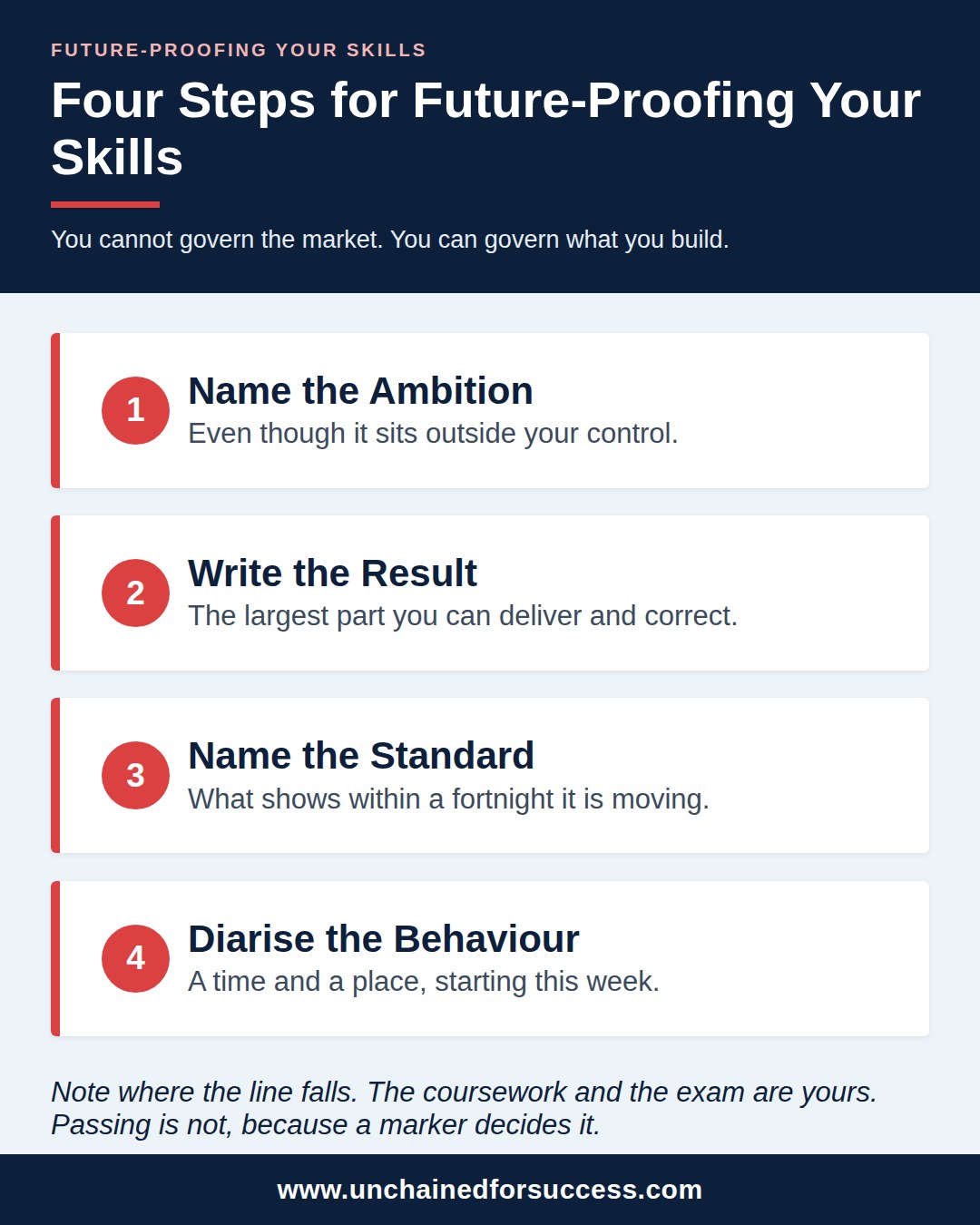
1. Name the ambition honestly, even though it sits outside your control.
2. Write the largest result underneath it that you hold enough authority to deliver and to correct, by a date.
3. Name the standard that would tell you within a fortnight whether it is moving.
4. Put the behaviour in the diary with a time and a place.
Then decide what you will stop doing to make room, because every commitment has a cost and a learning plan with no time attached is a wish. The resource library has planners if you want a structure.
Two Traps in Future-Proofing Your Skills
Both are common, and both feel like diligence at the time.
The first is collecting. Courses started, tools sampled, certificates half-finished. It creates a sense of motion, and it leaves nothing you could show a stranger. Depth in one thing usually does more for you than introductions to five.
The second is waiting for the field to settle. People delay choosing because the landscape keeps moving, and the delay can cost more than picking the wrong thing would have. A skill you built and did not need still taught you how to build a skill.
Future-proofing your skills rewards starting badly over planning perfectly. You can correct a direction you are moving in. You cannot correct a standstill.
Frequently Asked Questions
How many skills should I work on at once? Fewer than feels comfortable, and usually one, unless two genuinely support each other in the way writing and presenting do. Breadth feels productive and often produces a collection of introductions, and an introduction to five tools is worth less in a hiring conversation than competence in one.
Is a qualification worth it? Sometimes, and the honest answer is that credentials still carry weight despite what you read. Judge it on whether the qualification produces something you can show, because demonstrable work is what survives a change of employer.
What if my industry changes faster than I can learn? Then the useful move is to learn things that transfer rather than things tied to one system. That is my reading rather than a finding. The research above shows that fast-changing skill content erodes an early earnings advantage; it does not show that general knowledge is immune.
Share the ambition you have been carrying and the result underneath it that you could actually deliver, in the comments.
If you want an outside view of how your goals are designed, executed and governed, the Goals Readiness Score scores each of the nine components separately and names the weakest one.
Which part of staying employable is actually yours to decide?
Sources on Future-Proofing Your Skills
- World Economic Forum. (2025). The Future of Jobs Report 2025, Skills Outlook. https://www.weforum.org/publications/the-future-of-jobs-report-2025/in-full/3-skills-outlook/
- Fuller, J. B., and the Burning Glass Institute. (2024). Skills-based hiring: the long road from pronouncements to practice. Harvard Business School Project on Managing the Future of Work. https://www.hbs.edu/managing-the-future-of-work/Documents/research/Skills-Based%20Hiring.pdf
- Deming, D. J., and Noray, K. (2020). Earnings dynamics, changing job skills, and STEM careers. The Quarterly Journal of Economics, 135(4), 1965 to 2005. https://doi.org/10.1093/qje/qjaa021
- Autor, D., Chin, C., Salomons, A., and Seegmiller, B. (2024). New frontiers: the origins and content of new work, 1940 to 2018. The Quarterly Journal of Economics, 139(3), 1399 to 1465. https://doi.org/10.1093/qje/qjae008
- Macnamara, B. N., and Burgoyne, A. P. (2023). Do growth mindset interventions impact students' academic achievement? Psychological Bulletin, 149(3 to 4), 133 to 173. https://doi.org/10.1037/bul0000352
- Yeager, D. S., and colleagues (2019). A national experiment reveals where a growth mindset improves achievement. Nature, 573(7774), 364 to 369. https://doi.org/10.1038/s41586-019-1466-y
Continue Your Journey
Explore more resources from the Unchained Goals Framework: