

A freelance designer learns on a Tuesday that her largest client is cutting its budget by half from next month. That client is forty per cent of her income and most of her plan for the year. She can treat the news as a disaster, or she can treat it as a signal and change what the signal calls for. An adaptability mindset is the second response.
Whatever your starting point, it is a set of behaviours you can practise for responding to change while holding what should not move. You can practise them before the Tuesday arrives. This article sets out those behaviours, shows what to hold steady while everything else moves, and keeps the evidence to what it supports.
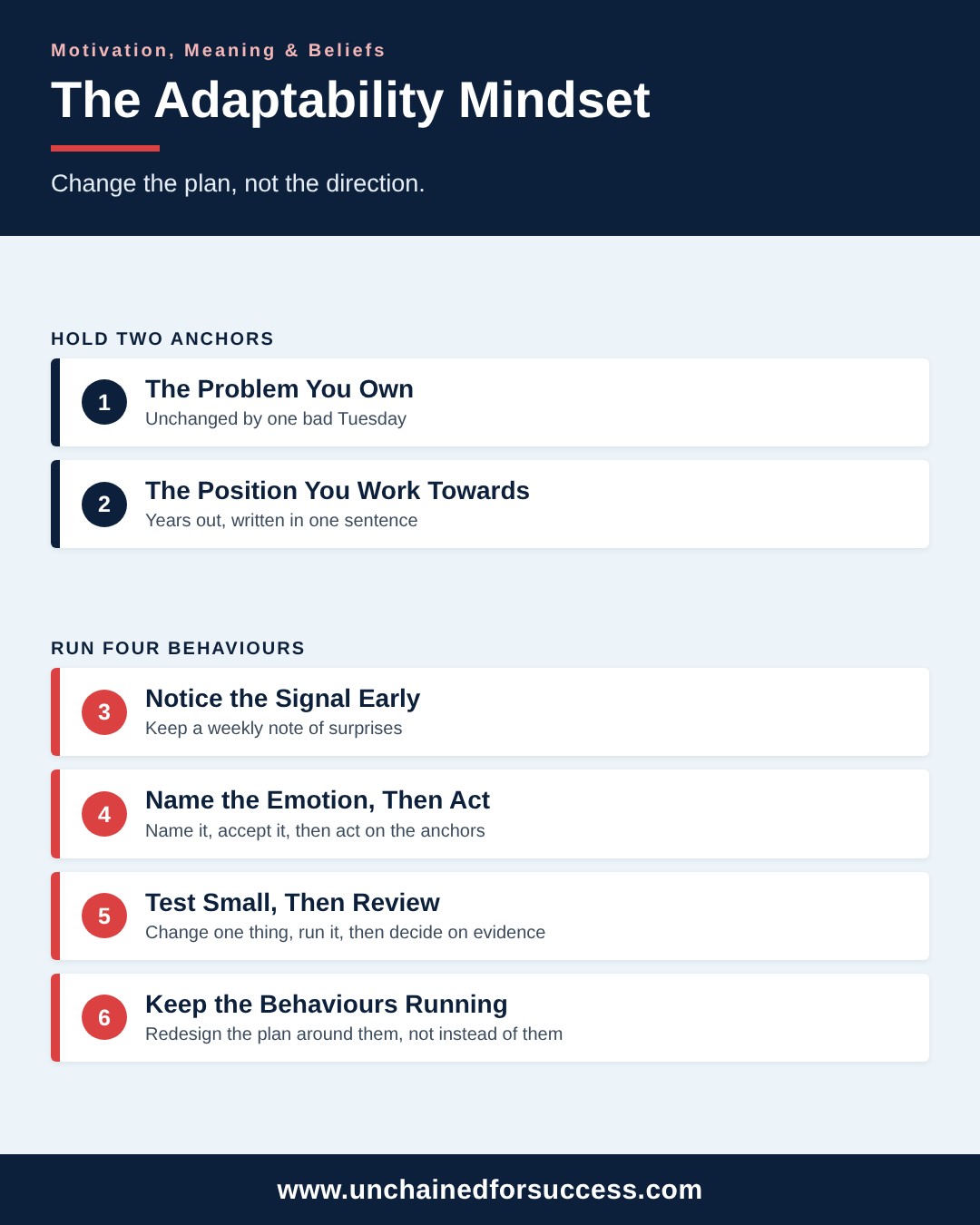
Adaptability is knowing what to change and what to keep. Change everything and you have no direction. Change nothing and your plan rests on ground that has gone.
What an Adaptability Mindset Is Not
It is not optimism, and it is not the belief that change is always an opportunity. Some changes are losses, and calling them opportunities does not make the loss smaller. Nor is it flexibility about everything. A person who changes direction every time the ground shifts is not adaptable. They have no anchor.
The research on adaptive performance makes this concrete. Pulakos and colleagues (2000) analysed more than a thousand critical incidents from twenty-one jobs and found eight distinct kinds of adaptive behaviour.
They include handling emergencies, handling work stress, solving problems creatively, dealing with uncertain situations, learning new tasks and technologies, and adapting to other people and cultures. Adaptive performance, in that research, is a set of things people do at work, and the authors describe each dimension as behaviour. The taxonomy describes adaptive performance through observable behaviours; it does not test whether practising them improves adaptability.
That is the useful starting point. An adaptability mindset, as used here, is a set of behaviours you can practise so that they run when the signal arrives. The four practices below are this article's recommendations for responding to change. They are not drawn from that taxonomy.
An Adaptability Mindset Starts With What You Hold
Before you can decide what to change, you need to know what you are not changing. For the designer, two things held. One client's budget did not change the problem she had chosen to work on: small food businesses that look less credible online than their food deserves. Nor did it change the position she was working towards: a studio with six retained clients, two staff and a waiting list, three years out.
What had to change was the plan for the next twelve months, and the behaviours in it.
The Unchained Goals Framework gives these two anchors names. The problem you have accepted responsibility for solving is your Purpose. Your Vision is the long-term position you have committed to building within it. Everything below them exists to move you towards the Vision: the goals, the plan and the behaviours you repeat. All of it is open to change when the ground shifts.
Write your two anchors down before the next shock, in two sentences. When change arrives, keep them in view. If the change touches neither, you are changing a plan or a goal, not a life. If it appears to challenge one of them, examine whether that anchor needs revising before you redesign the goals beneath it. That is rare, and it is a different piece of work.
Four Behaviours That Make Up an Adaptability Mindset
With the anchors held, four behaviours do the adapting in an adaptability mindset.
Notice the signal early. Look for the signal before the change arrives. A client takes longer to reply. The course you planned on reviews its entry requirements. Your manager starts asking different questions. The designer had noticed the client querying her invoices for two months and had read it as admin. Keep a short note of anything that surprises you. Once a week, ask what the surprises have in common.
Name the emotion, then act on what matters. David and Congleton (2013) describe four practices for working with difficult thoughts and feelings: recognise the pattern, label the thought or emotion, accept it, and act on your values. The research behind those practices is on psychological flexibility, reviewed by Kashdan and Rottenberg (2010), and on acceptance and commitment therapy, summarised by Hayes and colleagues (2006).
That research is on psychological flexibility in general. It did not test a response to a change like the designer's, so take the practices, not a promised effect. The designer's first evening was fear, labelled as fear. The next morning's work was a list of the food businesses she had wanted to approach for a year.
Test Small and Keep Moving
Test small, then review. The designer ran one change for a test period she set in advance, four weeks: three outreach emails every Tuesday and Thursday morning before client work. Twenty-four emails, four conversations, one new retained client.
The new client showed the approach could work. She then compared its value with the income she needed to replace, and decided how much more outreach the plan needed. Choose a test period long enough to gather useful evidence, with an earlier review if the cost or risk becomes unacceptable.
Keep the behaviour going while the plan changes. The temptation under change can be to stop everything and think. Hold the behaviours that still serve the goal. Her client work, Friday invoicing and monthly portfolio update all continued. Only the plan around them moved.
Change the Route, Not the Destination
This is the line that separates an adaptability mindset from drift. Two situations call for two different reviews, and it helps to know which one you are in.
If your performance has fallen below its agreed range and met the trigger you set, use the diagnostic sequence. It starts at execution. Did the behaviour happen? Is it producing the standard? Is the standard the right measure? Only then the plan, and what sits above it.
If a known change has broken a planning assumption before any shortfall shows, as with the designer's Tuesday, the question is which layer the change reaches.
Which Layer Did the Change Reach?
Start by assuming it reaches the plan. The plan is the sequence of steps, and the assumptions about time, money and people, that connect your repeated behaviour to the result you want. A client halving its budget, a childcare arrangement collapsing mid-term, a module moved to a different semester. Each one breaks an assumption in the plan. The repair is a new plan, built on the new assumption, serving the same goal.
Check next whether the change reaches the goal itself. If the result is no longer within your authority to deliver, or no longer serves your Vision, redesign the goal rather than the plan. And if the change has altered what the goal will cost you, ask two questions before you rebuild anything. Do you still accept the cost and consequences? Do the expected benefits still justify them?
Check the anchors last, and expect them to hold; an adaptability mindset rarely has to touch them. That is why you wrote them down: so you can check, rather than assume, whether the ground under them has moved.
A parent whose after-school care falls through in October faces the same test. The goal, submitting the last two assignments of a part-time qualification by June, still stands.
Her plan assumed three evening sessions of two hours, with each assignment planned at eight weeks. A new plan uses two early mornings of one hour and a Saturday of two: four hours a week instead of six. Each assignment now takes twelve weeks, so the two take twenty-four weeks from late October, and the second goes in during April, before the June deadline.
What the Company Research Does and Does Not Say
Much of what is written about adaptability is about companies. Reeves and Deimler (2011), writing in Harvard Business Review, argued that firms in fast-changing markets need four capabilities. They read and act on weak signals. Experiments run rapidly. Complex systems of partners and stakeholders get managed, and their people are unlocked and mobilised.
That is a practitioner argument about organisations, not a study of individuals, and it does not stretch to one. Two of the four capabilities do map onto the personal behaviours above: notice the signal, and test small. Take the shape, not the evidence.
Practise the Adaptability Mindset Before You Need It
Building an adaptability mindset during a crisis is the hard way. You meet every behaviour for the first time at the moment you need it most. Build it in calm, on small changes.
1. Write your two anchors in two sentences and keep them where you can find them.
2. Keep a weekly note of surprises and look for the pattern.
3. When a change lands, name the feeling first and act on the anchors second.
4. Change one thing in the plan, run it for a test period you set in advance, and review before changing more.
5. Keep the behaviours that still serve the goal running while you redesign the rest.
If repeated changes keep knocking your goals over, the fault may sit in the design of the goals rather than in your adaptability. The Goals Readiness Score is 18 questions, about ten minutes, and it points to the weakest part of your goal design.
An Adaptability Mindset Is a Practice You Can Start
Whatever your starting point, you can practise specific behaviours that help you respond to change. People hold anchors or they do not, notice signals or miss them, test small or leap, and keep behaviours going or stop. Each of those is a choice you can practise, and practising them is what an adaptability mindset is.
Start building your adaptability mindset with the anchors this week. The next change will arrive on its own schedule, and you will meet it knowing what you are not giving up.
Write down the one change you are adapting to at the moment, and which layer it reached.
What are your two anchors, and when did you last read them before deciding what to change?
Further Reading
Three related posts from this series: Why Ownership Changes Everything, Handling Setbacks Without Losing Direction and How to Refine Your Vision Without Changing Direction. The Framework Glossary explains Purpose and Vision.
Frequently Asked Questions
Is an adaptability mindset the same as a growth mindset?
No. A growth mindset is a belief about whether ability can grow. An adaptability mindset, as used here, is a set of behaviours for responding to change while holding your anchors. You can hold either without the other, and you can practise the behaviours whatever you believe about ability.
How do I know whether a change needs a new plan or a new goal?
It depends on which situation you are in. If a known change has invalidated an assumption, assess whether the plan can still deliver the goal; if the assumption can be repaired while preserving a feasible goal, revise the plan. If performance has already fallen below its agreed range and met your trigger, diagnose from execution upwards. Change the goal when the evidence shows that it is no longer governable or no longer serves your direction.
Can you practise an adaptability mindset without a crisis?
Yes, and that is the better time. Small changes arrive without being asked: a meeting moved, a deadline brought forward, a tool replaced. Run the four behaviours on those, and the responses are familiar when something larger arrives.
Does Research Support an Adaptability Mindset?
None of the sources below tests the two-anchor method, which comes from the framework's architecture. Pulakos and colleagues (2000) describe adaptive behaviour at work; they do not test how to develop it. David and Congleton (2013) is a practitioner article. The psychological flexibility research behind it, reviewed by Kashdan and Rottenberg (2010) and Hayes and colleagues (2006), does not directly validate this article's four behaviours. Reeves and Deimler (2011) is a practitioner argument about companies, used here for shape only.
Sources
• Pulakos, E. D., Arad, S., Donovan, M. A. and Plamondon, K. E. (2000). "Adaptability in the workplace: development of a taxonomy of adaptive performance." Journal of Applied Psychology, 85(4), 612-624. Available at: https://doi.org/10.1037/0021-9010.85.4.612.
• David, S. and Congleton, C. (2013). "Emotional agility." Harvard Business Review, November 2013. Available at: https://hbr.org/2013/11/emotional-agility.
• Kashdan, T. B. and Rottenberg, J. (2010). "Psychological flexibility as a fundamental aspect of health." Clinical Psychology Review, 30(7), 865-878. Available at: https://doi.org/10.1016/j.cpr.2010.03.001.
• Hayes, S. C., Luoma, J. B., Bond, F. W., Masuda, A. and Lillis, J. (2006). "Acceptance and commitment therapy: model, processes and outcomes." Behaviour Research and Therapy, 44(1), 1-25. Available at: https://doi.org/10.1016/j.brat.2005.06.006.
• Reeves, M. and Deimler, M. (2011). "Adaptability: the new competitive advantage." Harvard Business Review, July-August 2011. Available at: https://hbr.org/2011/07/adaptability-the-new-competitive-advantage.
Continue Your Journey
Explore more resources from the Unchained Goals Framework: