You have probably met the figure. People with an accountability partner achieve their goals 95 per cent of the time. It appears in coaching decks, business books and a great many articles about building self-leadership.
As far as I can establish, it has no study behind it. That is worth knowing, but it is not the useful part. The useful part is that real research has tested accountability, the answer is more specific than any percentage, and the specific version is something you can set up this week. It is also the most practical starting point for building self-leadership that I know of.
What Actually Makes Accountability Work
Two pieces of research point at the same thing, and they get there by different routes.
The larger one pooled 138 experiments covering 19,951 people, all randomly assigned to monitor their progress or not (Harkin and colleagues, 2016). Monitoring progress did help. Two features made it help more. Writing the progress down beat not writing it down, and letting someone else see it beat keeping it private.
The second is smaller, and it tested a sequence close to the one people claim. Gail Matthews at Dominican University of California randomly assigned working adults to five conditions over four weeks (Matthews, 2007). One group only thought about their goals. The others wrote them down, added action steps, shared those with a friend, or shared them and sent that friend a weekly progress report.
The weekly reporting group rated their progress highest. They also scored above the group who shared their commitments and then sent nothing.
Hold that second study lightly. It was presented at a conference and never published or peer reviewed. The outcome is self-rated, and 118 of the 267 who started did not finish. The reporting group also received weekly reminders from the researchers, so the winning condition bundles several things together. Even so, its shape matches the big meta-analysis, from a completely different design, and both point somewhere useful.
So the part of building self-leadership that the evidence points at is specific: keep a record, and have somebody see it on a schedule. Neither study separated out what the other person contributes, so this is not a case for choosing your reader carelessly. It is a case for making sure the record and the report actually happen.
Building Self-Leadership Is Not the Same as Telling People
This distinction is worth holding on to, because the popular advice collapses it, and getting it wrong costs you.
Announcing a goal and reporting progress against it are different acts, and they pull in different directions. Across three experiments, telling someone about an intention that mattered to your sense of who you are, and having them notice it, led to less action afterwards rather than more (Gollwitzer and colleagues, 2009). The post on why clear goals do not get executed covers that result in full.
So the instruction is narrow and easy to follow. Do not tell people your goal and feel better for it. Record what you actually did, and show somebody the record.
One is a conversation. The other leaves something anyone could check.
Setting It Up So It Survives Contact With a Real Week
The research takes you as far as recording and reporting. How you arrange that is where I have to stop citing and start recommending, so take the rest of this section as the way I would set it up rather than as anything a study has tested.
Keep the record boring. Building self-leadership does not need a journal, just a single line per week naming what you did, not how it went. "Two drafting sessions, Tuesday and Thursday" is a record. "Made decent progress" is a memory, and memories drift kindly.
Pick the reader before you need one, and pick somebody who will ask what the record says rather than how you are feeling about it. My own preference is a colleague over a close friend, because the question stays factual. Nobody has tested that comparison, and the study above used a supportive friend, so treat it as preference rather than evidence.
Fix the day. I use a standing ten minutes a fortnight, on the basis that an open invitation to check in quietly becomes nothing. The interval is mine, not a finding.
And give them one question to ask you: what does the record show. That is the whole job. Building self-leadership at this level is administrative rather than emotional, which is why it survives weeks when your motivation does not.
What Self-Leadership Actually Means
The term has a real origin, which is more than much management vocabulary can claim.
Charles Manz introduced it in The Art of Self-Leadership, published in 1983, and set out the scholarly version three years later (Manz, 1986). His point was simple, and it is the whole reason this is worth your time. Self-management asks how to finish a task. Self-leadership adds the earlier question: what should be done at all, and why.
Discipline alone does not answer that earlier question, which is why building self-leadership is not the same as trying harder. It is how people end up admirably consistent at something they never chose.
A meta-analysis of 57 effect sizes across 16,493 observations found self-leadership tracking individual outcomes at .38, which the authors call a strong relationship (Knotts and colleagues, 2022). It tracked creativity more strongly than plain task performance. Treat the size with some care, since this work is measured by questionnaire, and usually one person rates both their own self-leadership and their own results.
Where Building Self-Leadership Gets Concrete
Most writing on this subject starts with self-awareness, and tends to stay there. The trouble is practical rather than academic. Researchers who reviewed the management literature closely found no consistent definition of the term across that writing, and proposed a working one of their own (Carden, Jones and Passmore, 2022). Where the definition is left vague, you cannot tell whether yours is improving.
So building self-leadership needs something alongside it that you can be wrong about.
The Unchained Goals Framework calls it Ownership: consciously accepting the cost of a goal and the consequences of pursuing it, within your authority. Not enthusiasm. Not commitment in the motivational sense. Accepting a price you have actually named.
The Decision Building Self-Leadership Turns On
That takes three moves, and the third is easy to leave out.
First, name the cost. What will this goal take in time, money, energy, and the things you will not do instead? Write it down.
Second, check your reason against it. The framework calls that your Why, and its job is to justify the cost you have just written.
Third, decide whether you accept it. Not whether the reason is good. Whether you are willing to pay that price, carry what follows, and answer for the decisions and the work that are yours. Write that decision down too, with the date. Note the boundary. You are accepting the cost and the consequences within your authority. You are not promising an outcome you could not control.
A justified cost you never agreed to pay is how goals quietly stall. The reason held up; nobody ever said yes. That acceptance is where building self-leadership stops being a view about yourself. It becomes a decision on the record.
Nobody has tested that exercise against anything, and I am not claiming it beats reflection. What I claim is narrower and more useful. It leaves a record, so three months on you can compare the cost you named with the cost you actually paid, and decide again with better information.
The framework also treats your assumptions about what is possible as a structural component, called Beliefs, because an unexamined assumption rules options out without announcing itself. The framework glossary sets out both.
Can You Do This Alone?
Partly, and it is worth being straight about the limits.
A meta-analysis covering 335 samples and 26,573 people found that leadership training works, and that how you run it decides how much (Lacerenza and colleagues, 2017). Of four comparisons between taught courses and ones people worked through alone, two favoured the taught version and two showed no clear difference. No clear difference does not mean equal; it means the study could not tell.
That is training in leading other people, so carry it across carefully. It points the same way as the finding on year-end reviews, where led sessions beat solo ones.
My practical reading for building self-leadership, drawn from both areas rather than demonstrated by either: the parts you can genuinely do alone are the record and the cost question, and the part that benefits from another person is the review. Neither study tested a self-leadership review, so that is an inference rather than a finding.
Building Self-Leadership This Month
Five things, and none of them requires a new identity. This is building self-leadership reduced to what you can check.
1. Name the cost of your main goal, across time, money, energy and what you will not do instead.
2. Check whether your reason for the goal still covers that cost.
3. Decide in writing whether you accept that cost and what follows from it, and date the decision.
4. Record what you actually did each week, in writing, rather than how it felt.
5. Show that record to one person on a fixed day each fortnight.
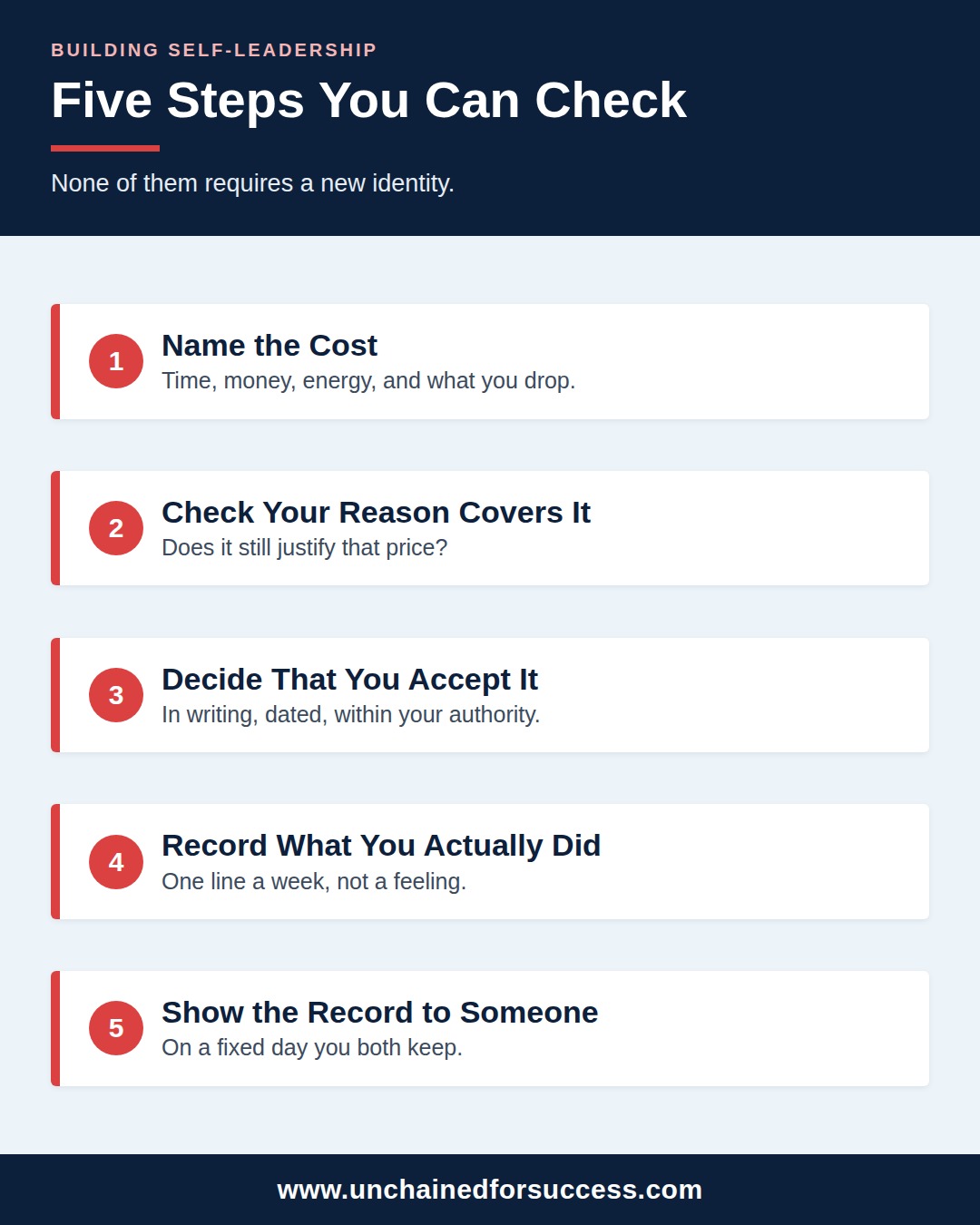
The recording in step four and the reporting in step five are the parts with evidence behind them. The fortnightly interval is mine. No study has tested it against a weekly or monthly one. Steps one to three are what the framework adds, and step three is the one that turns a justified goal into an accepted one.
Start with step four if you only do one. It costs a minute a week, and it is the thing the rest of your building self-leadership work hangs on.
If the first attempt breaks down, handling the setback without losing direction matters more than restarting with more enthusiasm.
Frequently Asked Questions
Do I need an accountability partner? The arrangement the evidence supports most directly is a record and somebody who reads it, which is narrower and easier to set up than a partnership. My own reading is that ten minutes with a colleague who asks what the record says does more than a friend who asks how it is going, though no study has compared the two. If a partner is how the reporting actually happens, that is the arrangement working.
Is building self-leadership just discipline? No, and the distinction is the useful part. Discipline answers how to do the work and leaves untouched the question of what should be done, which is where building self-leadership starts.
What if I lead myself well and still miss the goal? Then work up in order rather than reaching for a verdict. Start with three questions: was the behaviour happening as recorded, was it the right behaviour, and was the measure the right one.
If all three hold, your building self-leadership work is not the problem, so go up a level. The plan, your assumptions about what is possible, whether you still accept the cost, and whether your reason still covers it. Then, last of all, ask whether the result was ever yours to deliver. Taking responsibility means checking that order rather than blaming your character.
Share one goal whose real cost you have never written down, in the comments.
If you want an outside view of how your goals are designed, executed and governed, the Goals Readiness Score scores each of the nine components separately and names the weakest one.
What would your record of last month show, as opposed to your memory of it?
Sources on Building Self-Leadership
- Harkin, B., Webb, T. L., Chang, B. P. I., Prestwich, A., Conner, M., Kellar, I., Benn, Y., and Sheeran, P. (2016). Does monitoring goal progress promote goal attainment? A meta-analysis of the experimental evidence. Psychological Bulletin, 142(2), 198 to 229. https://doi.org/10.1037/bul0000025
- Matthews, G. (2007). The impact of commitment, accountability, and written goals on goal achievement. Podium presentation, 87th Convention of the Western Psychological Association, Vancouver. https://www.dominican.edu/sites/default/files/2020-02/gailmatthews-harvard-goals-researchsummary.pdf An unpublished conference presentation rather than a peer-reviewed paper. The percentages widely attributed to it come from a university press release, not the study, which reports mean scores only.
- Gollwitzer, P. M., Sheeran, P., Michalski, V., and Seifert, A. E. (2009). When intentions go public: does social reality widen the intention-behavior gap? Psychological Science, 20(5), 612 to 618. https://doi.org/10.1111/j.1467-9280.2009.02336.x
- Manz, C. C. (1983). The Art of Self-Leadership: Strategies for Personal Effectiveness in Your Life and Work. Prentice-Hall.
- Manz, C. C. (1986). Self-leadership: toward an expanded theory of self-influence processes in organizations. Academy of Management Review, 11(3), 585 to 600. https://doi.org/10.5465/amr.1986.4306232
- Knotts, K., Houghton, J. D., Pearce, C. L., Chen, H., Stewart, G. L., and Manz, C. C. (2022). Leading from the inside out: a meta-analysis of how, when, and why self-leadership affects individual outcomes. European Journal of Work and Organizational Psychology, 31(2), 273 to 291. https://doi.org/10.1080/1359432X.2021.1953988
- Carden, J., Jones, R. J., and Passmore, J. (2022). Defining self-awareness in the context of adult development: a systematic literature review. Journal of Management Education, 46(1), 140 to 177. https://doi.org/10.1177/1052562921990065
- Lacerenza, C. N., Reyes, D. L., Marlow, S. L., Joseph, D. L., and Salas, E. (2017). Leadership training design, delivery, and implementation: a meta-analysis. Journal of Applied Psychology, 102(12), 1686 to 1718. https://doi.org/10.1037/apl0000241
- Newland, S. (2018). The power of accountability. The Standard, Association for Financial Counseling and Planning Education, 3rd quarter 2018. https://www.afcpe.org/news-and-publications/the-standard/2018-3/the-power-of-accountability/ Listed as the traceable step behind the 95 per cent claim, not as evidence for it. It cites only a blog post of 8 January 2015 at uponly.co, where the trail ends.
Continue Your Journey
Explore more resources from the Unchained Goals Framework: