

Take an illustrative case. A package manager on a hospital build needs design queries answered in five working days. The design team does not report to her, is answering in twelve, and has heard the complaint before. She has no authority to make them faster. That is the hardest case when you influence your team: people who owe you nothing.
The answer time was never hers to control. What she could control was three things: the evidence she put in front of the design lead, the query format she changed and the promises she kept. Six months later they are answering in four, and the five-day standard is in their own weekly report, which she did not write. That is what it means to influence your team and organisation for lasting success: the change outlives the pressure that started it.
This article sets out how she did it and what the research on influence and trust says. It also explains why influence tends to fade once the person applying it looks away.
Influence that lasts is other people owning the standard. Until then, you are still the one carrying it.
Why Influence Your Team Rather Than Instruct It
Authority alone may secure compliance without lasting commitment. That is the first reason to influence your team rather than instruct it. On a programme, much of the work that decides your result is done by people who do not report to you. Designers, contractors, the client's own staff, the planning authority.
The method is the same for your own team. The difference is that authority lets you skip it, and in my experience the standard then lasts about as long as your attention. Gallup's 2026 report put worldwide employee engagement at 20 per cent for 2025. Whatever the figure measures, it is a reminder of one thing. Having people on the payroll is not the same as having their commitment to your standard.
So the question is not whether you can make people do something. It is whether you can influence your team to adopt a standard as their own. Then it holds when you are not in the room. Researchers have studied which tactics went with a request being acted on, which is where lasting adoption starts.
What the Research Says About How to Influence Your Team
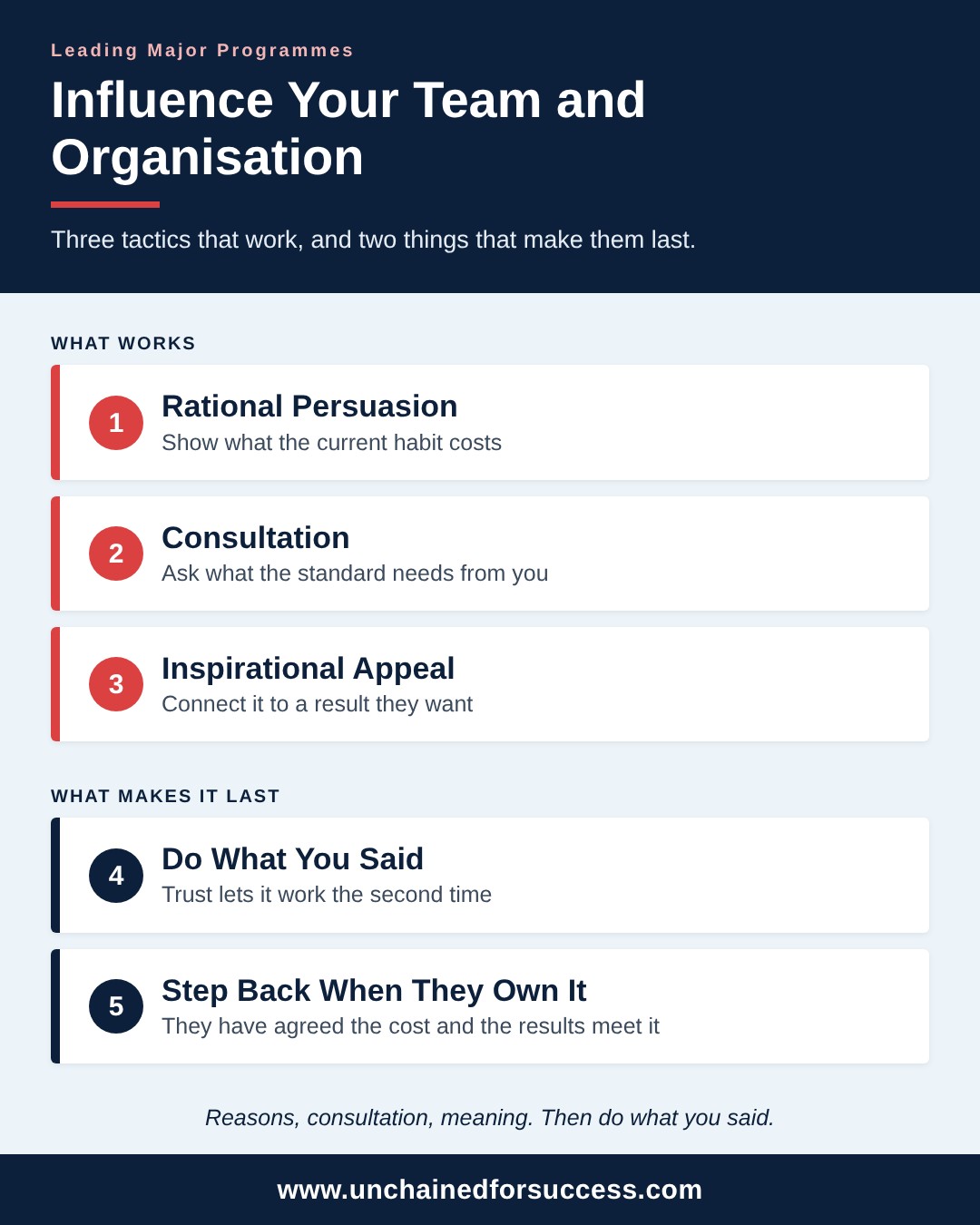
Yukl and Tracey (1992) studied 128 managers in five large companies. They asked 526 subordinates, 543 peers and 128 bosses how those managers tried to influence them. They also asked how well it worked. Three tactics came out on top. Rational persuasion: giving evidence and reasons. Consultation: asking the other person to help shape the plan. Inspirational appeal: connecting the request to something the other person values.
The least effective were pressure, bringing in allies to lean on someone, and appeals to rules or position. The ratings came from one point in time, so the study shows association rather than cause, and the managers worked in US corporations. Peers and bosses were among the targets, so the study did cover influence across reporting lines.
It matches what I have seen on programmes. The package manager used all three of the effective tactics and none of the ineffective ones.
These are three approaches to consider when you influence your team; the package manager combined them. Rational persuasion: she showed the design lead a one-page record of what twelve-day queries had cost on site in the previous quarter. Days lost, and rework.
Consultation: she asked what a five-day standard would need from her side, and changed her query format to match. Inspirational appeal: she connected the standard to what the design team valued in their own work. A design the site could build without rework, in a hospital that opened safely and on time.
Trust Is What Lets You Influence Your Team Twice
A tactic works for one request. Trust is what lets you influence your team the second time without starting from nothing. Dirks and Ferrin (2002) pooled 106 studies and found trust in a leader associated with performance, citizenship, satisfaction and commitment. They singled out the person's direct leader as a particularly important referent.
Colquitt and colleagues (2007), across 132 samples, tested three qualities of the person being trusted: ability, benevolence and integrity. Each goes closely with trust. Good at the job, acting in the other person's interest, and keeping to principles they accept. Doing what you said is the visible part of the third.
Dirks and Ferrin's review describes what goes with trust rather than what produces it, and it is about trust in a leader. The package manager led nobody on the design team, so applying it to her case is my reading, not the study's finding.
On that reading the design team trusted her for three reasons. Her query record was accurate. She changed her own process first. And when she said she would take the design team's resourcing case to the programme board on their behalf, she did.
Integrity is the one I have seen break by accident. In my experience, promising a change to someone's workload and then not delivering it costs more influence than never promising at all.
Influence Your Team Until They Own the Standard
The five-day standard lasted because of what happened in month three. The design lead put it in his own weekly report, with his own reasons, and started chasing his team on it. He had also agreed what it would cost. Half a day of one designer's week held for queries, two smaller packages waiting a day longer, and his own name against the standard if it slipped.
By then the package manager was no longer the source of the standard; she had become one of the people who received it.
The Unchained Goals Framework has a name for that moment. Ownership is the conscious acceptance of the cost and consequences of pursuing a goal, within what you have the authority to govern. In the framework's terms, the five-day standard could last as a goal only of someone with authority over the design team's time, which here was the design lead.
What Moves People to Own It When You Influence Your Team
Influence that lasts is influence that ends in someone else's Ownership. Until it does, you are still the one carrying the cost, and in my experience the standard fades when you stop influencing your team.
Two things, in my experience, move people from compliance to Ownership. One is consultation done properly. It is where the cost of the standard is named by the person who will carry it, and where the decision sits with the person who has the authority to make it.
The other is a shared direction they can see their work serving, which is what makes that cost worth carrying. What the design lead cared about was a hospital that opened on time and ran as designed from the first day, without the site team carrying design rework into operation. His route to it was the five-day standard.
Shared direction of that kind is what the framework calls Vision, and a programme without one gives influence little to attach to.
Influence Your Organisation the Same Way
Scale changes the numbers, not the method you use to influence your team.
Take a programme director who wants early-warning notices raised at the first sign of a problem rather than at final account. She faces the same three tasks. Show the cost of the current habit with evidence. Ask the people who will live with the standard to help shape it. Connect it to a result they want.
The difference at organisational scale, in my experience, is that trust grows through fewer, more visible acts. One early-warning notice handled well, without blame, teaches an organisation more than a policy does. One handled badly undoes the policy. A director's integrity gets its test in public, which is why the first case under a new standard matters more than the standard itself.
Where you cannot influence your organisation, check the goal before the tactics. A standard people cannot meet with the resources they have is unlikely to be adopted, whatever the argument. The Goals Readiness Score is 18 questions, about ten minutes, and it points to the weakest part of your goal design.
Influence Your Team for Lasting Success: This Week
Pick one standard you need other people to hold, and one person whose adoption of it would matter most. I suggest starting there, one person at a time. The trust that lets you influence your team further is built on the first person.
1. Write down what the current habit costs, in units they recognise.
2. Ask what the standard needs from you, and change that first.
3. Connect the standard to a result they want, in their words.
4. Do what you said, visibly, and note it.
5. Set a date to look. Reduce the chasing once they have accepted the cost, the standard is in their reporting, and the results meet it consistently without quality or workload problems.
Normal oversight continues. Note what changed and what evidence supports continuing. If any of the three is missing, go back to step 2. Ask again what it needs from you. Check whether they can meet it with the people and time they have before you argue for it harder.
To influence your team and organisation for lasting success is to work yourself out of the loop. The standard that still holds when nobody is pushing is the one you built well.
Write down the one standard you need someone else to own, and the evidence you will show them first.
Whose adoption of one standard would change your programme most, and what do they care about?
Further Reading
Three related posts from this series: Why Ownership Changes Everything, Standards Define Outcomes: 5 Tests to Apply This Week and Building Legacy: How to Lead Beyond Your Role. The Framework Glossary explains Ownership, and the framework page sets out Vision.
Frequently Asked Questions
How do I influence my team when I have no authority over them?
The same way the package manager set out to influence the design team. Evidence of what the current habit costs. Consultation on what the standard needs from you. A connection to something they want. Then doing what you said. Authority was not the lever; much of the work that decides your result is done by people who do not report to you.
Why does my influence fade when I stop pushing?
Because the standard is still yours. It lasts when the other person has accepted the cost of it as their own. There are three signs that you have managed to influence your team. The other person has agreed what the standard costs, it appears in their reporting rather than in your reminders, and the results meet it. Consultation that surfaces the cost, and a shared direction that justifies it, are what move people there.
Can you influence your organisation without a senior role?
Yes. The package manager started with one standard and one person, and I would recommend the same start. Scale changes how visibly people test your integrity, not what it takes to influence your team.
Does Research Support How You Influence Your Team?
The sources below describe influence tactics and trust; none tests the five-step method here, which is the practical conclusion drawn from them.
Yukl and Tracey (1992) measured influence tactics, as rated by the subordinates, peers and bosses of 128 managers, against how well each tactic worked. They did not measure whether a standard adopted under influence held once the manager's attention moved on.
Dirks and Ferrin (2002) pooled 106 studies on trust in a leader and its relationship with performance, citizenship, satisfaction and commitment. Colquitt and colleagues (2007) pooled 132 samples on how ability, benevolence and integrity relate to trust. Colquitt's review covers trust in leaders and in co-workers. Neither tested an intervention of this kind across teams, or whether its effect lasted, which is the package manager's case. Gallup's figure is a survey estimate of engagement, not a study of influence.
Sources
• Yukl, G. and Tracey, J. B. (1992). "Consequences of influence tactics used with subordinates, peers, and the boss." Journal of Applied Psychology, 77(4), 525-535. Available at: https://doi.org/10.1037/0021-9010.77.4.525.
• Dirks, K. T. and Ferrin, D. L. (2002). "Trust in leadership: meta-analytic findings and implications for research and practice." Journal of Applied Psychology, 87(4), 611-628. Available at: https://doi.org/10.1037/0021-9010.87.4.611.
• Colquitt, J. A., Scott, B. A. and LePine, J. A. (2007). "Trust, trustworthiness, and trust propensity: a meta-analytic test of their unique relationships with risk taking and job performance." Journal of Applied Psychology, 92(4), 909-927. Available at: https://doi.org/10.1037/0021-9010.92.4.909.
- Gallup (2026). State of the Global Workplace: 2026 Report. Available at: https://www.gallup.com/workplace/697904/state-of-the-global-workplace-global-data.aspx
Continue Your Journey
Explore more resources from the Unchained Goals Framework: