Motivation is the wrong place to start when you set out to build habits. A habit that depends on how you feel is not yet a habit, because feelings are exactly the thing that changes on the day you need it most.
This post covers what a habit is in the Unchained Goals Framework, five steps to build habits from a behaviour you have already defined, what the research does and does not show, and how to keep a habit alive when your routine changes.
What It Really Means to Build Habits
A habit is a behaviour that has become easier to start through repetition in the same setting. Wendy Wood and Dennis Rünger's review of the research describes habits as "context-response associations in procedural memory". In plain terms, the setting starts to do some of the deciding for you.
That is the whole benefit. You do not gain enthusiasm. You spend less of your attention on whether to begin.
So the goal is not a behaviour you love. It is a behaviour you can start without a debate, on an ordinary Tuesday, when nothing about the day is helping. That is what it means to build habits rather than run on willpower.
Why Discipline Does Not Build Habits on Its Own
Discipline pays a fresh price every time. You notice the behaviour is due, weigh it against everything else, and choose it anyway. That works, and it is expensive.
Design lowers the price. A fixed cue, a protected slot and a version small enough to do badly all cut the size of the daily decision. The discipline you have then goes further, because less of it is spent at the start line.
Discipline without design has to keep paying the full decision cost. Design reduces that cost and makes consistency more likely. Without discipline, no design ever gets started, so both matter. Design is simply where to begin. Together they build habits that hold.
Where Habits Sit in the Unchained Goals Framework
In the Unchained Goals Framework, Habits is the final stage of the Directional Execution Spine and the last layer designed before the Control System is installed to govern the full architecture.
What that means in practice is simple enough. A dated result needs a standard to hold along the way; the standard needs a behaviour you schedule; and repeating that behaviour in a stable setting makes it easier to begin. The framework calls the last step Habit Conversion. It reduces how much deciding each occasion needs, rather than removing the decision.
One rule governs how you build habits here. Within the framework, every designed habit should trace back to a behaviour that serves a measurable standard and a dated result. A repeated behaviour without that link may still be a habit in ordinary language, but it is not a habit designed to serve the goal.
The framework overview and the glossary set out the rest of the architecture for anyone who wants it.
Five Steps to Build Habits From a Process Goal
These five steps build habits from a behaviour you have already defined. Settle all five before the first occurrence, not after the first week fails.
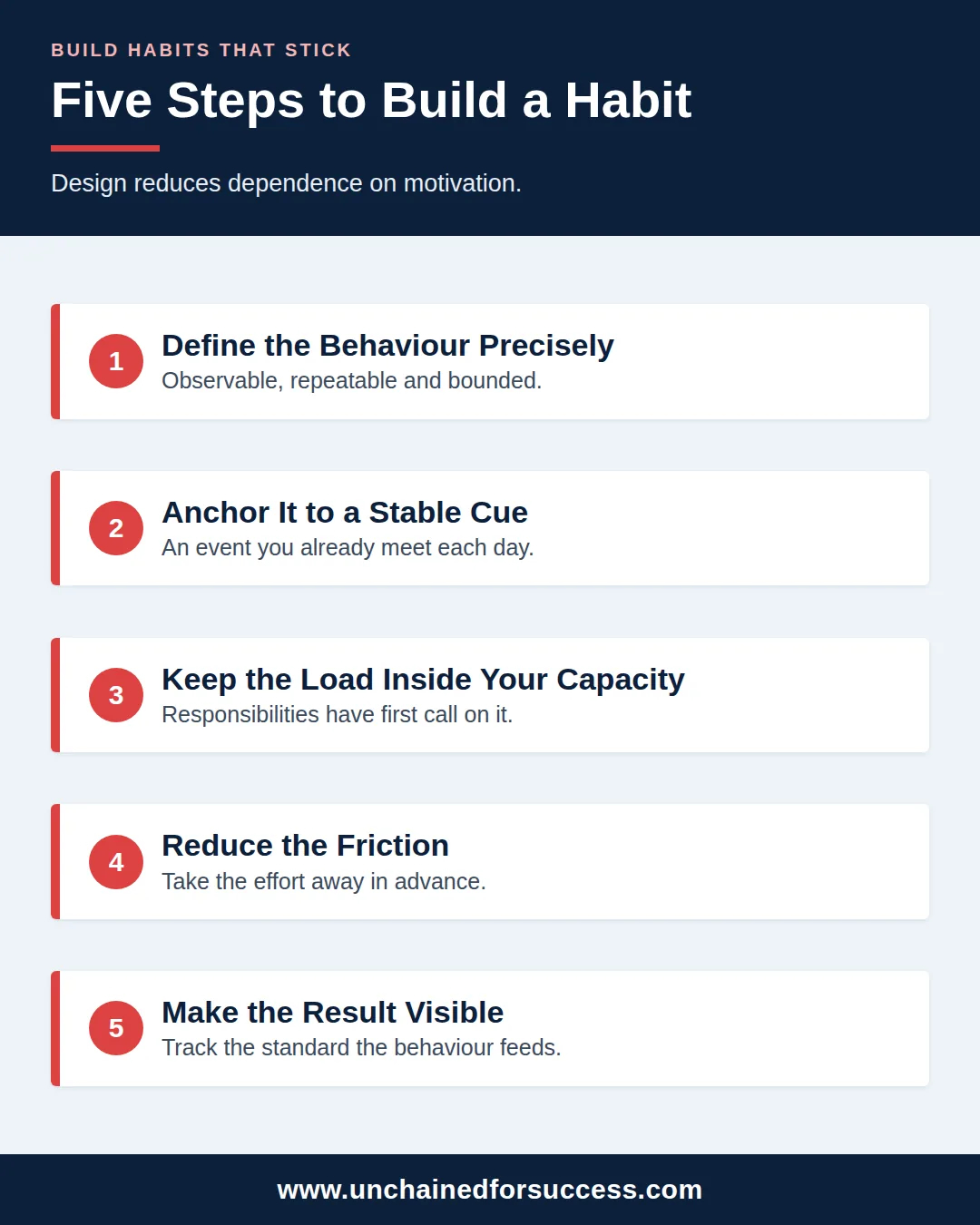
1. Define the behaviour precisely. Make it observable, repeatable and bounded. "Exercise more" cannot settle, because nobody can say whether it happened. "Ten minutes of movement on Monday, Wednesday and Friday before breakfast" can.
2. Anchor it to a stable cue. A cue can be a time, a place, an event that already happens, or a condition such as receiving a report. An event you already do reliably makes a better anchor than a time you hope to protect.
3. Keep the load inside your capacity. A behaviour that costs more than you can afford breaks, and early enthusiasm hides that. Capacity is not whatever is left once the goal has taken its share. Family care, paid duties, essential administration and rest have first call on it. Cut it until repetition steadies, and grow it only once continuity is established.
4. Reduce the friction. Name what makes it effortful and take that away in advance. Kit in the car. Draft already open. A recurring calendar hold nobody can book over.
5. Make the result visible. Repetition with no visible link to progress gets harder to sustain. Track the standard the behaviour feeds, so you can see that it is doing something. Where the behaviour also fits the person you are becoming, it meets less resistance.
How Long It Takes to Build Habits
Two points matter to anyone trying to build habits, and the caveats matter as much as the numbers.
How long it takes varies enormously. Phillippa Lally and colleagues tracked 96 volunteers performing one simple daily behaviour. Among the 39 whose data fitted the model well, the time to near-automatic performance "ranged from 18 to 254 days". The widely quoted 66 days is the median for that subgroup, and the study ran 84 days, so the longer figures are projected rather than observed. The volunteers chose their own simple behaviour and reported it themselves.
Missing a day is not a reset. In the same study, missing one opportunity "did not materially affect the habit formation process".
What Research Suggests About Cues and Frequency
On cues, the practical advice is to choose one you already meet every day. Benjamin Gardner, Phillippa Lally and Jane Wardle's article for general practice puts it simply: "Be consistent: choose a time and place that you encounter every day of the week." They suggest expecting around ten weeks for a daily behaviour. It is a short practice commentary rather than new research, and its timing figure restates Lally.
Frequency may matter too. Navin Kaushal and Ryan Rhodes followed 111 new gym members over twelve weeks and report that "exercising for at least four bouts per week for 6 weeks was the minimum requirement to establish an exercise habit". That threshold came out of one self-selected group after the fact, with self-reported measures and no control group, so treat it as a signal rather than a prescription.
On "habit stacking", a popular name for attaching a new behaviour to an existing routine: the label is not itself a separate mechanism, and we found no research testing it under that name.
What it describes has been tested directly. Keller and colleagues ran a randomised trial comparing routine-based cues with time-based cues, which is the closest direct test. The framework reaches the same place by a different route, asking you to attach new behaviours to existing stable rhythms. That is the cheapest way to build habits that survive an ordinary week.
Seven Reasons Habits Break
Habits break for structural reasons. Weakness does not tell you which part of the design gave way. Knowing the reasons helps you build habits that hold.
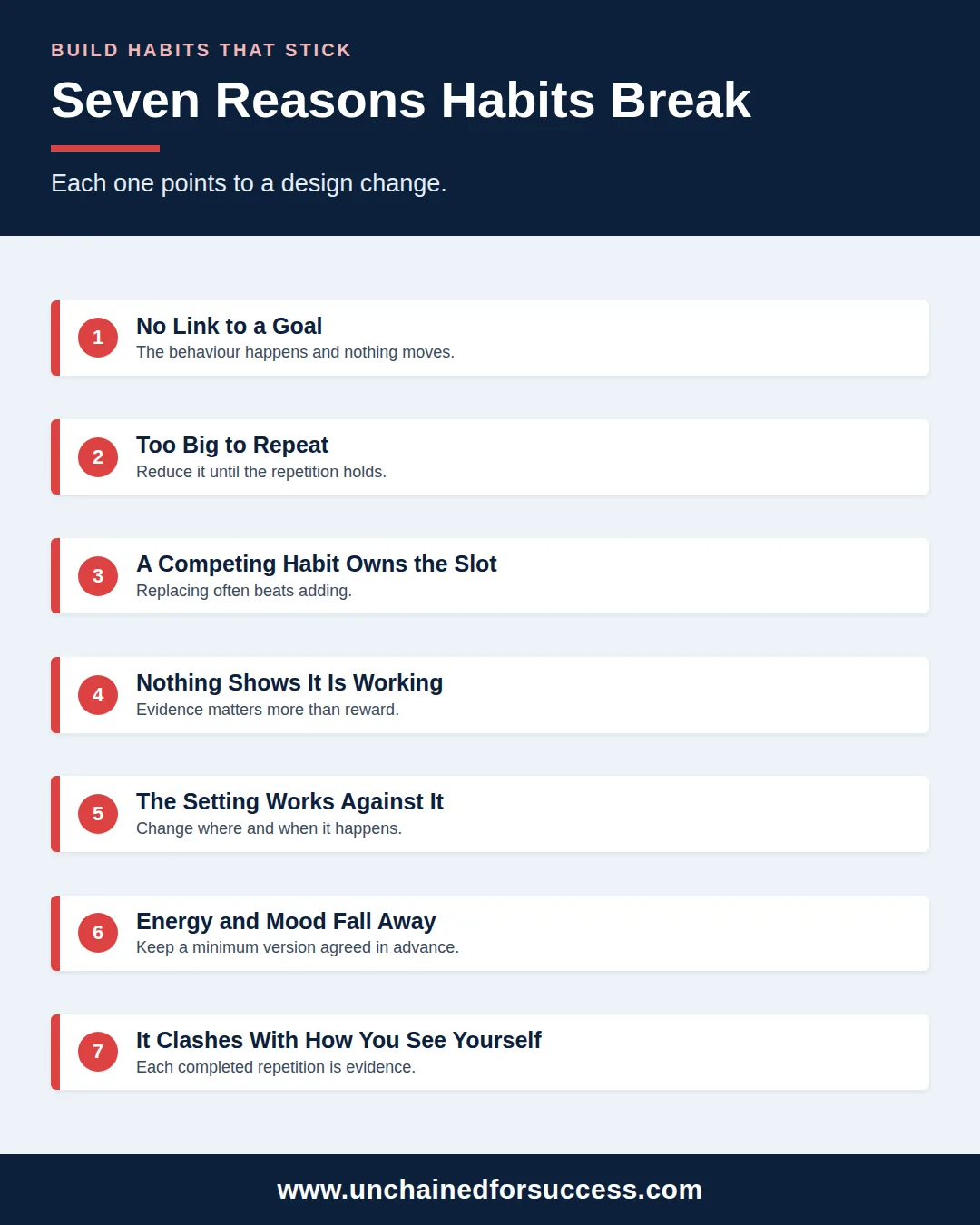
No link to a goal. The behaviour happens and nothing moves. Trace it to a standard or drop it.
Too big to repeat. The unit exceeds what you can sustain. Reduce it until it holds, then scale.
A competing habit already owns the slot. An established pattern carries years of reinforcement. Raise its friction and lower the friction on the new one. The framework's reading is that replacing the old behaviour often works better than adding a new one beside it.
Nothing shows it is working. Reinforcement does not need a dramatic reward. It needs evidence that the behaviour moves something you can see.
The setting works against it. Focused work in an interrupt-heavy room is a design fault. Change where and when, before changing how hard you try.
Emotional variability overrides the design. Stress, fatigue, competing demands and disappointment all cut the energy available, and discretionary behaviours go first. The answer is the minimum version below, agreed before the pressure arrives.
It clashes with how you see yourself. A behaviour that contradicts your own picture of yourself meets quiet resistance. Repetition can shift that picture, because each completed occasion is evidence.
That last point runs both ways in the framework. Habit does not replace what you believe about yourself. It influences it indirectly, through the evidence that repeated behaviour produces.
The Minimum Version That Keeps a Habit Alive
A minimum version is the smallest form of the behaviour that keeps the pattern intact. It is not the target. It is the floor.
Sixty minutes of training becomes fifteen. A full weekly review becomes a twenty-minute checkpoint. A writing session becomes one paragraph.
Agree it in advance, while the week is calm. Under pressure there are two common responses: abandoning the behaviour, or pushing the full version and burning capacity you do not have. The framework's reading is that both weaken the pattern, and a reduced version can hold it.
Be honest about what it holds. The minimum version protects continuity, not the full standard. If you are running on it week after week, that is a signal to reopen the plan rather than a quiet way to accept a shortfall.
Re-establishing a pattern that has stopped can demand more conscious effort than keeping a smaller one going. Protecting the floor is how you build habits that last past a difficult month.
Build Habits in Practice
The people and teams below are illustrations, not clients. Each shows how to build habits around a real week rather than an ideal one.
Someone Studying Alongside Work and Caring
Aisha is working through a language course alongside a full-time job. She spends two evenings a week with her mother, and she is away two weeks in four. Her goal is to finish all thirty course units and record ten practice conversations by 14 May. The standard that gets her there is three units finished and one conversation recorded every fortnight, both of which she can count herself.
Her old routine needed her desk, her notes and a quiet hour, so travel ended it every time. The rebuilt behaviour anchors to something that happens wherever she is: twenty minutes of practice on a phone app, after the first coffee of the day, before she opens email. Her minimum version is one exercise. The cue moved from a place to an event, which is why it now survives the hotel week and the evenings at her mother's.
A Partner Who Stopped Writing Proposals
A consultancy partner agreed to write proposals every Friday afternoon. Client deadlines land on Fridays, so the slot lost every week.
Moving it to Tuesday and Thursday at 09:00, before the day fills, gave the behaviour two protected slots. Keeping a template open in advance removed the friction. The firm's goal is eighteen proposals issued to qualified opportunities by 31 March, which is a count the partners control. The standard it feeds, six proposals issued a month, sits on the dashboard where the partners can see it, so the behaviour has visible evidence behind it.
A Project Team and Its Risk Review
A delivery team is working to close its design stage by 31 October. The standard it holds is that every high-rated risk has a named owner and a dated next action reviewed within the last fortnight, which the team can check itself.
Its weekly risk review had drifted from 60 minutes to a hurried 15.
Rather than insisting on the hour, the team defined the minimum version: a 20-minute session with a pre-read owned by the risk lead. Under pressure it runs short. It does not disappear, and the action log is updated either way.
How to Build Habits That Survive a Change of Routine
Habits are often strongly tied to their setting, which is why a house move, a new job, a new shift pattern or a baby can end several at once.
Wendy Wood, Leona Tam and Melissa Guerrero Witt followed 115 students moving to a new university. Strong exercise habits held where people kept exercising in the same place, and did not hold where the place changed. The authors describe their design as essentially correlational, so read it as a pattern.
So when life changes, review the cue rather than the behaviour. That is how people build habits that survive a move. Ask what now happens reliably every day in the new arrangement, and attach the behaviour there. Then run the minimum version at the start, so the pattern re-establishes before you ask more of it.
Frequently Asked Questions About How to Build Habits
How long does it really take? It varies, and Gardner and colleagues trace the popular three-week figure to anecdote rather than research. In the study above, the time to near-automatic performance ranged from 18 to 254 days among the 39 volunteers whose data fitted the model, so judge by whether starting is getting easier rather than by a date.
Does habit stacking work? Attaching a new behaviour to an existing routine is sound, and it is what the framework asks for. We found no research testing the popular name itself, so use the idea and ignore the branding.
I broke a habit I had for months. Do I start from zero? No, although rebuilding the rhythm can cost more than protecting it would have. The cue and the pattern are still familiar. Return at the minimum version, at the same cue, and judge it by whether starting is getting easier.
Build Habits One at a Time
You can build habits that hold, and the work is design rather than determination. Define the behaviour, anchor it to something that already happens, keep it affordable, remove the friction, and let the result show.
Choose one behaviour this week. Write those five lines for it. Then set the minimum version now, while the week is calm, because that is the version that will carry it through the week that is not.
For the full method, read the Unchained Goals Framework overview, and the glossary explains the individual terms. The Goals Readiness Score is a short self-assessment if you want one: 18 questions, under five minutes. Why Consistency Fails covers what to check when a behaviour keeps breaking, Why Habits Matter More Than Motivation covers what to rely on instead of mood, and How to Rebuild Self-Trust covers the ground where repeated follow-through matters most.
Which habit would you rebuild first, and what cue would you attach it to? Share it in the comments.
Sources
• Psychology of Habit by Wendy Wood and Dennis Rünger, Annual Review of Psychology, 67, 289 to 314, 2016
• How Are Habits Formed: Modelling Habit Formation in the Real World by Phillippa Lally, Cornelia H. M. van Jaarsveld, Henry W. W. Potts and Jane Wardle, European Journal of Social Psychology, 40(6), 998 to 1009, 2010
• Making Health Habitual: The Psychology of Habit Formation and General Practice by Benjamin Gardner, Phillippa Lally and Jane Wardle, British Journal of General Practice, 62(605), 664 to 666, 2012
• Exercise Habit Formation in New Gym Members: A Longitudinal Study by Navin Kaushal and Ryan E. Rhodes, Journal of Behavioral Medicine, 38(4), 652 to 663, 2015
• Habit Formation Following Routine-Based Versus Time-Based Cue Planning: A Randomized Controlled Trial by J. Keller, Dominika Kwasnicka, Patrick Klaiber, Lukas Sichert, Phillippa Lally and Lena Fleig, British Journal of Health Psychology, 26, 807 to 824, 2021
• Changing Circumstances, Disrupting Habits by Wendy Wood, Leona Tam and Melissa Guerrero Witt, Journal of Personality and Social Psychology, 88(6), 918 to 933, 2005
Continue Your Journey
Explore more resources from the Unchained Goals Framework: