June arrives, and the midpoint of the year is in sight. The targets you set in January now feel distant, and progress looks uneven. This is the moment to review your goals mid-year, before drift quietly becomes the story of your year. A mid-year goal review is not a guilt trip about what slipped. It is a course correction, a deliberate reset of the plan so the second half delivers what the first half promised.
It is easy to skip this step. Skip it, and the choice narrows to pushing harder on a stale target or quietly abandoning it. Both responses cost momentum.
There is a better path. When you review your goals through a clear structure, you stop guessing and start steering. This article gives you that structure: a mid-year goal review run through the nine components of the Unchained Goals Framework, so you can review your goals, reset your plan, and turn the second half of the year into deliberate progress.
Why You Should Review Your Goals Mid-Year
The mid-year point is not arbitrary. A correction made now has six months to compound before December. Wait until autumn, and the runway shortens. Choose to review your goals now, while small adjustments still change the outcome.
The evidence supports the practice of looking. Harkin and colleagues pooled 138 studies with nearly 20,000 participants and reported the results in Psychological Bulletin. Prompting people to monitor their progress towards a goal promoted attainment, and the effect was larger when the progress was physically recorded or reported to someone else. In other words, checking progress moves the needle.
Reviewing also protects motivation. Amabile and Kramer analysed nearly 12,000 diary entries from 238 people in 26 project teams at seven companies and reported, in the Harvard Business Review, that of all the things that lift emotions and motivation during a working day, the most important is making progress in meaningful work.
That is a pattern in working diaries rather than a controlled trial, but it is a large one. A review surfaces that progress. Therefore, it does double duty. It corrects the plan, and it refuels the will to continue.
There is a quieter benefit too. When you review your goals, you replace anxiety with clarity. Vague worry about falling behind becomes a specific, fixable list. That shift alone changes how the next six months feel.
What It Really Means to Review Your Goals
To review your goals properly, go deeper than checking whether they are on track. Tracking outcomes tells you where you are. It does not tell you why, or what to change. For that, you must examine the system beneath the goal.
This is the difference between outcome and process. The Outcome Goal states the destination. The Performance Goal sets the operating standard that shows you are on track. Beneath it, Process Goals name the controllable actions that produce that standard. A useful review examines both, because the numbers show where you are, not which part of the system beneath them has weakened.
Reviewing your goals does not mean lowering your ambition. It means protecting that ambition from drift, distraction and poor structure. A strong review does not ask whether you should want less. It asks what must change so the goal can still move.
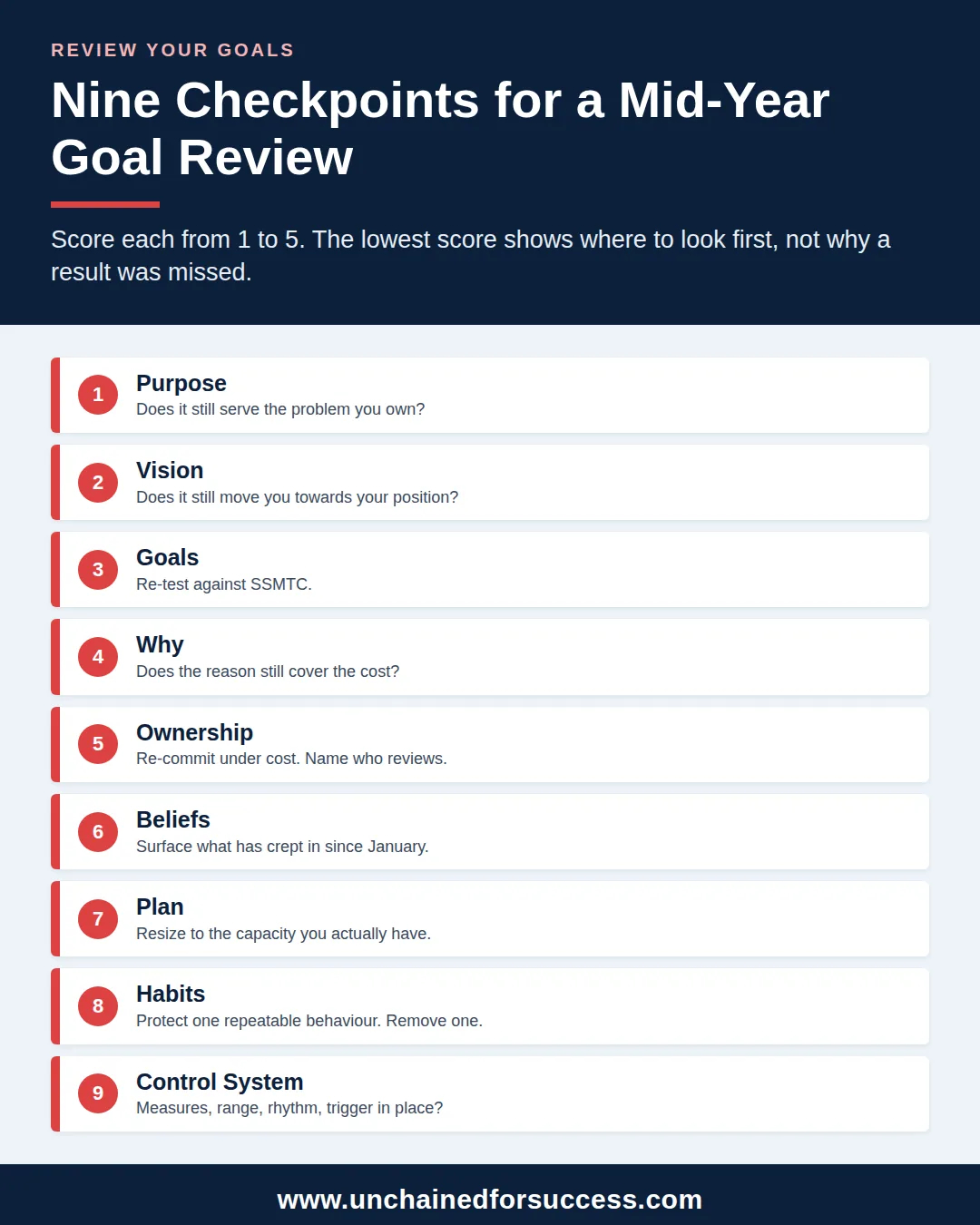
The Unchained Goals Framework gives you a structured way to answer, and it calls the exercise an Architectural Audit. Score each component from 1, absent or unexamined, to 5, fully designed and stable. The lowest score identifies a candidate for design attention; it does not establish the cause of a missed result.
Where Performance has already fallen below its agreed range and meets the predefined trigger, diagnose in the framework's fixed order first, starting with whether the agreed actions happened, then use the audit to strengthen the design. A result above the range needs validation, not diagnosis.
How to Review Your Goals With the Unchained Goals Framework
Work through the nine components in the order they were designed, because each one feeds the next. Each is a checkpoint, not a chore. Together they turn a vague sense of "must do better" into a precise plan.
The Foundation: Purpose and Vision Before You Review Your Goals
1. Purpose, the filter to apply first. Before you judge any goal, return to Purpose, the problem or domain you have accepted responsibility for. It is the prior filter, the test every goal must pass before the others matter.
Ask two questions. Is the problem I have accepted responsibility for clear enough to rule unsuitable goals out? And does this goal still serve that problem? If it does not, no amount of better planning will rescue it. Cut it, and redirect that energy.
2. Vision, the position you committed to. Vision is the long-term position you have committed to holding within that Purpose. Confirm that it is still a committed position, one that rules some attractive options out, then ask whether each surviving goal still moves you towards it. A goal can be well built and still point somewhere you no longer intend to go. The post on refining your vision shows how to sharpen it without changing direction.
Review Your Goals Against SSMTC
3. Goals, re-tested against the structure. Next, re-test each surviving goal against SSMTC: Stretched, Specific, Measurable, Time-bound and Under your control. A goal that felt right in January may now be too vague, or it may rest on factors you cannot govern. Tighten it. Check that each Outcome Goal still has a Performance standard and a Process Goal beneath it. Remember that a stretch goal still has to stay within your control to remain a goal at all.
When You Review Your Goals, Check Why, Ownership, Beliefs and Plan
4. Why, the reason that covers the cost. A goal needs a Why strong enough to carry it through the hard middle: a reason that justifies the goal's cost. If your Why no longer covers the cost, reconnect with it or retire the goal. A Why borrowed from general inspiration will not hold.
5. Ownership, re-committed under cost. Ownership is the conscious acceptance of the goal's cost and of the consequences of pursuing it within your authority. Name the full cost again, knowing what you know now, and accept it out loud to someone who will remember. Then name who reviews, because accountability drives success when willpower fades. You stay accountable for the result; the reviewer checks the evidence.
6. Beliefs, surfaced and tested. Ask which beliefs have crept in since January. "I am too busy" and "this is not working" might be accurate. Test these statements against the evidence. Correct a real capacity or process problem; challenge an assumption when the evidence does not support it, and rebuild the belief system that the second half will rely on.
7. Plan, resized to current capacity. The Plan must give a credible path within the capacity you can sustain, after allowing for every other goal and commitment drawing on the same time.
If the first half overran your capacity, shrink the next stage. If your capacity has genuinely grown and held for more than one cycle, the Plan can carry more. A goal becomes risky when ambition grows faster than the capacity to deliver it, the principle set out in growing faster without losing control.
Habits: Review Your Goals at the Cadence They Require
8. Habits, the repeatable engine. Habit Conversion turns the behaviours in your Process Goals into routines that need less deciding each time. Identify the single repeatable behaviour, at the cadence the goal requires, that drives your most important goal, and protect it. Then remove one routine that drains energy without return.
Under Governance: Review Your Goals Against the Control System
9. Control System, with measures, range, rhythm and trigger in place. Finally, ask whether the Control System is actually running: are the Performance measures defined, is there an agreed range, is there a review rhythm, and is there a pre-agreed trigger that opens a proper diagnosis when Performance falls below that range and meets the trigger? A goal with no working Control System drifts without anyone noticing, and drift that nobody measures cannot trigger a response.
Review Your Goals in Practice: Three Examples
The framework adapts to any scale. Here is what it looks like to review your goals across three settings. The people in them are illustrations, not clients.
An Individual Who Resized the Plan
Maria set out to publish a book this year, and by June she has drafted two chapters. Her review shows the Purpose and Vision still hold, but her Plan ignored her capacity. So she resizes the Outcome Goal to a finished first draft by 31 December, sets a Performance standard of one chapter drafted every three weeks, protects a 6 am writing routine, and asks a friend to check the chapter count each week.
A Business That Rebuilt the Goal Inside Its Control
A founder targeted forty new clients and has signed twelve. The review reveals a Control Boundary problem, because the goal depended on referrals he could not govern. Forty new clients stays as the commercial result he wants, but it cannot be the goal he governs.
His Outcome Goal is a documented enquiry and onboarding process in use by 31 December. The Performance standard is that every new enquiry is logged and receives a response within two working days. Beneath that, his Process Goal is to review the enquiry queue each working day and complete the required responses and handovers.
That system does not guarantee forty clients. It does guarantee that every enquiry is handled well, which is the part of the result within his authority. He accepts again, knowing what he knows now, the cost of running it.
A Project That Found a Planning Gap, Not a Motivation Gap
A team aimed to launch a platform in the third quarter, yet scope crept and the date slipped. Their review exposes a planning gap, not a motivation gap. They cut two features, protect the core, and reset a credible date the whole team believes in.
How to Review Your Goals This Week
To review your goals well, you do not need a retreat. You need ninety focused minutes. List every active goal, personal and professional, in one place. Score each against the nine checkpoints above, in order, from 1 to 5. Note the lowest score, because that is the candidate for design attention, not proof of what caused a miss. Then write one decision per goal: keep, reshape or retire.
Then choose the single most important goal for the second half. Define one repeatable behaviour that drives it, at the cadence the goal requires, and one routine to remove. Book a recurring check-in, because what gets reviewed reliably gets done.
Record the results where you will see them daily. Progress that is written down and reported to someone is where Harkin's team found the effect strongest. Gollwitzer's work on implementation intentions, in American Psychologist, suggests that if-then plans improve follow-through by linking a chosen response to a specific situation: "when it is 6 am, I open the manuscript".
Common Mistakes When You Review Your Goals
Reviewing outcomes only. Numbers show the symptom, not the cause, so examine the system beneath them.
Adding more instead of choosing. A reset that piles on new goals repeats the original mistake. Subtract first.
Skipping Purpose and Vision. Optimising a goal that no longer matters is wasted effort, however efficient.
Confusing a busy first half with a productive one. Motion is not progress, so be honest about results. A related post explains why being busy does not mean progress.
Treating the review as a one-off. A single audit fades. Schedule the next check-in before you close this one.
Review Your Goals: Frequently Asked Questions
How long should a mid-year goal review take? Ninety focused minutes for a personal set of goals; half a day for a team. The nine checkpoints are quick once the goals are listed in one place. What takes time is the honesty, not the method.
What if I have never set a Performance measure or a trigger? Set them now, as part of checkpoint nine. Write down what you expected by this point and what actually happened, decide whether the gap is a one-off or a pattern, and agree the range and trigger you will use for the next review. The post on handling setbacks shows what a missing measurement layer cost one programme, and how it was rebuilt.
Should I review every goal, or just the ones that slipped? Every goal. A goal that looks fine can be failing quietly at the Plan or Ownership layer, and a goal that slipped may only need one layer corrected. The audit is cheap; the drift it catches is not.
Review Your Goals, Then Steer
Half the year remains, and that is enough. When you review your goals mid-year, you trade quiet drift for deliberate direction. You keep what still serves your Purpose, reshape what has slipped, and release what no longer fits. That is course correction, and it is how strong years are built in the second half, not only the first.
Book ninety minutes this week, list every goal, and run the nine checkpoints. The SSMTC Goal Design Canvas and the Control System Dashboard in the Resource Library give you the sheets to do it on. If you want an outside view of how your goals are designed, executed and governed, the Goals Readiness Score is an optional next step: 18 questions, under five minutes.
Share the one decision your review produced (keep, reshape or retire) in the comments.
How you started does not decide the year. Whether you are willing to steer does. Which goal will you review first?
Sources
• Does Monitoring Goal Progress Promote Goal Attainment? A Meta-Analysis of the Experimental Evidence by Harkin, Webb, Chang, Prestwich, Conner, Kellar, Benn and Sheeran, Psychological Bulletin, 142(2), 198 to 229, 2016. Accepted version at White Rose Research Online
• The Power of Small Wins by Teresa M. Amabile and Steven J. Kramer, Harvard Business Review, May 2011
• Implementation Intentions: Strong Effects of Simple Plans by Peter M. Gollwitzer, American Psychologist, 54(7), 493 to 503, 1999. Full text at the University of Konstanz repository
Continue Your Journey
Explore more resources from the Unchained Goals Framework: