

When growth stalls, an easy first instinct is to blame the goal. So you reset the target, push harder, and wait for momentum to return. Yet the goal may be fine. The problem can be quieter and harder to see. You may have outgrown your capacity, and the systems, routines and energy that once carried you can no longer carry what you are now trying to do.
This article gives you seven warning signs to watch for, so you can tell when you have outgrown your capacity before the limit breaks something. By the end, you will know whether you need a different goal or a rebuilt capacity, and which part of your approach to repair first.
Why It Matters When You Have Outgrown Your Capacity
Growth does not have to collapse in a single dramatic moment. It can erode. Effort keeps rising while results quietly flatten. The instinctive response is to work even harder. That instinct is understandable, but it can speed up the damage. When you have outgrown your capacity, more effort does not restore progress. It drains the reserves you have left.
Ron Carucci, a consultant writing in the Harvard Business Review, draws the distinction for companies. Growth means adding revenue at the same pace as you add resources. Scaling means adding revenue at a much greater rate than cost. Multiplying what worked, he argues, is not the same as building for sustainable growth, and one day the wave will crest.
The same trap catches individuals and teams. Capacity you multiply rather than build reaches a ceiling. Recognising early that you have outgrown your capacity changes the outcome. A limit you can name is a limit you can fix. A limit you ignore can become burnout, missed commitments and a slow loss of trust in your own ability to deliver.
Why Capacity Expires
It is tempting to think of capacity as a fixed trait. In practice it is a living system. It suits a particular stage and then expires when the demands change. You built the capacity that carried you through one level of ambition for that level. Once the demand increases, the same structure can shift from engine to constraint.
Capacity is also far more than time. It includes your skills, systems, energy, routines, decisions, delegation and recovery. When growth outpaces any one of these, the whole structure strains. You can have plenty of hours in the day and still be operating beyond what your routines, decisions or recovery can support.
The Unchained Goals Framework puts this distinction inside the Plan. A credible Plan rests on sustainable capacity, the pace you can hold without breaking down, rather than peak capacity, what you could reach for a short time under ideal conditions. Plans built around peak capacity look ambitious and cannot absorb pressure. That is the mechanism behind several of the signs below.
Last week we looked at how to grow faster without losing control. This week the question is more diagnostic. How do you know the capacity that once carried you is no longer enough? The seven signs are how you tell.
The 7 Signs You Have Outgrown Your Capacity
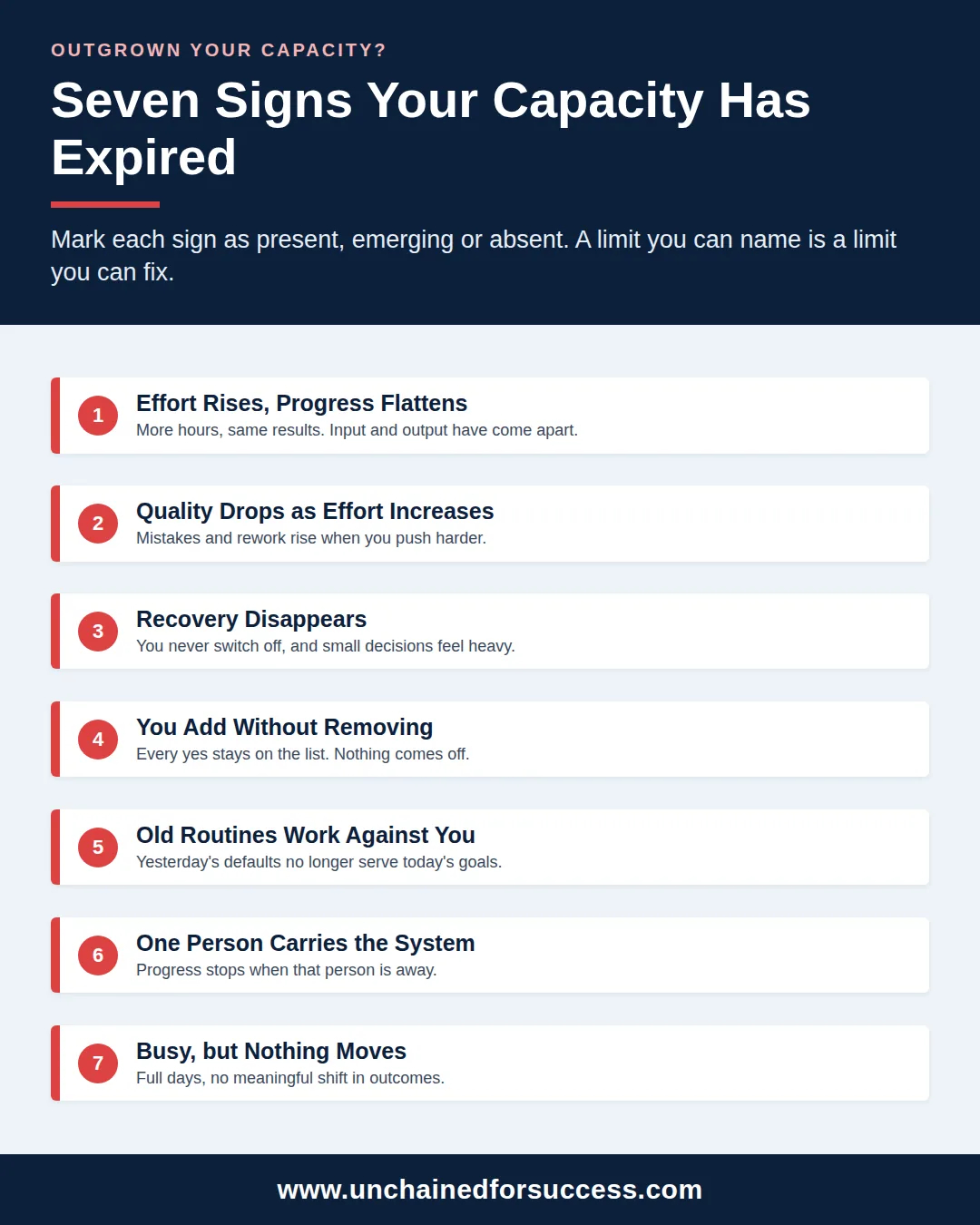
The First Four Signs You Have Outgrown Your Capacity
1. Effort rises but progress flattens. You put in more hours, more energy and more attention, yet the results barely move. Input and output have come apart. This is the pattern the framework's Process check asks about: is activity high but impact low?
2. Quality drops as effort increases. When you push harder and the standard of your work falls rather than rises, the system carrying that work has reached its ceiling. More effort poured into a capacity that is already full does not lift quality. It brings mistakes and rework. This is what a Plan built on peak capacity looks like from the inside.
3. Recovery disappears and decisions feel heavier. You no longer switch off, and even small choices feel like work. Jim Loehr and Tony Schwartz argued in the Harvard Business Review that the real enemy of high performance is not stress but the absence of disciplined, intermittent recovery. Their evidence comes from their own work with athletes and executives rather than a controlled trial.
Our reading is simple: when rest goes, consistency goes too, and heavier decisions are a symptom to watch once you have outgrown your capacity.
4. You keep adding commitments without removing anything. Every new opportunity gets a yes, and nothing comes off the list. Mark Mortensen and Heidi Gardner surveyed more than 500 managers for the Harvard Business Review and found that 81 per cent of those working on teams worked on more than one at the same time. They describe the stress, fatigue and weakened cohesion they associate with it.
Add without taking away, and you treat the limit as if it did not exist. That is one of the clearest ways to have outgrown your capacity without noticing.
The Last Three Signs You Have Outgrown Your Capacity
5. Your old routines now work against your goals. The routines that built your earlier success now quietly hold you back. Routines formed around an earlier goal, not the one you hold now. When the goal grows, the old routine can work against the new Process. If your routines no longer move you towards what you are now trying to achieve, redesign the Process behaviour and its cue and cadence rather than reach for more willpower.
6. The system or team depends on one person. When progress stops the moment one person is unavailable, you multiplied capacity rather than built it. When the constraining resource fails, the whole system stalls. The framework treats this as a bottleneck the Plan must protect first, and build capacity around.
7. You feel busy, but outcomes are not improving. This is the felt experience of an expired capacity. Your days are packed, and yet nothing meaningful is shifting. Sign 1 is the measurable gap between input and output. Sign 7 is the sense of motion without movement, and it can arrive before the data confirms that you have outgrown your capacity. A related post explains why being busy does not mean progress.
Where to Look Once You Have Outgrown Your Capacity
What follows is our reading of the framework, not a rule the framework states. These seven signs are not a new model. Each one points to a component of the Unchained Goals Framework that may have reached its limit. The signs tell you where to look once you have outgrown your capacity. The framework tells you what to repair.
Signs 1 and 7 point to the Process layer: the repeated work has come loose from the Performance standard it exists to produce, so activity no longer moves the measure. Next, Signs 2, 4 and 6 point to the Plan, which sizes the goal to sustainable capacity, declares trade-offs and protects the bottleneck.
Signs 3 and 5 point to Habits, where you design routines with cues, a cadence, recovery and a minimum version for hard weeks. Sign 4 also touches Why and Ownership, because a goal whose opportunity cost has never been named, the things that must be declined to pursue it, has not had its cost and consequences fully accepted.
Two Rules Before You Repair Anything
Two rules govern what you do next. If a Performance measure has already fallen below its agreed range and met the trigger you agreed before you started, the Control System opens a diagnosis in a fixed order: Habit consistency, Process validity, Performance measure validity, then Plan, Beliefs, Ownership and Why, and finally whether the outcome still sits inside your authority. Run the order; do not skip to the layer the signs suggest.
If no measure has fallen below its range and met its trigger, the Control System has nothing to diagnose. Treat the signs instead as a prompt for the Architectural Audit, the framework's structural review. Score each of the nine components from 1 (absent or unexamined) to 5 (fully designed and stable) and start where the score is lowest. The lowest score shows where the design is weakest, not what caused a particular miss.
If the Plan is where you start, Capacity Before Goals sets out the rule that applies: the Plan may build, acquire, free or release capacity before you need it, but future capacity must have a credible route, a timing and an owner.
What It Looks Like When You Have Outgrown Your Capacity
The people in these examples are illustrations, not clients.
Outgrown Your Capacity? An Individual Example
An individual whose routines expired. A consultant's Outcome Goal is to complete the twelve engagements in her order book by 31 December, each signed off with no rework request. Her Performance standard is every deliverable sent within the agreed turnaround, and her Process is three delivery days and one business-development day a week.
She adds smaller jobs on top of the book each quarter and works longer to keep up. Income rises, then plateaus, while rework requests creep in and weekends disappear. Signs 1, 2 and 3 are all present.
Her turnaround measure has been below its range at two consecutive monthly reviews, which is the trigger she agreed, so she runs the order. The Process happened as designed, so Habit consistency is sound. The Process cannot produce the standard at the current volume of work, so Process validity fails and the diagnosis stops there.
Redesigning the Process means resizing her week to sustainable capacity rather than the peak capacity her Plan assumed. She has outgrown her capacity rather than her ambition.
So she takes no additional work for one quarter, redesigns her week with a fixed recovery window, and keeps the December goal, which still passes SSMTC. The turnaround measure returns to range the following month, and she records the cause.
Outgrown Your Capacity? A Business Example
A business built around one person. A founder's Outcome Goal is to grow the firm to £2 million in revenue by the end of next year while she personally approves every decision. Growth stops whenever she is away. This is Sign 6.
Her Performance standard is every decision above an agreed value turned round within five working days, and her Process is a weekly decision review. Her Plan never protected the bottleneck, which is her own decision authority, and her managers hold no Outcome Goal of their own.
The repair has two parts. The Plan builds capacity around the bottleneck rather than through it. Each manager then receives an Outcome Goal translated into something they have the authority to govern, with a Performance standard and Process of their own beneath it, so the bottleneck moves out of her diary. That is structural delegation, not a harder-working founder.
Once the delegations are in place, the decision measure holds inside its range through her next fortnight away, and she records what changed.
Outgrown Your Capacity? A Project Example
A project that never said no. A project team's Outcome Goal is to hand over an operational system by 30 September. Its Performance standard is milestone variance within two weeks, and its Process is a weekly scope and risk review. The team keeps absorbing new requirements without dropping any, and the deadline quietly slips while everyone stays frantically busy. Signs 4 and 7 together.
The Plan declared no trade-off, so every request became scope, and the weekly review drifted into a status meeting that no longer protected the variance measure. Milestone variance has already exceeded two weeks at three consecutive reviews, so the trigger has been met and the team runs the fixed order before changing anything.
The fix is to name the cost, agree with the sponsor what yields, and reconnect the weekly review to the measure that matters. Once the review is protecting the variance measure again, it returns inside two weeks and the team records the cause.
How to Respond When You Have Outgrown Your Capacity
Four steps turn the signs that you have outgrown your capacity into a repair, whichever rule applies.
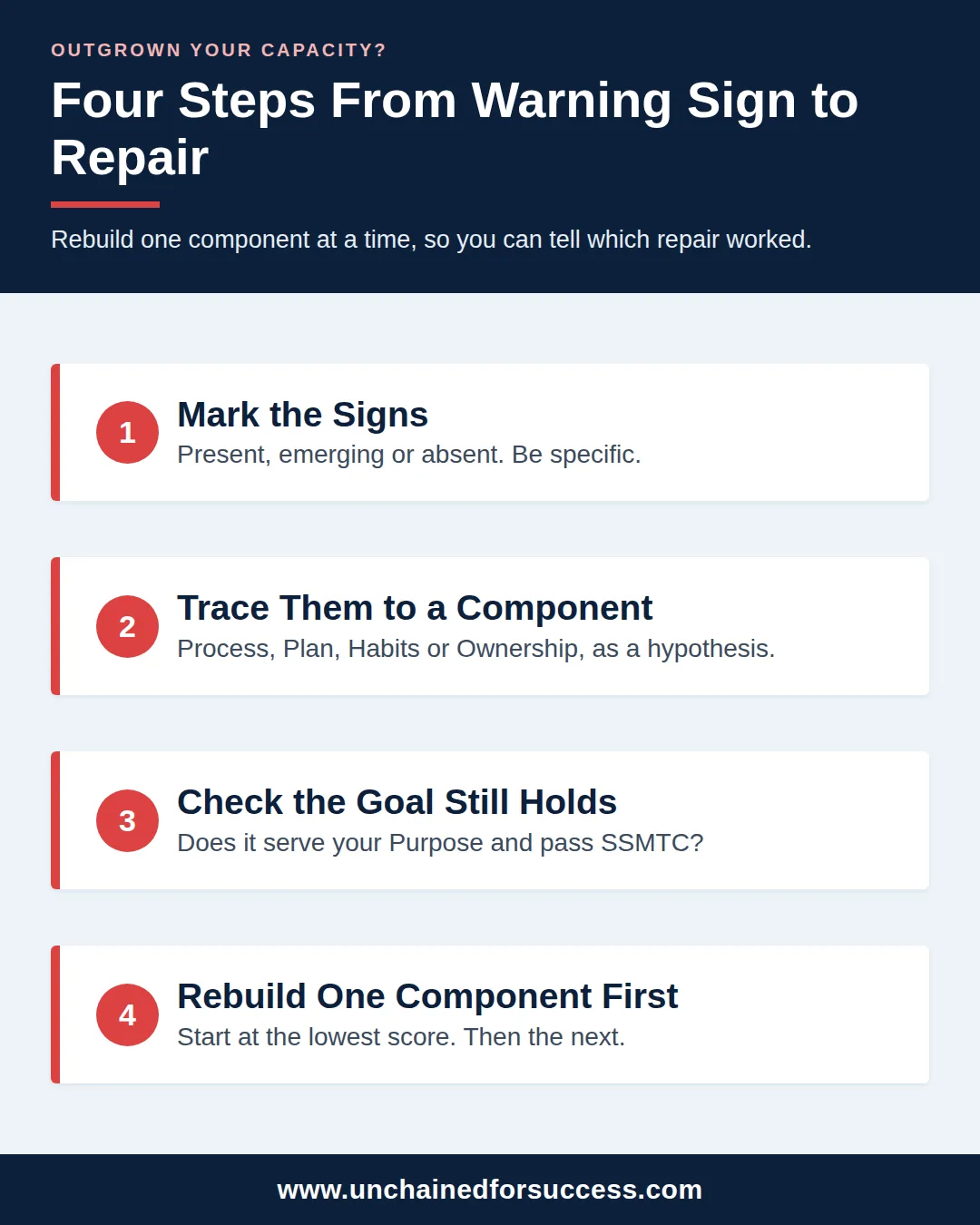
Step 1. Mark the signs. Read the seven signs honestly against your own situation and mark each as present, emerging or absent. Be specific, because a vague sense of being stretched is not evidence.
Step 2. Trace them to a component. Group the signs you marked. Using the mapping above, note which component each group points to. Treat that as a guess to test, not a finding. If a measure has already fallen below its range and met the trigger you agreed, run the fixed diagnostic order instead.
Check the Goal Before You Rebuild Capacity
Step 3. Check the goal still holds. If you are running the fixed diagnostic order, the goal is examined last, so do not touch it here. Otherwise, before you rebuild anything, confirm the goal is still worth rebuilding for. Does it still serve the problem you have accepted responsibility for? Does it still pass SSMTC, including sitting inside your authority? If it does not, reshape or retire the goal rather than rebuild capacity for it.
Step 4. Rebuild one component first. If the goal holds, score the nine components as in the structural review and start where the score is lowest, using your sign clusters to sharpen the scoring. Rebuild one component at a time, exactly as you would grow capacity deliberately. Stretch Goals Must Stay Within Your Control shows the same principle from the design side: the ambition stays, and you rebuild the structure to carry it.
Common Mistakes After You Have Outgrown Your Capacity
Treating the symptom as the problem. Working longer to fix flat progress, or hiring faster to fix a one-person dependence, addresses the surface and ignores the structure underneath.
Changing the goal when the goal was never the issue. If your Purpose still backs the goal and it still passes SSMTC, resetting the target simply resets the same trap at a new number.
Rebuilding every component at once. Scattered repair spreads effort thinly, and you cannot tell which repair worked. Sequenced repair, one component at a time, is what the post on growing faster without losing control sets out.
Pushing through instead of recovering. If you are already stretched, Sustainable Success covers what pushing too hard costs, and Design Recovery Habits shows how to build rest back into the week.
Outgrown Your Capacity: Frequently Asked Questions
How do I know whether I have outgrown my capacity or simply chosen the wrong goal? Do not start by changing the goal. If a measure has fallen below range and met its trigger, run the fixed order, which examines the goal last. If not, check that the goal still serves your Purpose and still passes SSMTC. A goal that passes both is not where to begin. A goal that fails either test needs reshaping first.
Is capacity a component of the Unchained Goals Framework? No. The nine components are Purpose, Vision, Goals, Why, Ownership, Beliefs, Plan, Habits and the Control System. Capacity enters the design through the Plan, which must rest on sustainable rather than peak capacity, and through Habit design, which builds in recovery.
How many of the seven signs need to be present before I act? One clear sign that persists is enough to act on. Several signs pointing at the same component make that component the obvious place to start scoring, but the score, not the count, decides where you rebuild first.
Outgrown Your Capacity? Rebuild It Before You Reset the Goal
Capacity is not a fixed possession. You build it for a stage, and it can expire when the demands move beyond it. The seven signs are how you catch that expiry early, while it is still a warning rather than a crisis.
So before you reset your goals again, run the check for whether you have outgrown your capacity. Mark the seven signs this week, trace the ones you marked to a component, and choose the one component you will rebuild first. If you want an outside view of how your goals are designed, executed and governed, the Goals Readiness Score is an optional next step: 18 questions, under five minutes.
Share which of the seven signs you recognised first in the comments.
Which sign have you been explaining away, and what would it cost to keep doing so?
Sources
• Midsize Companies Shouldn't Confuse Growth with Scaling by Ron Carucci, Harvard Business Review, 25 July 2016
• The Making of a Corporate Athlete by Jim Loehr and Tony Schwartz, Harvard Business Review, January 2001
• The Overcommitted Organization by Mark Mortensen and Heidi K. Gardner, Harvard Business Review, September to October 2017
Continue Your Journey
Explore more resources from the Unchained Goals Framework: