

The year-end review is among the most recommended and least useful rituals in working life. You list what went well, you list what did not, you feel briefly clearer, and nothing about next year changes. Your 2025 lessons learned deserve better than that. What follows is a method for turning a year of experience into decisions you will actually act on.
The difference between a review that works and one that does not is not effort or honesty. It is order. Reviews that change behaviour follow a fixed sequence, and they end in a decision rather than an insight.
Why Most Year-End Reviews Change Nothing
Start with the failure, because it is easy to recognise.
You sit down in late December. You write three wins and three disappointments. The disappointments are attributed to being too busy, and the wins to working hard. Then you set next year's goals, which look a great deal like this year's.
Nothing in that process tests anything. It gathers impressions, and impressions form after the fact, shaped by how the year ended rather than how it ran.
What the Evidence Says About Reviewing a Year
There is better research here than the subject usually attracts, and one finding matters more than the headline.
A meta-analysis of 46 samples covering 2,136 people found that structured debriefs, deliberately reviewing what happened and what to change, improved performance by roughly 25 per cent over groups that did not debrief (Tannenbaum and Cerasoli, 2013). It held for individuals as well as teams.
Now the detail that gets left out. Debriefs run with a facilitator produced a considerably larger effect than those without one. Both helped. Structure is doing a good deal of the work, not reflection on its own.
Read that honestly and it says something specific. A review works better when someone holds it to a process. Doing it alone is not useless, and it is the weaker version.
Your 2025 Lessons Learned Need a Fixed Order
Here is the practical core, and it is the part most reviews skip.
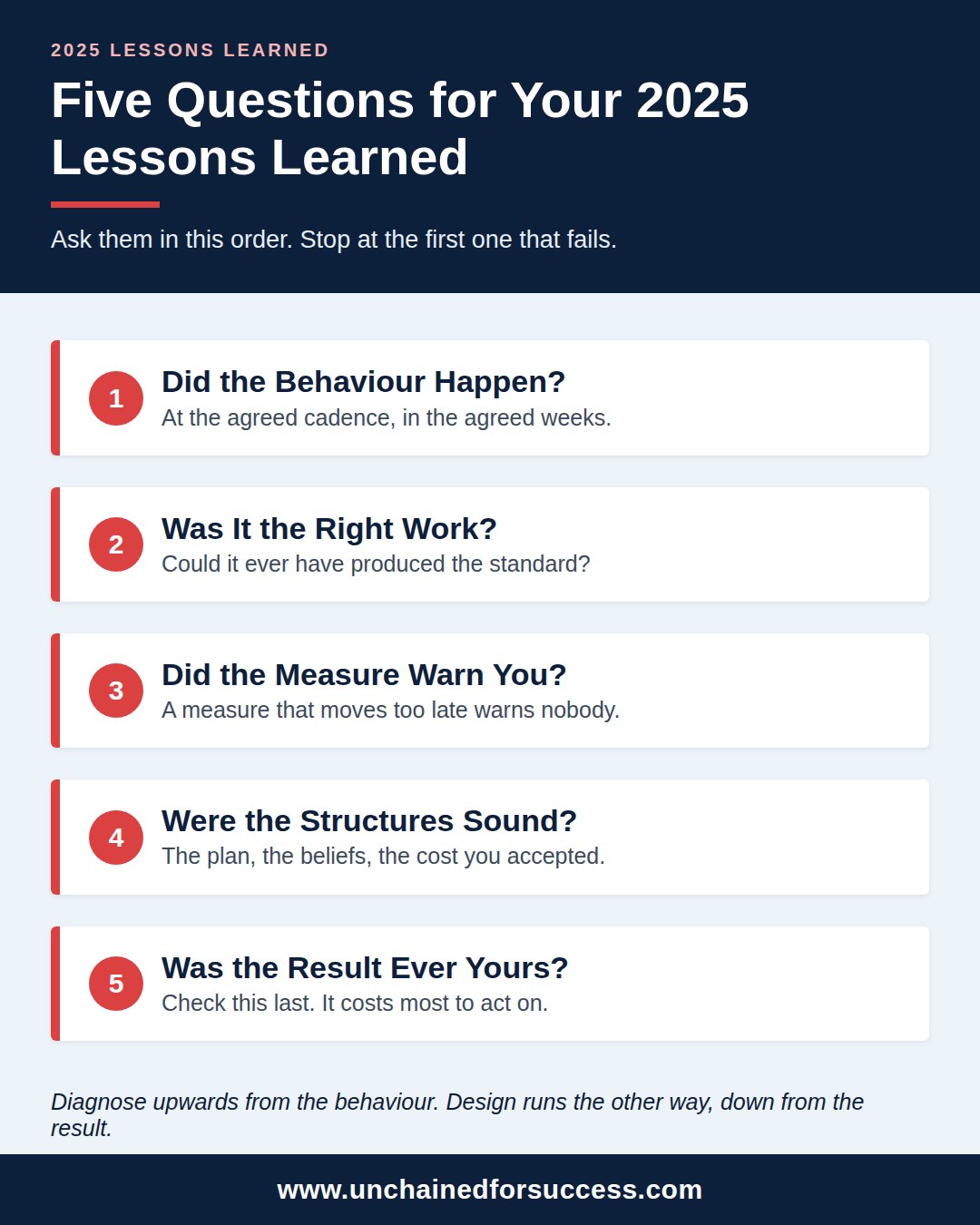
Diagnose from the bottom of the structure upwards. Why that way round? Lower levels are the cheapest evidence to check, and confirming them costs almost nothing. Start at the top instead and you can find yourself rewriting a strategy when the actual fault was a missed Tuesday.
The Unchained Goals Framework sets the order: behaviour consistency, then the validity of the work itself, then whether the measure told you anything, then the structures underneath, and only at the end whether the result was ever yours to deliver.
Run your 2025 lessons learned through that sequence and you get a diagnosis rather than a mood. Skip it, and your 2025 lessons learned will be a list of feelings with dates attached.
Start Where the Evidence Is Easiest to Check
Take one goal that did not move and ask the cheapest question first. This is where your 2025 lessons learned should start.
Did the behaviour actually happen? Not roughly. At the agreed cadence, in the agreed weeks. Where the answer is no, the review can stop there, because nothing above it was ever tested.
If it did happen, was it the right work? A behaviour can run faithfully all year and produce nothing, because it was never capable of producing the standard it was meant to serve.
If the work was right, did the measure tell you anything? A measure that only moves once the year is over gave you no warning. That is a design fault in the measure, not a failure of effort.
Work Upwards Through the Structure
Only when those three are clear does it make sense to look higher.
Was the plan coherent, or did it assume time you never had? Were there beliefs about what was possible that went unexamined all year? Did you accept the cost of the goal, or agree to it and then resent it? And did the reason for doing it still hold in November?
Last of all, ask whether the result was ever inside your control. Some goals fail because they were never yours to deliver, and no amount of behaviour would have fixed that. That is the most expensive answer, which is exactly why it comes last.
Why January Is a Good Moment for 2025 Lessons Learned
The timing is not arbitrary, and there is evidence behind it.
Researchers found that aspirational behaviour rises sharply after what they call temporal landmarks: the start of a week, a month, a year, a semester, a birthday (Dai, Milkman and Riis, 2014). They saw it in Google search data across 3,104 days, in gym attendance among 11,912 university members, and in 66,062 commitment contracts.
The authors are careful about what this shows. It is field data, so it demonstrates the pattern rather than explaining the mechanism, and the landmarks are mostly ones our calendar invented.
Still, the practical reading is sound. A boundary in the calendar makes people more willing to change something, so act on your 2025 lessons learned while that willingness is there.
What Your 2025 Lessons Learned Should Say About the Wins
Failure gets all the attention in a review, and that is a mistake with a practical cost.
When something worked, the useful question is not whether you are pleased. It is what made it repeatable. Was the behaviour small enough to survive a bad week? Was the standard visible early enough to correct against? Did you have real authority over the result, so effort actually moved it?
Those answers are transferable. A win you cannot explain is a win you cannot repeat, and most people leave a review able to describe their successes without being able to reproduce them.
So give the wins the same sequence as the failures. Your 2025 lessons learned should end with two lists: what to change, and what to protect. In my experience the second list comes out shorter and gets used more.
The Progress You Stopped Noticing
One more finding is worth carrying, because it corrects a common distortion.
Researchers collected nearly 12,000 daily diary entries from 238 knowledge workers across 26 project teams (Amabile and Kramer, 2011). Of everything that lifted people's engagement and mood at work, the strongest single factor was making progress in work that mattered to them, even small progress.
Note the limits. This is diary data collected over time, so it shows a strong daily association rather than proving that manufacturing small wins raises performance.
Even so, it explains something you will meet in your own review. A year that felt flat often contains real progress that went unrecorded, because nobody writes down the ordinary week.
Turning 2025 Lessons Learned Into Next Year's Design
A lesson that does not change a design is not a lesson. It is a feeling about the past.
So for each of your 2025 lessons learned, write the change it implies at the level where the fault actually sat. A missed behaviour changes the cue or the size of the behaviour. An invalid process changes the work. A useless measure changes the standard. A goal outside your control gets translated into one you can govern.
Then decide what evidence next year would tell you the change has worked, and when you will look. Without that, you have swapped one untested plan for another.
What to Do With Your 2025 Lessons Learned This Week
Set aside an hour, and take three goals rather than the whole year. Your 2025 lessons learned do not need every project in the room.
For each one, run the sequence above and stop at the first level that fails. Write one sentence naming the level and one sentence naming the change. That is six sentences, and it will be more useful than six pages.
Then book the review that will test it. The resource library has planners if you want a structure to work inside, and handling setbacks covers what to do when the first test comes back badly.
Finally, consider finding someone to run the next review with you. Facilitated debriefs outperformed unfacilitated ones in the research above, though both helped, so treat this as worth arranging rather than essential.
Frequently Asked Questions
How far back should a review go? One cycle is usually enough for a first pass, and that is my recommendation rather than a finding. Older material invites storytelling, because the details you still remember are the ones that made the best story. Go further back deliberately, when you are testing whether a fault keeps recurring.
What if the same lesson keeps appearing? Then treat it as a structural fault rather than a lesson. Before moving up the sequence, check the cheaper explanations: was the change actually made, was it made consistently, and was it large enough to matter? Only once the correction was genuinely applied and the fault still returned does it make sense to look one level higher.
Should a team do this together? Yes, and the evidence on facilitated debriefs supports it. One caution: run it so people can say what actually happened. A review that nobody can be honest in produces a tidy document and no information.
Share one thing from this year you are going to change at the level it actually failed, in the comments.
If you want an outside view of how your goals are designed, executed and governed, the Goals Readiness Score scores each of the nine components separately and names the weakest one.
Which of this year's disappointments would survive an honest look at whether the work ever happened?
Sources on 2025 Lessons Learned
- Tannenbaum, S. I., and Cerasoli, C. P. (2013). Do team and individual debriefs enhance performance? A meta-analysis. Human Factors, 55(1), 231 to 245. https://doi.org/10.1177/0018720812448394
- Dai, H., Milkman, K. L., and Riis, J. (2014). The fresh start effect: temporal landmarks motivate aspirational behavior. Management Science, 60(10), 2563 to 2582. https://doi.org/10.1287/mnsc.2014.1901
- Amabile, T. M., and Kramer, S. J. (2011). The power of small wins. Harvard Business Review, 89(5), 70 to 80. https://hbr.org/2011/05/the-power-of-small-wins
Continue Your Journey
Explore more resources from the Unchained Goals Framework: