Growth without burnout sounds like a contradiction to anyone who has been told that progress means pushing harder, sleeping less and treating exhaustion as proof of commitment. It is not a contradiction. Growth will stretch you, and it should. The question is whether the stretch builds your capacity or drains it faster than you can refill it.
This post opens the Growth Without Burnout series. It follows Saying No Strategically, which closed the series on focus and trade-offs. By the end, you will know how to tell healthy discomfort from harmful overload. You will also have five practices that help you pursue a demanding goal at a pace you can keep.
Why Growth Without Burnout Matters
Long hours, packed diaries and constant pressure can look like progress from the outside. Yet a full week and a productive week are not the same thing. As Why Focus Drives Results and Busyness Doesn't argues, activity is not achievement.
If the pursuit of a goal steadily wears down the energy you need to finish it, something in the design is wrong. The goal may be right. The effort may be sincere. But the way you are carrying it cannot last, and the cost can arrive before the result does.
So growth without burnout is not a softer form of ambition. It is ambition built to survive the long middle of a goal, when the early excitement has faded and the finish still feels far away.
Growth Without Burnout Starts With Telling Stretch From Overload
Every meaningful goal asks for discomfort. New routines feel awkward. Old beliefs face a test. Better choices cost something. That kind of stretch is part of becoming the person, team or organisation the goal needs.
Burnout is different. The World Health Organization describes it as a syndrome understood to result from chronic workplace stress that has not been successfully managed. It names three features: exhaustion, growing mental distance or cynicism about the job, and reduced effectiveness at work.
The WHO uses the term only for work, not for other parts of life. Even so, in our view a personal goal pursued at an unsustainable pace can drain you in similar ways. The WHO would simply not call that burnout.
Here is the practical difference as we see it, and it is a pattern over time rather than a single test. Look at whether the demands stay manageable, whether you recover between pushes, and whether your ability to function is holding up or slipping. Learning can stay uncomfortable for a long time, and exhaustion can have several causes, so treat these as signals to examine rather than a diagnosis.
What Stress Research Tells Us
Two findings shape how we think about growth without burnout. Jeffery LePine, Nathan Podsakoff and Marcie LePine combined 101 samples in a meta-analysis of workplace demands. They separated two kinds. Challenge demands include heavy workload, time pressure and high responsibility. Hindrance demands include red tape, office politics, unclear roles and worry about job security.
Once strain was taken into account, challenge demands went with better performance on average, and hindrance demands went with worse. However, both kinds went with more strain. Most of the studies took a single snapshot in time, so this is a pattern rather than proof of cause.
Our reading for growth without burnout is simple. Even the right kind of stretch is not free. You still pay for it, so you need to plan how you will recover. The study looked at workplace stress, not at the practices in this post.
Christina Maslach and Michael Leiter reviewed burnout research in World Psychiatry. They point to six areas where a poor fit between a person and their work goes with burnout: workload, control, reward, community, fairness and values.
Our reading is that two of those six, workload and having a say over your work, are things the design of a goal can address directly. That is where the framework comes in.
How the Framework Supports Growth Without Burnout
The Unchained Goals Framework does not treat burnout as a failure of character. It treats overload as a design problem, and several parts of the framework help you design against it.
First, every Goal must pass the framework's five-part test, SSMTC: Stretched, Specific, Measurable, Time-bound and Under Your Control. Two of those five matter most here. Stretched asks for more than your current comfort without going beyond what you believe is possible, so the framework expects discomfort, but not a goal you think is impossible. Protecting your energy is the Plan's job, as the next paragraphs show.
Under Your Control is the fifth, and it asks whether the goal sits inside your Control Boundary. In plain terms, do you have enough authority to act on the main causes of the result and correct things when they drift? That is not the same as certainty about the outcome, and it does not mean limiting goals to your own actions. A goal that fails this test can leave you with pressure but no authority to act on it.
Next, the Plan tests whether there is a credible path to the goal within sustainable capacity, not peak capacity. Peak capacity is what you could manage for a short burst in ideal conditions. Sustainable capacity is what you can keep up without breaking down.
The Plan also weighs the goal against every other commitment drawing on the same time and energy, which is the heart of growth without burnout. If no credible path exists, the goal should not go ahead in that form.
What Keeps the Stretch Steady
When the Plan reveals a material cost you had not counted, revisit your Why and Ownership. Your Why explains why the goal is worth its cost. Ownership means consciously accepting that cost and the consequences of pursuing the goal within your authority.
Habit Conversion then turns the key actions into routines that need less deciding each time, which reduces how much you depend on motivation. Finally, the Control System compares your Performance measures with an agreed range. When a result falls below range and meets the trigger you set, it opens a diagnosis rather than a demand to push harder.
Growth Without Burnout in Practice
The people and organisations below are illustrations, not clients.
Growth Without Burnout for an Individual
Sarah is a manager who wants a promotion. She believes she must say yes to every project to prove her value. Six months into her push for promotion, her diary is full, her strategic work is invisible and she is exhausted.
A promotion depends on other people's decisions, so it sits outside her Control Boundary. First, she tests her belief about saying yes by asking her manager what counts most. The answer is two pieces of strategic work, not constant availability. So she agrees an Outcome Goal with her manager that she can govern. She will deliver both pieces, a new supplier review process and a cost reduction case, to the leadership team by 30 September.
Her Performance standard is each planned milestone completed by its date, checked in a weekly review. That standard is deliberately a leading one: it tells her where she stands months before the September handover.
Beneath it, her Process Goal is two three-hour blocks a week, Tuesday and Thursday mornings, analysing supplier data and drafting the cost case before anything else. She also logs every new request and checks it against her Plan before she answers.
She and her manager agree the trigger in advance: two missed milestones in a row opens a closer look, starting with whether those blocks actually happened. That is a project rule for this example, not a health threshold, and a serious problem does not have to wait for a second miss.
A Business That Paused New Work
Growth without burnout looks different for a firm. A growing consultancy wins more work than its team can deliver. Leaders push everyone to absorb it. Quality starts to slip and two senior consultants resign.
The leaders make a declared trade-off in the Plan. They pause new client onboarding for one quarter and hire one consultant, with a named owner and a start date.
Before committing to that, they add up the days each current engagement still needs and compare the total with the days the remaining team can actually work. If the hire slips, two engagements move their later milestones by agreement with those clients. Their Outcome Goal is to complete every current engagement due by 30 June on its contracted date.
The Performance standard is every milestone delivered by its agreed date and scoring at least four out of five against the firm's quality checklist at internal review, with no mandatory item failed, since an average can hide one critical gap.
Their Process Goals are a capacity review every Monday and a peer check of every deliverable against the quality checklist before it goes to the client. The leaders compare booked consultant days with available days. When the pause ends, they accept a new engagement only if bookings stay below 85 per cent of available days. That figure is their own limit for this example, not a framework rule.
A Project That Cut Its Scope
On a project, growth without burnout usually means less scope, not more hours. A digital transformation project keeps adding scope. Every department wants its request included. The team has not grown, morale is low and dates keep slipping.
So the project sponsor redefines the Outcome Goal as phase one, the core workflow for three departments, live by 30 November. The Performance standard is each fortnightly sprint delivering its agreed items, with no more than one sprint in three falling short.
The team's Process Goals are sprint planning that commits only to items the team's available days can cover, and a weekly change review. That review tests every new request against the agreed phase one scope, the essential compliance, security and usability requirements, the capacity available and the date. Anything optional goes into a phase two log through the agreed change decision, rather than being turned away at the desk.
Five Practices for Growth Without Burnout
You do not need to overhaul your life to build growth without burnout into your week. These five practices give you a place to start.
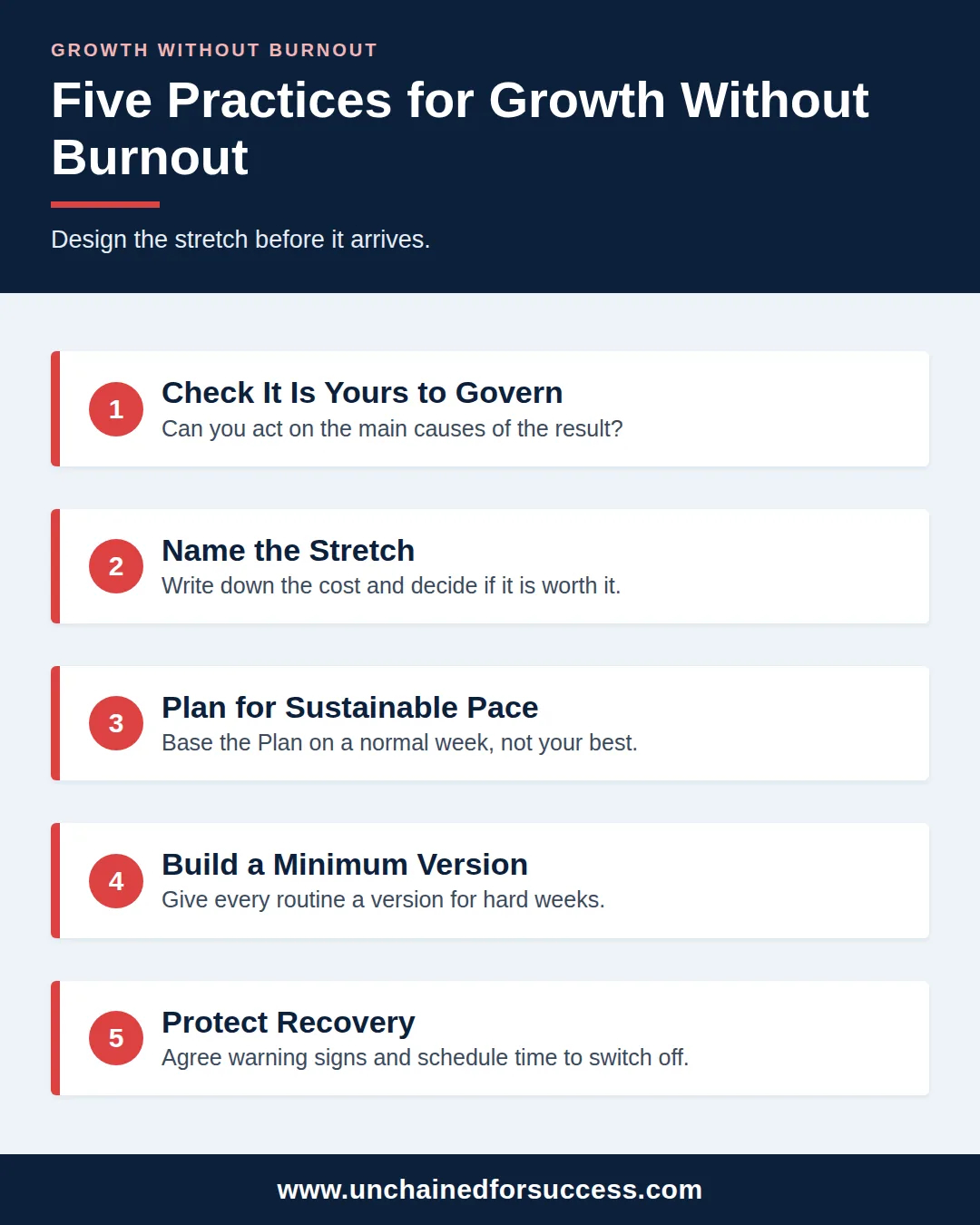
1. Check What You Can Control
Pressure rises when the result you are chasing depends on things you cannot act on. Approval, market conditions and other people's choices may matter, and you cannot govern them.
So ask whether you have enough authority over the main causes, and over the decisions needed to correct the result when it drifts. If you do not, restate the ambition as the largest result you can govern, and let the original stand as what you hope the system produces. This is about authority, not about limiting yourself to what you do alone.
2. Name the Stretch You Are Accepting
Write down what the goal will cost you over its whole length. That might mean evenings, a lost hobby or harder conversations. Then decide, knowing what you know now, whether the result is worth it, and accept that cost deliberately. A cost you have named and accepted is one you can plan around.
3. Plan for a Pace You Can Maintain
Base your Plan on the pace you can keep, not on your best week. List everything else drawing on the same hours and energy, and compare the total with what you have. If the sums do not work, you must sequence, delegate or drop something, or change the goal or its date and test it again. Capacity Before Goals walks through that test in detail.
Then decide what will give if pressure rises: time, cost, scope or quality. How Trade-Offs Create Progress explains how to declare that in advance.
4. Build a Smaller Version Into Every Routine
Big goals can overwhelm. Start with the result you want, such as completing a 10 kilometre run by 31 May, then name the routine that produces it: 45 minutes of training on Monday, Wednesday and Friday before work. Then add a smaller version for hard weeks that still serves the same standard, such as a 20 minute run rather than a stretching session.
The smaller version protects continuity during a difficult period. It may not deliver the full planned rate of progress, so if you are using it week after week, that is evidence to revisit the Plan rather than a way to keep the shortfall quiet.
5. Protect Recovery
Growth without burnout depends on recovery, so give it an action rather than an intention. At the end of the working day, write down tomorrow's first task and close work messages until your agreed start time. Shift patterns, caring duties and on-call rotas change what that looks like, so set the version that fits your week.
Then decide in advance which signs will make you revisit the Plan. Examples include sleep that no longer restores you, routines missed several weeks running and rising errors. If you want the Control System to track one of them, define it as a measure with a range and a trigger.
A review of recovery research by Sabine Sonnentag and Charlotte Fritz reports that work demands, especially heavy workload, predict less switching off during time off. Less switching off, in turn, predicts more strain and lower well-being. So treat recovery as part of the Plan, not a reward for finishing. Design Recovery Habits That Sustain Your Performance shows how.
Common Mistakes That Block Growth Without Burnout
Three mistakes can undo growth without burnout, even with good intentions.
Confusing motion with progress. A full calendar feels productive, but it tells you little about whether the goal is moving. Check your Performance measure, not your hours.
Treating recovery as weakness. Skipping rest can look like commitment. In practice, it can draw down the energy you need to finish the goal.
Adding without subtracting. Capacity is finite. If you keep taking on new work without removing anything, the load grows until something gives. Each time you add a goal, reassess the Plan against everything else drawing on the same hours. The Hidden Cost of Yes looks at what each new commitment really costs.
A Weekly Check of Our Own
Here is a quick weekly check. It is ours, not a framework tool.
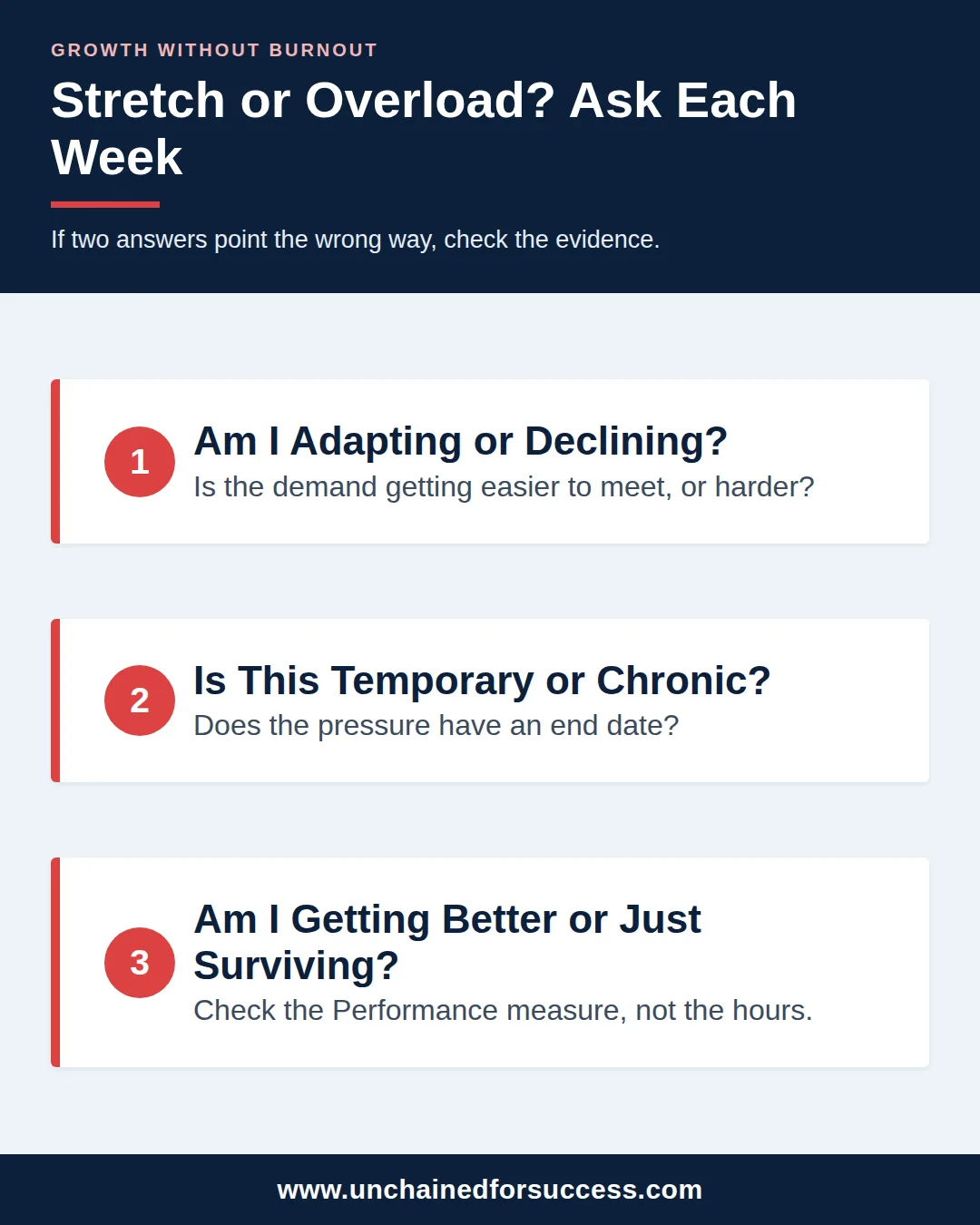
Am I adapting to this demand, or declining under it? Is the discomfort temporary, or has it become the ongoing state? Am I getting better at this, or just surviving?
These are reflection prompts for growth without burnout, not a burnout assessment. If an answer concerns you, look at what has changed and at what support or adjustment you need.
The evidence comes next. Did the agreed actions happen consistently? If they did, are those actions producing anything, and is the measure telling you the truth? Those are the first two questions of the framework's diagnosis, and the framework overview sets out the rest. If the load itself has changed, revisit the capacity assumptions in your Plan before the next week begins.
Frequently Asked Questions About Growth Without Burnout
Does growth without burnout mean avoiding hard weeks? No. Stretched goals can demand periods of intense effort. The test is whether the intensity is deliberate, time-limited and followed by recovery, or whether it has quietly become the normal pace.
Is burnout a medical condition? The WHO classifies burnout as an occupational phenomenon, not as a medical condition, and uses the term only for work. If exhaustion persists or worries you, speak to a doctor or other qualified professional.
What should I do if I am already overloaded? Start with the Plan, because growth without burnout begins with what you are carrying now. List every commitment drawing on your time and energy, then decide what to pause, delegate or drop. Keep the minimum version of your key routines, and agree any changes with the people they affect.
Choosing Growth Without Burnout This Week
Growth will stretch you, and that is not a sign you are doing something wrong. Burnout, however, is not the price of success. In our view, the risk rises when a plan is built for your best week rather than a normal one.
Planning your demands and your recovery can help make progress more sustainable. Put the goal within your authority. Base the Plan on the pace you can keep. Name the cost, build routines with a smaller version for hard weeks, and decide the warning signs in advance.
This week, choose the goal that is costing you the most energy. Write down its three biggest demands on your time, and one thing you will pause to make room for them. If you want a wider view of how your goals are designed, executed and governed, the Goals Readiness Score takes 18 questions and under five minutes.
Share the one thing you paused, and what it made room for, in the comments.
Which of your goals is stretching you, and which is simply wearing you down?
Sources
• Burn-out an "occupational phenomenon": International Classification of Diseases, World Health Organization, 28 May 2019
• A Meta-Analytic Test of the Challenge Stressor-Hindrance Stressor Framework: An Explanation for Inconsistent Relationships Among Stressors and Performance by Jeffery A. LePine, Nathan P. Podsakoff and Marcie A. LePine, Academy of Management Journal, 48(5), 764 to 775, 2005
• Understanding the Burnout Experience: Recent Research and Its Implications for Psychiatry by Christina Maslach and Michael P. Leiter, World Psychiatry, 15(2), 103 to 111, 2016
• Recovery From Job Stress: The Stressor-Detachment Model as an Integrative Framework by Sabine Sonnentag and Charlotte Fritz, Journal of Organizational Behavior, 36(S1), S72 to S103, 2015
Continue Your Journey
Explore more resources from the Unchained Goals Framework: