Saying no strategically can be a hard skill to learn, because the requests you most need to refuse are not always bad ones. They are interesting, flattering, reasonable and hard to turn down. Yet each one draws on the same limited hours, attention and energy as the goal you committed to. Saying no strategically is how you keep that commitment when everything else is asking for a share.
This post closes the series on focus and trade-offs. How Trade-Offs Create Progress showed that every meaningful result requires a deliberate choice. The Hidden Cost of Yes looked at how unchecked agreement erodes the work those choices depend on. This one turns the idea into a practice: a clear, respectful no, given for a reason you can explain.
Why Saying No Strategically Matters
Saying no strategically is not about being difficult. It is about being directed.
Every yes claims time. It uses attention. It can create follow-on obligations that were not visible when you agreed. And it can pull you into work that was never part of the plan and is hard to undo once started.
One extra commitment, taken alone, looks harmless. Across weeks and months, though, small yeses add up to a load that can leave the most important work finishing last. The cost does not need to arrive as a crisis. It can arrive as drift.
Why Clear Priorities Come First
Saying no strategically starts with knowing what you are protecting. Most people cannot protect priorities they have never written down, and in large organisations the priorities are often unknown even to the people executing them. Donald Sull, Charles Sull and James Yoder studied 124 organisations for MIT Sloan Management Review. Only 28 per cent of the executives and middle managers responsible for executing strategy could list three of their company's strategic priorities.
That is a survey of what those managers could name, not a test of saying no. Our reading is simple. Decide your priorities, and the responsibilities you carry alongside them, before the next request arrives. Then your no rests on a reason rather than a mood.
Refusing is also socially awkward, and there is evidence for that. Francis Flynn and Vanessa Lake found that people underestimated how readily others agree to a direct request for help. Part of the reason, they found, is that askers underestimate the social cost of saying no. Neither study tests the five questions below.
Saying No Strategically Is a Planning Decision
In the Unchained Goals Framework, saying no is not a personality trait. It is part of the Plan.
The Plan tests whether there is a credible path to a goal within sustainable capacity. It weighs that goal against every other commitment drawing on the same time and energy over the same period. The framework also says to reassess the Plan when another goal is introduced or when a material assumption about capacity changes. In our reading, a significant new request can change that assumption, even when nobody calls it a goal.
Strategy sits inside the Plan, and the framework is clear that strategy decides what will not be pursued as well as what will. Declaring trade-offs in advance, deciding what gives way when capacity tightens, is one of the Plan's six structural elements. Derek Lidow puts it well in Harvard Business Review. Smart leaders identify trade-offs, "choosing what not to do as much as what to do".
Where a Good No Starts: Purpose and Vision
Saying no also tests whether your Purpose and Vision are doing their job. Your Purpose, the problem you accept responsibility for, should rule some attractive paths out, even ones that promise success. If it rules nothing out, it is not yet guiding your choices.
Your Vision, the long-term position you have committed to, should rule out at least one attractive opportunity you are declining now because of it. If nothing is being rejected, the Vision lacks seriousness.
What a Well-Placed No Protects
Saying no strategically protects more than your calendar. Here is what it guards.
It protects the goal from dilution. When competing commitments keep arriving, the main goal can become one priority among many. The goal does not disappear. It simply stops getting the sustained attention it needs to move, which is why focus drives results and busyness does not.
It protects the Why and Ownership. Your Why explains why the goal is worth its cost. Ownership means consciously accepting that cost and the consequences of pursuing the goal within your authority. An unplanned yes can raise the cost you accepted. If it adds material cost, revisit both before you carry on.
It protects the Plan from overload. A plan that absorbs every new request stops working as a plan. It becomes a record of what people asked for, rather than a guide to what you decided mattered.
It protects your routines. Habit Conversion turns the key actions into routines that need less deciding each time. Frequent, unplanned interruptions break that rhythm, and a routine that keeps breaking takes longer to become easy.
Saying No Strategically in Practice
The people and organisations below are illustrations, not clients.
Saying No Strategically as an Individual
A senior manager is studying for a chartered management qualification while leading a team of twelve. Each week brings new invitations: optional steering groups, mentoring requests and cross-functional task forces. Every one is legitimate. Each would add work that spills into the early mornings she has set aside for study. Taken together, they would cost her hours she does not have.
First decide what you will achieve, the standard that shows you are on track, and the action you will repeat. The framework calls these the Outcome Goal, the Performance standard and the Process Goal.
Her Outcome Goal is to submit her three remaining assignments by 31 July. Her Performance standard is one finished assignment every three weeks, each checked against the marking criteria before she sends it for her tutor's pre-submission review. From 7 to 8 am each weekday, she drafts or revises the next assignment section against those criteria, before opening her inbox. That is her Process Goal.
She agrees three rules with her director. First, she declines optional meetings where her attendance is not needed for a decision, essential information or her responsibility to her team. Second, she takes mentoring requests only from her own team until the end of July. Third, one cross-functional request passes to a colleague who wants the experience, agreed with that colleague and her director rather than announced.
A Consultancy Choosing Its Clients
Saying no strategically works the same way for a firm. Three new engagements come to a specialist consultancy in one quarter. Each looks commercially attractive. Before answering, the leadership team asks one question. Do this client and this work fit the position we have committed to over the next three years?
One does. Two do not. The team accepts the one and declines the other two, explaining the reason and suggesting firms better suited to the work. Their Outcome Goal is to deliver the accepted engagement to the agreed standard by its contracted date of 30 September. Declining the other two keeps the senior consultants it needs free for it.
Their Performance standard is each project milestone delivered on its planned date, having passed the firm's internal quality review. Their Process Goal is a weekly allocation of those consultants to the next milestone's tasks. A fortnightly delivery review checks that work against the milestone plan. Alongside it, they check every new enquiry against the three-year position before anyone writes a proposal.
A Programme Manager and Two Requests
A programme manager is delivering a compliance change across five departments, with a statutory go-live date of 1 July. The sponsor has given her authority over the plan, the budget and the delivery team; only scope changes go to the sponsor. Ten weeks out, two senior stakeholders ask for extra scope. Both ideas are sensible. Neither is in scope, and adding either would put the date at risk.
Saying no strategically here does not mean refusing on her own, because scope decisions belong to the sponsor. Instead, she writes an impact assessment for each request within two working days. Then she takes both to the sponsor's weekly change board with a recommendation to log them for phase two.
Her Outcome Goal is compliant go-live on 1 July. Her Performance standard is each readiness checkpoint signed off on its planned date with no critical defects open. Beneath that, her Process Goal has two parts. She holds a weekly readiness review with each of the five department leads. She also writes an impact assessment for any change request within two working days. The change board accepts her recommendation, and the team scopes phase two separately.
An Ordinary Week, the Same Decision
Saying no strategically needs no job title. You have set aside Tuesday evening to finish a course assignment. A request to organise a community event would take three evenings. Before agreeing, decide whether the event can wait, be shared with someone else, or replace something that matters less. The question is the same one the manager asked, without a steering group in sight.
Five Questions for Saying No Strategically
You do not need a complicated system. You need a short filter you will actually use before you answer. This one is ours, and it takes about a minute.
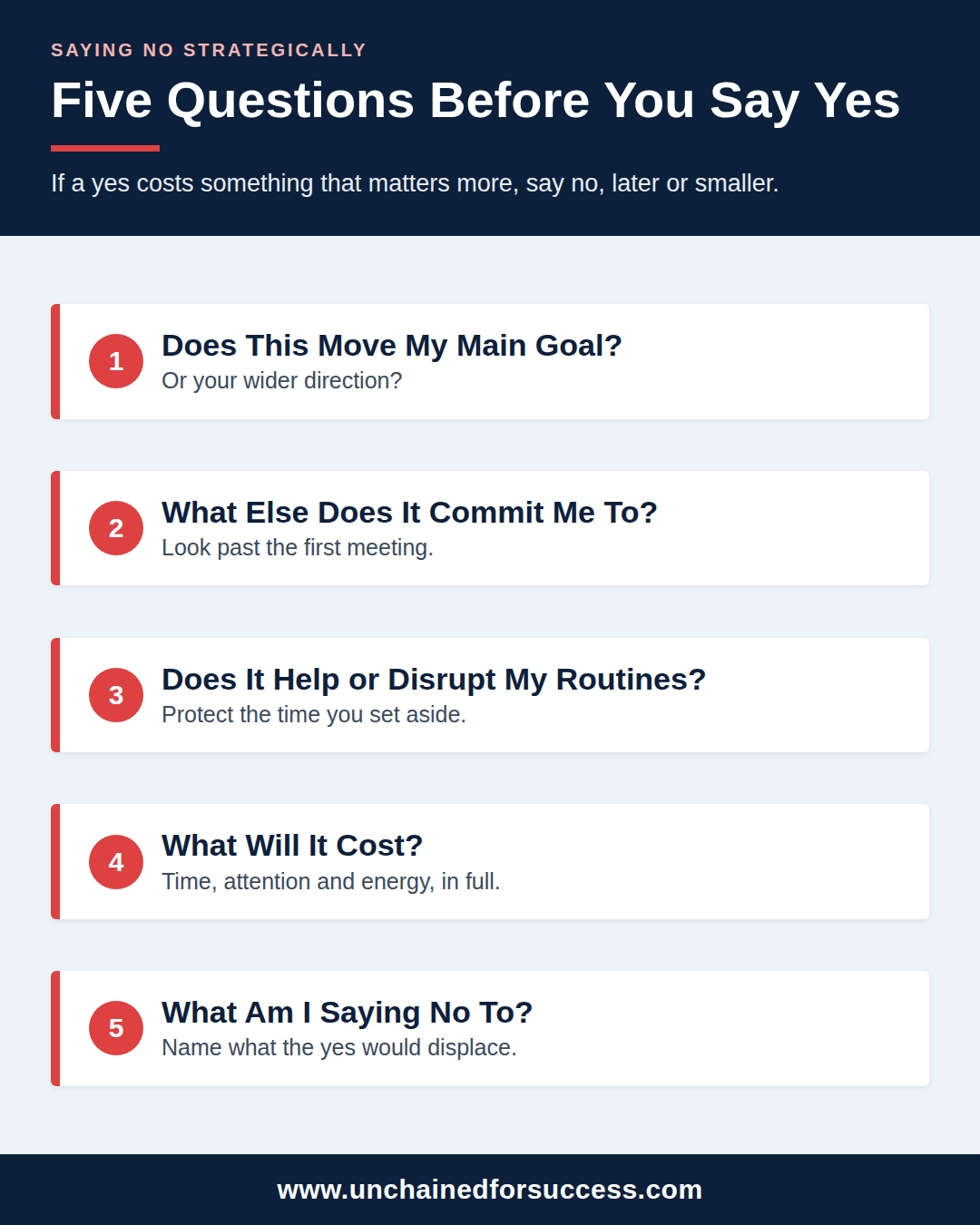
1. Does this support my priorities? Count your responsibilities as well as your main goal: family, essential duties and promises already made. A request that serves none of them is a candidate for no.
2. What else does it commit me to? Look past the first meeting to the follow-up work, the reporting and the expectations it creates.
3. Does it help or disrupt my routines? A request that lands in your protected time can cost more than one that does not.
4. What will it cost in time, attention and energy? Estimate the full time required, including preparation, travel, follow-up and repetition, not just the first hour.
5. What am I saying no to if I say yes? Every yes takes time from something. Name what that is.
The fifth question can be the most revealing, because it makes the hidden cost visible before you commit. If the answer is something that matters more, the request needs a no, a later date or a smaller version.
How to Say No Well
You do not have to answer on the spot, and that is where many unwanted yeses come from. "Let me check my commitments and come back to you" buys the time to run the questions, with a day you can meet attached.
When you are saying no strategically, a good no is short, respectful and clear. It explains the priority rather than defending yourself. For example: "Thank you for thinking of me. I am protecting my mornings for a qualification until the end of July, so I cannot join the group. I could review the final paper in August."
Three forms cover most requests. "I cannot take this on." "I can do it after 31 July." "I can help with the first draft, not the whole paper." A smaller offer still has a cost, so price it first.
Where you can, point to someone better placed. Treat that as an introduction to explore, not a promise on their behalf.
Four Mistakes That Undermine Saying No Strategically
Four patterns turn a sound no into a damaging one. Each undoes the work of saying no strategically.
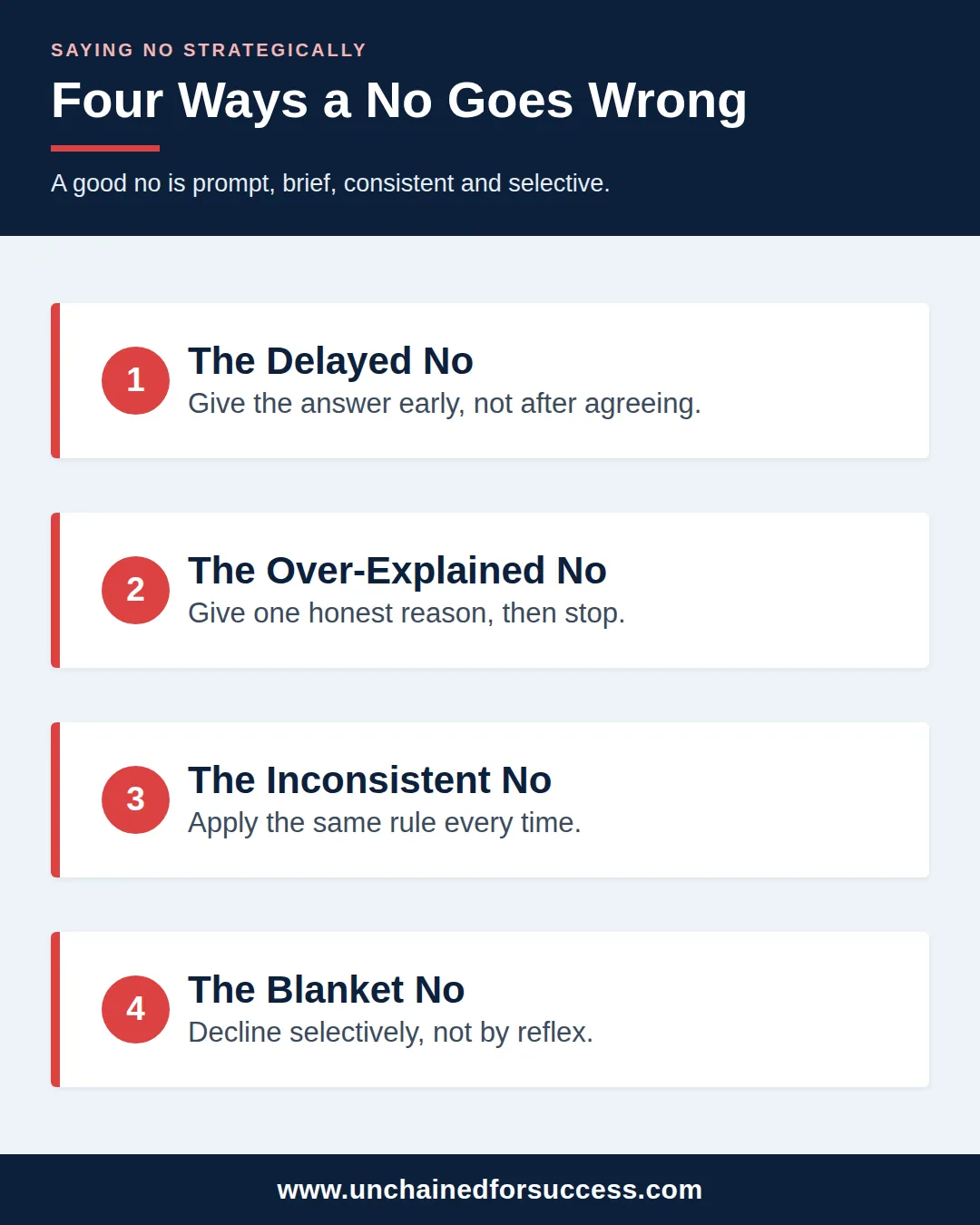
The delayed no. Agreeing now and withdrawing later can cost more goodwill than a clear no at the start. If the answer is no, give it early.
The over-explained no. A long, apologetic explanation can invite negotiation. Give one honest reason, linked to your priority, and stop there.
The inconsistent no. Declining one request and accepting a similar one soon after can teach people to keep asking. Apply the same decision principles every time, and say when the circumstances have changed. Consistent principles can still produce different answers.
The blanket no. Swinging from yes to everything to no to everything is a reaction, not a strategy. The aim is progress, not simply less activity, as Why Being Busy Doesn't Mean Progress explains. The aim is a selective no that protects what matters and leaves room for the requests that do fit.
Frequently Asked Questions About Saying No Strategically
Will saying no damage my relationships at work? Saying no strategically can damage a relationship if the no is late, vague or inconsistent. A prompt, respectful no that explains your priority and offers an alternative can be easier to accept than a yes you later fail to honour.
What if the request comes from my manager? For competing legitimate tasks, start by showing what the new request would displace, and ask which matters more. That turns a refusal into a shared decision about priorities, which is where it belongs. Some requests still warrant a plain no, and that is a different conversation.
How do I know which requests to accept? Write down your main goal, the priorities that serve it and the responsibilities you carry anyway. Then run each significant request through the five questions. If it fits, check the full cost against your existing commitments. Agree any changes with the people affected. Accept only when you have a credible way to deliver. If it does not fit, decline or defer it.
Start Saying No Strategically This Week
Saying no strategically is not a withdrawal from ambition. It is how ambition keeps its shape under pressure. Your time, attention and energy are finite, and if you do not decide where they go, other people's priorities are likely to decide for you.
Real progress does not depend on doing more. It depends on protecting the few things that matter, and defending that choice consistently when it is tested.
Before the end of today, find one commitment in your diary that no longer fits your priorities or responsibilities. Run it through the five questions. If it no longer fits, agree how to stop it, reduce it or hand it over, then put the recovered time into the action that matters most.
For the full method, read the Unchained Goals Framework overview, and the glossary explains the individual terms. The Goals Readiness Score is a short self-assessment if you want one: 18 questions, under five minutes.
The next article, Growth Without Burnout, looks at how to stretch without wearing yourself down.
Share the one yes you turned into a no, and what it made room for, in the comments.
What are you currently saying yes to that your main goal cannot afford?
Sources
• Why Strategy Execution Unravels and What to Do About It by Donald Sull, Rebecca Homkes and Charles Sull, Harvard Business Review, March 2015
• No One Knows Your Strategy, Not Even Your Top Leaders by Donald Sull, Charles Sull and James Yoder, MIT Sloan Management Review, February 2018
• A Better Way to Set Strategic Priorities by Derek Lidow, Harvard Business Review, February 2017
• If You Need Help, Just Ask: Underestimating Compliance With Direct Requests for Help by Francis J. Flynn and Vanessa K. B. Lake, Journal of Personality and Social Psychology, 95(1), 128 to 143, 2008
Continue Your Journey
Explore more resources from the Unchained Goals Framework: