


You set the goal with care. For a few weeks it went well. Then a busy month, a setback or simple tiredness took over, and now the goal sits untouched. When you want to recommit to your goals, it is tempting to wait until you feel ready, or to restart with a big push. Both can stall again within weeks.
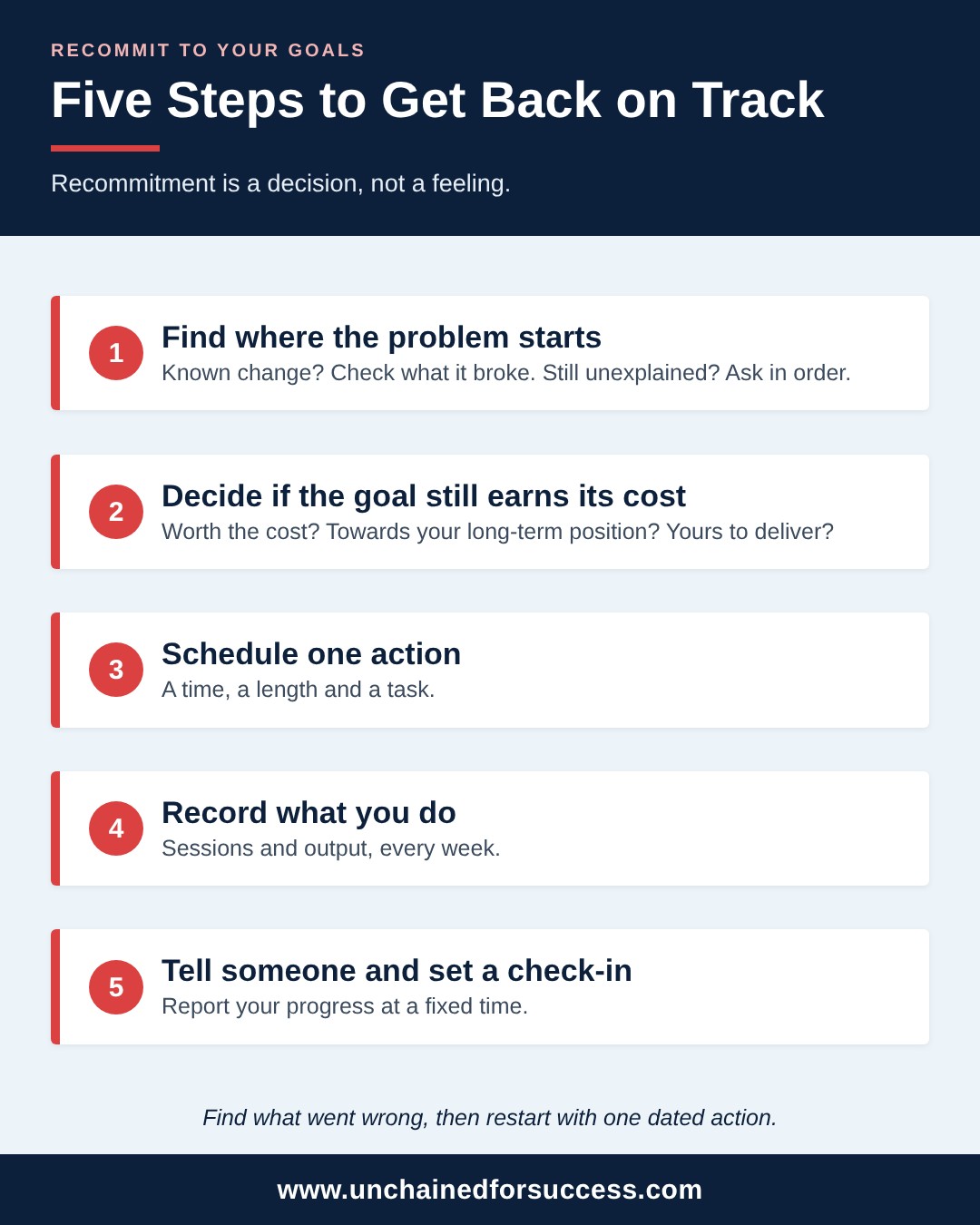
Recommitment is a decision, not a feeling. It holds best when you do three things in order: find out what pulled you off track, check the goal still deserves its place, and restart with one scheduled action that you record and share.
You do not need to feel ready to recommit. You need to know what went wrong and what you will do next.
Why Goals Drift Off Track
Drifting does not mean you are the wrong person for the goal. Goals drift for ordinary reasons: the plan assumed time you no longer have, a setback made the goal feel further away, or the work was never fixed to a time, so other demands took it. Each reason needs a different fix, so look back before you push forward.
Take an illustrative case. A logistics manager set a goal in January to finish the first draft of his book, 60,000 words, by 31 December. By May he had written 24,000. Then his company restructured, his evenings filled with work, and he stopped. It is now late July.
Step 1: Find What Pulled You Off Track
Write down what you planned, what happened and what got in the way. If you already know what changed, such as new working hours, start there: which part of your plan did that change break?
If the cause is not clear, or the known change does not explain the shortfall, ask two questions first. Did I do the work I planned? If I did, was it producing what the goal needed?
If both answers are yes, carry on up in order: the measure, the plan, whether you still believe it is possible, whether you still accept the cost, whether the reason still justifies it, and whether the result is still within your authority. Stop at the first answer that shows a problem.
The manager knew what had changed: the restructure had taken his evenings. The time slot was broken, not the writing. Before May he had been writing about 500 words an hour and keeping pace.
Be kind to yourself in this step. It is practical, not soft. In one experiment by Breines and Chen, students who treated a failed test with self-compassion studied longer for the retest than those in a control group, though their retest scores were no better. Blame can make a review defensive, and a defensive review struggles to find the cause.
Step 2: Decide Whether to Recommit to Your Goals at All
Before you recommit to your goals, check they still deserve it. Three questions settle it:
• Does the reason I started still justify what the goal now costs?
• Does it still move me towards the long-term position I have chosen?
• Is the result still within my authority to deliver?
The framework calls that long-term position your Vision. A goal that no longer serves it is a candidate to revise or retire. Retiring a goal after this check is not giving up. It is a decision made on evidence.
The manager's answers were all yes. The book still mattered enough to give up several hours a week for it, it still served the long-term position he had chosen, and finishing a draft was his to deliver. So the goal stood.
Step 3: Recommit to Your Goals With One Scheduled Action
Check the numbers first. He had 36,000 words left and about 22 weeks: roughly 1,650 words a week, or just over three hours at his pace. He found four hours he could protect: Tuesday and Thursday, 6 am to 7 am, and Saturday, 8 am to 10 am.
Then he restarted small: one Tuesday session, twenty minutes re-reading the last chapter and forty minutes writing. The full plan resumed the following week, and its margin of about 300 words a week covered the short first week. A small first step gets you moving. It does not replace the work the goal needs, so set the date the full plan resumes.
Step 4: Make Your Progress Visible
He kept a simple sheet: date, minutes written, words written. It showed whether the sessions were happening and whether they were producing enough.
Across 138 experiments, prompting people to track their progress improved goal attainment, more so when they wrote it down (Harkin and colleagues; mostly health goals).
Step 5: Recommit to Your Goals Out Loud
Tell one person what you are doing, by when, and when you will report back. The same research found tracking worked better when people reported their progress to others.
He told his partner and agreed a ten-minute check every Sunday evening: words written against the target. After the short restart week, that target rose from about 1,650 to about 1,700 words a week, comfortably inside the 2,000 his four hours produce.
In week four, a work trip cost him a Thursday, so he wrote on Sunday morning instead and the week's total still landed. He also noticed that writing before work was easier than he expected, and kept it.
Should You Wait for a Fresh Start?
It is tempting to restart on a Monday, the first of the month or New Year, and research by Dai, Milkman and Riis found more goal-related activity just after such dates. Waiting has a cost, though: in experiments by Koo and colleagues, people who could see a fresh start coming put less effort into goals they were already pursuing. So schedule the next session you can protect, whatever the date.
A Long Recommitment of My Own
By the time we executed a contract in 2025, I had spent seven years as part of a group working towards a large development vision. For years we had nothing to show for it. We gave time, family life and our own money, and people told us to give up.
At times we almost agreed. Each year we asked why we had started. The answer was that the work was bigger than us. When we saw young people dying in search of opportunity abroad, we remembered our reason.
We acknowledged the fatigue without calling it failure. Then we scaled the ambition back to a phase we could deliver. We tracked meetings, agreements and small wins, and we held each other to account.
Recommit to Your Goals: Frequently Asked Questions
What if the original date now looks out of reach?
Work out what is left and the time remaining, as the manager did. If the numbers do not close, change the date or the scope before you restart.
How soon will I know if it is working?
Set a review point when you restart. Weekly suits work that shows output each week. Review sooner if one bad week puts the deadline at risk.
Recommit to Your Goals This Week
• Find where the problem started.
• Check the reason, the direction and your authority.
• Schedule one action, with a time, a length and a task.
• Record what you do.
• Tell one person and set a check-in.
To find the weakest part of how your goals are set up, try the Goals Readiness Score: 18 questions, about ten minutes, with your results after the contact details step.
Where did your goal start to drift?
Further Reading
These ideas draw on the Unchained Goals Framework. Related posts: Recovering Momentum After Disappointment, Why Failure Isn't the Real Problem and Mid-Year Goal Review: Persist or Change Direction. See also the Vision glossary entry.
Sources
• Breines, J. G. and Chen, S. (2012). "Self-compassion increases self-improvement motivation." Personality and Social Psychology Bulletin, 38(9), 1133-1143. Available at: https://doi.org/10.1177/0146167212445599.
• Dai, H., Milkman, K. L. and Riis, J. (2014). "The fresh start effect: temporal landmarks motivate aspirational behavior." Management Science, 60(10), 2563-2582. Available at: https://doi.org/10.1287/mnsc.2014.1901.
• Harkin, B., Webb, T. L., Chang, B. P. I., Prestwich, A., Conner, M., Kellar, I., Benn, Y. and Sheeran, P. (2016). "Does monitoring goal progress promote goal attainment? A meta-analysis of the experimental evidence." Psychological Bulletin, 142(2), 198-229. Available at: https://doi.org/10.1037/bul0000025.
• Koo, M., Dai, H., Mai, K. M. and Song, C. E. (2020). "Anticipated temporal landmarks undermine motivation for continued goal pursuit." Organizational Behavior and Human Decision Processes, 161, 142-157. Available at: https://doi.org/10.1016/j.obhdp.2020.06.002.
Continue Your Journey
Explore more resources from the Unchained Goals Framework: