


Three clients ask a bookkeeper the same question in one week, about a tax portal none of them can work. She answers each one and moves on, which is what an unprepared mind does with a signal.
A month later a fourth client asks. In the weeks between, she had written one sentence about where the practice was going and started a Friday note of anything that surprised her. The three portal questions, remembered, had gone into the first note as a single line. So when the fourth asks, the line is already there.
She offers one client a free session to see whether it is wanted. It is, and two more ask. So she runs a second test. She offers three clients a paid pilot at a set price; two accept, and she checks that she can deliver the sessions alongside the bookkeeping.
Then she records the decision as a goal. A one-hour session on the portal, designed, priced and offered to every client, and run monthly from the start of the next quarter for as long as it is paid for.
By the end of that quarter the monthly session has run three times, paid for each time. The questions had been there since the first week. What changed was that she had a prepared mind by the fourth, and not before.
That is the power of a prepared mind, and it is a practice rather than a gift.
This article explains what Pasteur meant by the phrase, what one well-documented case shows a prepared mind doing, and a method for building one whose weekly part takes ten minutes.
Chance does not favour the lucky. It favours the person who has decided what to look for and keeps a record of what turns up.
What Pasteur Meant by a Prepared Mind
The line usually quoted comes from an address Pasteur gave on 7 December 1854, at the inauguration of the Faculty of Sciences at Lille, delivered at Douai. In the original French, « Dans les champs de l'observation, le hasard ne favorise que les esprits préparés »: in the fields of observation, chance favours only the prepared mind. He was defending the value of theory to young men bound for industry.
His point was narrow and useful: a discovery that looks like luck is an observation that only someone with the right preparation could read.
So the phrase is not about optimism or openness. It is about observation, and about what you bring to it. The prepared mind is one that knows what it is looking for and has a way of catching what it was not.
The Power of a Prepared Mind in One Documented Case
Fleming's own record is a clear one. In the paper that reported penicillin in 1929, he describes culture plates "set aside on the laboratory bench". Then this: around a large colony of a contaminating mould, the staphylococcus colonies "became transparent and were obviously undergoing lysis". Then comes the sentence that matters: "Subcultures of this mould were made and experiments conducted".
That is the shape of it, in the words of the man who did it. He noticed something that did not fit, and he tested it. The weekly method later in this article is my application of that shape to ordinary work. Fleming's paper supports observation followed by experiment, nothing more.
On my reading of the case, the preparation was years of looking at bacterial cultures. His testing came from a decision to treat an anomaly as a question rather than a mess.
The case is in this article for what it shows about a prepared mind, not as proof that noticing leads to breakthroughs. Not every anomaly is something. The power of a prepared mind is that it gives the one that matters a chance to be tested, at the cost of a short weekly note.
What Makes Us Miss What Is in Front of Us
Three writers who have studied unsought findings, read together, point to one thing: the finding depends on who is observing and what they bring to it. Van Andel (1994) catalogued unsought findings across many fields and defined serendipity as "the art of making an unsought finding". Yaqub (2018), working from the sociologist Robert Merton's archives, built a taxonomy of four mechanisms. The one that fits everyday work is observer-led, where the finding depends on who is observing.
Dew (2009) puts serendipity where prior knowledge, active search and chance meet, which is the three-part shape of the bookkeeper's story.
Two things get in the way. The first is having nothing to read the surprise against.
The bookkeeper's fourth client stood out because by then she had a position for the practice. In five years, the firm that owner-managed businesses in her town come to for advice on tax and systems, with the bookkeeping as the way in rather than the whole of it. Against that position, a repeated question about a tax portal looked like a service. Against no position, it looked like admin.
The second is having nowhere to put it. In my experience a surprise you do not write down is gone by Friday. Three surprises written down in a month start to look like a pattern. Most of that power is a short written record.
Build the Power of a Prepared Mind in Four Moves
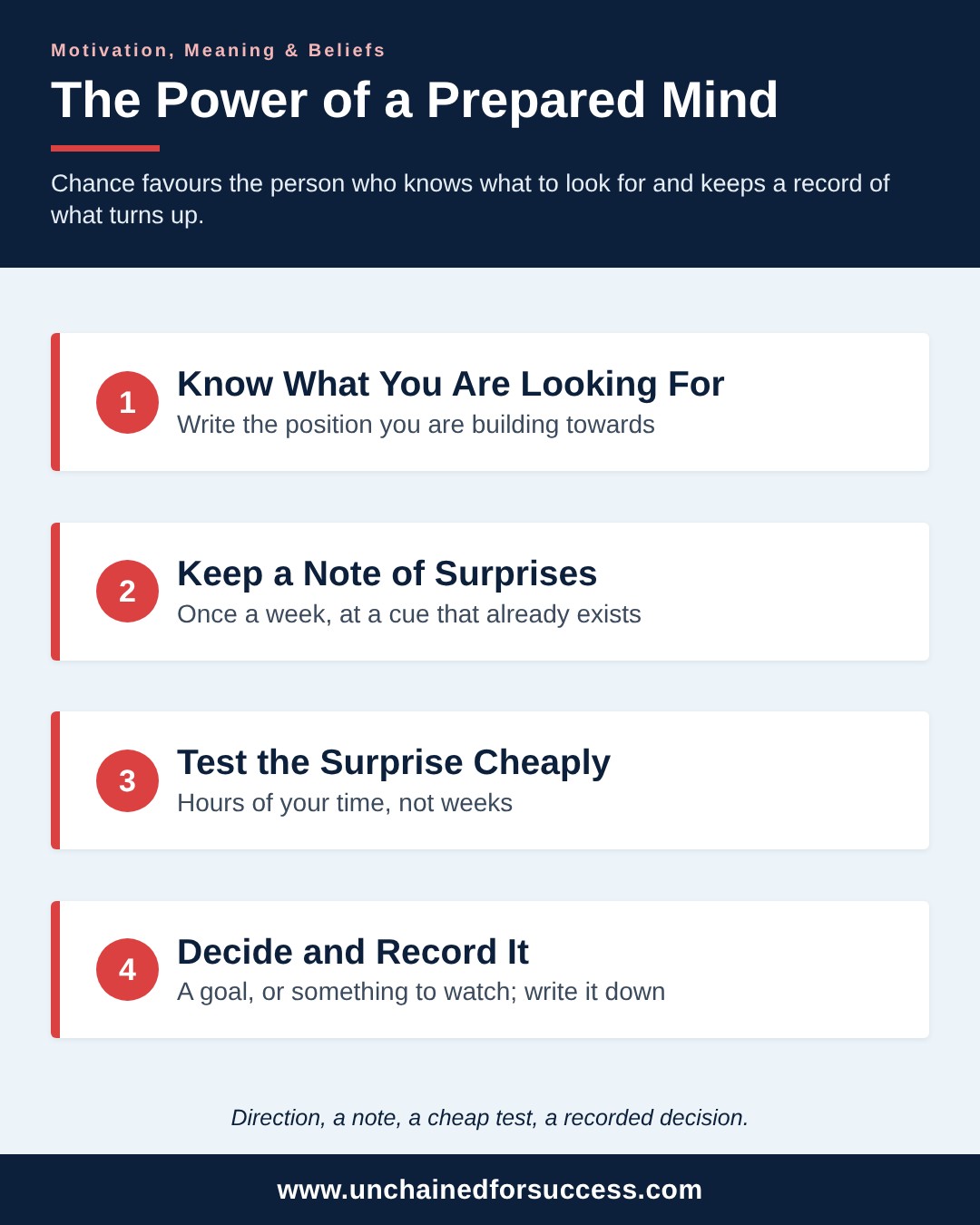
None of this needs a laboratory. It needs a direction, a note, a cheap test and a decision.
Know what you are looking for. Write down, in one or two sentences, the position you are building towards over the years ahead, a decade if you can see that far. What you will be, for whom, and within what limits, rather than the feeling. The Unchained Goals Framework calls this your Vision, and it is the filter that turns noise into signal.
A surprise that moves you towards it is worth a second look. A surprise that does not, you can let go without guilt.
Keep a note of what surprised you. Once a week is my recommendation, and the cadence matters less than the cue. At a time that already exists in your week, write down anything that did not fit. A question you were asked twice. Results better or worse than expected. Someone mentioning a tool, or a complaint from an unexpected direction. Three lines each. The bookkeeper's slot was Friday after invoicing, ten minutes, before she closed the laptop.
Test, Then Decide
Test the surprise cheaply before you dismiss it. Fleming made a subculture. The bookkeeper offered one session to one client at no charge and watched whether anyone else asked for it; then she offered three a paid pilot. My rule of thumb is that a test should cost hours of your own time, not weeks, even if the answer takes a few weeks to arrive.
It should also produce evidence you can act on. If the opportunity is commercial, the evidence that matters for a prepared mind is whether anyone pays and whether you can deliver it.
Decide, and record the decision. A surprise that passed its test either becomes a goal, with a result, a standard and a scheduled behaviour beneath it, or it goes back in the note as something to watch. Either way, write the decision down, so the same surprise does not get re-examined every month.
Where the Weekly Note Fits in Your Goal Design
The weekly note is a small, scheduled behaviour with a cue, the same shape as the behaviours that sit at the bottom of any goal in the framework. It serves no standard of its own; it is a discipline that keeps your plans honest when the ground changes, and the framework treats those disciplines the same way as the behaviours beneath a goal.
Repeat it at its cue for long enough and it needs less and less deciding, which is when the ordinary word for it is a habit.
In my experience it is also the kind of behaviour that drops first when the week fills up, which is why it needs a cue rather than an intention. Attach it to something that already happens, such as the Friday invoicing, the Monday team meeting or the walk home, and give it a fixed length. Ten minutes was enough for the bookkeeper; the record does not need to be good, only kept.
If the opportunities you notice keep failing at the decision stage, the fault may sit in the design of your goals rather than in your noticing. The Goals Readiness Score is 18 questions, about ten minutes, and it points to the weakest part of your goal design.
The Power of a Prepared Mind Starts This Week
Preparation is the part of luck you control. Fleming was prepared by years at the bench; the bookkeeper by a sentence about where her practice was going and a ten-minute slot on Friday. Both caught what they could have let pass.
1. Write your direction in one or two sentences.
2. Choose the weekly slot and its cue, and write down what surprised you this week, in three lines each.
3. Test one surprise cheaply.
4. Record the decision, whichever way it goes.
The power of a prepared mind is not that chance comes to you more often. It is that when it comes, you are already looking.
Write down the one thing that surprised you this week, and what a cheap test of it would be.
What did you notice this week that you have not yet written down?
Further Reading
Three related posts from this series: Reset Your Loops: Rewire Your Brain for Breakthroughs, How to Refine Your Vision Without Changing Direction and Why Ownership Changes Everything. The framework page sets out Vision in the build sequence.
Frequently Asked Questions
Is the power of a prepared mind just luck by another name?
No. Luck is the event; preparation decides whether you can read it. Pasteur's phrase is about observation, and Fleming's own account shows the two halves. On my reading, he noticed because years of looking at cultures had taught him what a normal plate looks like, and he tested because he treated the anomaly as a question.
How do I build a prepared mind if my work is repetitive?
Repetitive work is where repeated surprises are easiest to see, because the background is stable. The bookkeeper's opportunity was four versions of the same question. I would keep the weekly note for about a month before judging it, long enough for a repeat to show.
What if I notice opportunities but do not act on them?
Then look at the test and the decision first; the noticing is already happening. Make the test cheaper, so it costs hours of your time rather than weeks, and make it answer the question that matters, which for a commercial opportunity is whether anyone pays. Then write the decision down so the opportunity either becomes a goal or stops taking attention.
Does Research Support the Prepared Mind?
The sources behind this article describe serendipity; none of them tests the four-move method, which is the practical conclusion drawn here.
Fleming (1929) is the primary record of the penicillin observation and the experiments that followed it. Van Andel (1994) is a catalogue of unsought findings with a working definition. Yaqub (2018) is a taxonomy of mechanisms drawn from Merton's archives. Dew (2009) is a conceptual paper placing serendipity where prior knowledge, active search and chance meet. The last three are conceptual and literature-based; none measures an effect. Fleming reports his own experiments, not a method for others.
Sources
• Pasteur, L. (1854). Address at the inauguration of the Faculty of Sciences at Lille, delivered at Douai, 7 December 1854. In Œuvres de Pasteur, tome VII, Paris: Masson, 1939, p. 131. Available at: https://gallica.bnf.fr/ark:/12148/bpt6k7363q.
• Fleming, A. (1929). "On the antibacterial action of cultures of a Penicillium, with special reference to their use in the isolation of B. influenzae." British Journal of Experimental Pathology, 10(3), 226-236. Available at: https://pmc.ncbi.nlm.nih.gov/articles/PMC2048009/.
• van Andel, P. (1994). "Anatomy of the unsought finding. Serendipity: origin, history, domains, traditions, appearances, patterns and programmability." British Journal for the Philosophy of Science, 45(2), 631-648. Available at: https://doi.org/10.1093/bjps/45.2.631.
• Yaqub, O. (2018). "Serendipity: towards a taxonomy and a theory." Research Policy, 47(1), 169-179. Available at: https://doi.org/10.1016/j.respol.2017.10.007.
- Dew, N. (2009). "Serendipity in entrepreneurship." Organization Studies, 30(7), 735-753. Available at: https://doi.org/10.1177/0170840609104815
Continue Your Journey
Explore more resources from the Unchained Goals Framework: