
Search for high-performance habits and you will find the morning routines of famous people: the early alarm, the cold shower, the journal. A routine is a set of things you do. High-performance habits are different. They start from a result you want, a weekly standard that shows you are on track, and a planned behaviour that produces it. Repeat that behaviour at the same cue and it can become a habit that takes less effort to start.
Daily routines can help you succeed when each part serves a result. This post shows how to build them, in five steps.
Copying a routine borrows someone else's answer. Building a habit starts from your own result.
Why a Famous Routine May Not Work for You
A famous routine answers someone else's question. Their wake time and their journal fit their work, their body and their goals. And one person's success cannot tell you whether the routine caused it. Getting up early and achieving a great deal can each happen without the other.
Start with a different question: what does my result need me to do each week?
Step 1: Name the Result and Its Standard
Take an illustrative case. An operations manager wants to pass a Spanish B1 examination in June. She has 36 course units left and eighteen weeks to cover them, with two weeks after that for past papers.
That makes her weekly standard two units, each scoring at least 80 per cent on its test, a clear margin above the pass mark. The framework calls a standard like this a Performance Goal: a level you either meet or miss each week. Without one, you can keep a habit going for months without knowing whether it is moving you.
Unit tests show she is learning the course, not that she is ready for the examination. So on the first Sunday of each month, at 10 am, she also sits one timed section of a past paper, rotating through the skills the examination tests.
Step 2: Choose the Behaviour That Produces It
Each unit takes her about 45 minutes, so two units need about 90 minutes a week. A weekly online speaking lesson covers the speaking paper.
She writes the behaviour precisely: Monday, Wednesday and Friday, 6.45 am to 7.15 am, at the kitchen table, working through the next unit.
The framework calls this a Process Goal: something you can do, with a time or cue, a length and a task, that serves the standard above it. "Study more Spanish" has none of those.
The Daily Part of the Routine
One part runs every day: two minutes each evening noting what she did against the week's standard. It keeps the standard in view, so a slipping week shows up by Wednesday, not Sunday. Not all high-performance habits need to be daily. This one is, because it costs two minutes.
Step 3: Tie It to a Reliable Cue
High-performance habits form when the same behaviour follows the same cue. She writes hers as a plan: "If I have poured my first coffee on a Monday, Wednesday or Friday, then I open the next unit."
The cue does not have to be a clock time. A randomised trial by Keller and colleagues found no clear difference between tying a new behaviour to an existing daily activity and tying it to a set time. What matters is that it is reliable and specific.
How long until starting feels easy? It varies widely. In the best-known study, by Lally and colleagues, the estimates for simple daily behaviours ranged from 18 to 254 days. The often-quoted 66 days was the median, not a deadline. Judge your habit by whether it happens, not by how it feels in week three.
Step 4: Plan for Hard Days
Some mornings go wrong. For those she has a minimum version: ten minutes of vocabulary straight after her coffee, wherever she is. It keeps the cue in place and makes tomorrow's full session easier to start. It does not count as a unit. She makes up the missed unit on Saturday morning.
If she needs the minimum version most weeks, the full sessions are not happening, and she needs to find out why.
Step 5: Check High-Performance Habits Against the Standard
In week five, all three sessions happened, but both unit tests came in around 65 per cent. A streak tracker would have shown a perfect week. Her standard showed a problem.
So she asked in order. Did the sessions happen? Yes. Were they producing the standard? No: she was rushing new material without revising the last unit.
She made one change: five minutes of revision at the start of each session, starting at 6.40 am to keep thirty minutes for new work. That Saturday she revised the two weak units, then retook their tests and scored above 80 per cent, and two weeks later she cleared her margin on a timed practice section.
That order matters. If a session did not happen, ask what interrupted it. If it happened and the standard slipped, ask whether the behaviour can produce the standard. Only then question the standard itself, then the plan, whether you still believe the result is possible, whether you still accept the cost, whether the reason still justifies it, and whether the result is still within your authority. Stop at the first that shows a problem.
Review the good weeks too. They show which parts of your high-performance habits to keep.
What the Research Says About High-Performance Habits
Habits are behaviours that context sets off once they have been repeated there, according to a review by Wood and Rünger, which is why a stable cue matters. In six studies, people with more self-control tended to have stronger good habits, and those habits partly explained their better results (Galla and Duckworth); the studies measured links rather than testing a change. These studies support the ingredients. The link to a standard comes from the framework.
How I Track My Own Goals
I write a blog weekly and track my goals and habits using GoodNotes 6 and Apple Reminders. This ritual, anchored in my belief system, keeps me aligned with my long-term goals.
High-Performance Habits: Frequently Asked Questions
How many high-performance habits should I build at once?
Start with the one or two behaviours that produce your most important standard. Add more once those happen without much effort.
What if I miss a day?
Run the next session at its usual cue and make up the work. In Lally's study, missing one opportunity did not materially affect habit formation.
Build Your High-Performance Habits This Week
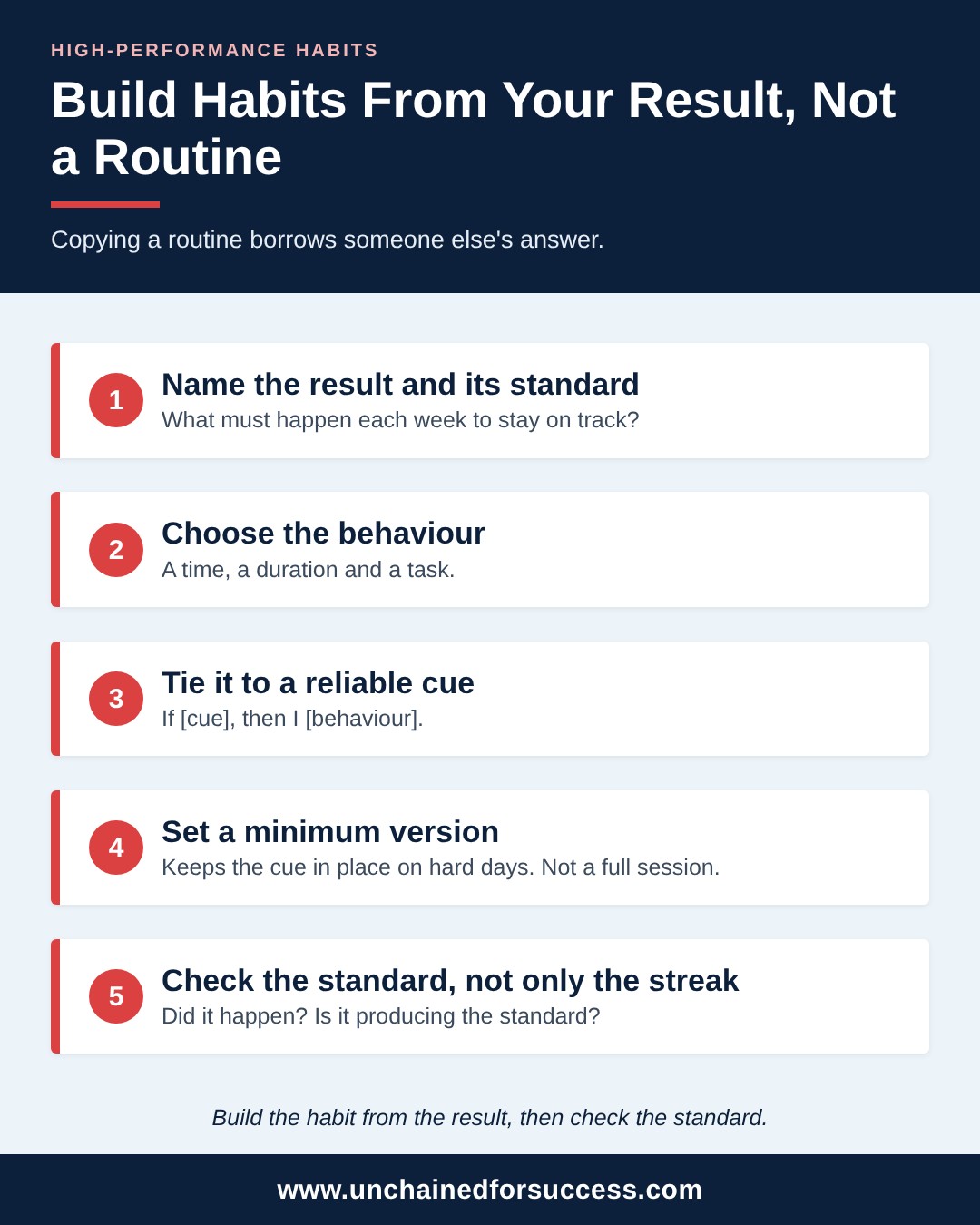
• Write the result and its weekly standard.
• Choose the behaviour that produces it, with when, how long and what task.
• Tie it to a reliable cue.
• Set a minimum version for hard days.
• Check the standard each week, not only the streak.
To see how well your goals are set up for habits like these, try the Goals Readiness Score: 18 questions, about ten minutes, with your results after the contact details step.
Which of your current habits serves a result you could name?
Further Reading
These ideas draw on the Unchained Goals Framework. Related posts: How to Build Habits That Stick, Why Consistency Fails: Even With Good Intentions and Standards Define Outcomes. Terms: Performance Goal and Process Goal.
Sources
• Galla, B. M. and Duckworth, A. L. (2015). "More than resisting temptation: beneficial habits mediate the relationship between self-control and positive life outcomes." Journal of Personality and Social Psychology, 109(3), 508-525. Available at: https://doi.org/10.1037/pspp0000026.
• Keller, J., Kwasnicka, D., Klaiber, P., Sichert, L., Lally, P. and Fleig, L. (2021). "Habit formation following routine-based versus time-based cue planning: a randomized controlled trial." British Journal of Health Psychology, 26(3), 807-824. Available at: https://doi.org/10.1111/bjhp.12504.
• Lally, P., van Jaarsveld, C. H. M., Potts, H. W. W. and Wardle, J. (2010). "How are habits formed: modelling habit formation in the real world." European Journal of Social Psychology, 40(6), 998-1009. Available at: https://doi.org/10.1002/ejsp.674.
• Wood, W. and Rünger, D. (2016). "Psychology of habit." Annual Review of Psychology, 67, 289-314. Available at: https://doi.org/10.1146/annurev-psych-122414-033417.
Continue Your Journey
Explore more resources from the Unchained Goals Framework: