


Executing under fatigue can affect the quality of the last work you do. I know this from writing books.
I am on my third book, and I will tell you from personal experience. You write the first two thirds with enthusiasm. If you are not careful, you will not finish the closing chapters well, and that undersells the book. Even when you have finished the whole manuscript well, reading it over and over again can get so boring that you no longer feel like reading it.
So the danger at the end is not always stopping. It is finishing badly: closing chapters that undersell the book, or close-out work done with less care than the work it completes. Research suggests motivation can even pick up as the end comes into sight. Wanting to finish is not the same as finishing well.
This post is for anyone finishing something that matters, whether a book, a qualification or a major project. It gives you four ways to keep executing under fatigue and still finish well.
What Executing Under Fatigue Looks Like at the End
On a personal goal, fatigue often arrives with doubt. Near the end, you can start questioning whether the goal is worth the effort and pain. That happens especially when you are incurring the different types of costs, but you are not seeing the benefit yet.
On a project, everyone can be fatigued at the end. The major structures are complete, and what remains is the finishing work that lets the client accept the works, use them or take them into maintenance.
UK construction recognises this risk. The Soft Landings framework, launched by BSRIA and the Usable Buildings Trust in 2009 and adopted by central government in 2016, exists to make the move from construction to use a planned stage of its own. Writing in the RIBA Journal, Gary Clark notes that Soft Landings research points to the three months either side of practical completion as critical to building handover, and that delays earlier in a project typically squeeze commissioning.
In both cases, the end is predictable. So the answer is not to hope your energy holds. It is to prepare for the finish before it arrives.
The end of a goal is when energy can run lowest and the work matters most. Prepare for it.
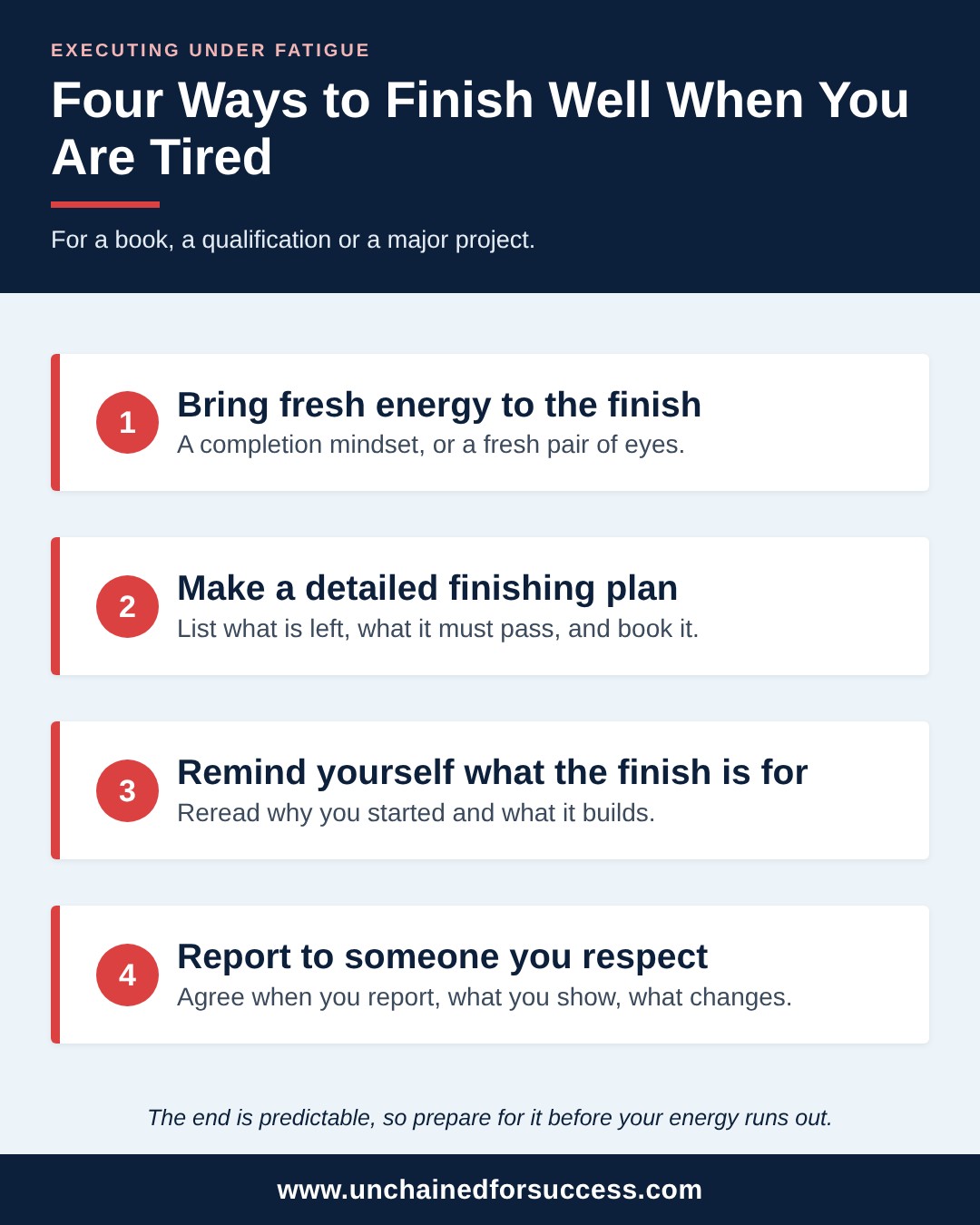
Four Ways to Keep Executing Under Fatigue
1. Bring Fresh Energy to the Finish
On a project, my answer is to have three different types of team: the set-up team, the delivery team and the completion team. Each brings a different mentality, and these three management teams will normally help the engineering team get across the line. Of course, some people, such as engineers, will be in delivery and will also be needed for close-out.
On a personal goal, you cannot hand the finish to someone else. You can still treat it as a new stage that needs a different mindset. Stop building and start closing. Ask what is left, what "finished" means, and what has to be true before you hand the work over. Where rereading has gone stale, a fresh pair of eyes, such as an editor, a colleague or a tutor, can see what you no longer can.
2. Make a Detailed Finishing Plan
Having a proper, detailed finishing plan is always important. List every remaining item, estimate the time each one needs, and book it. Give the closing chapters, or the close-out items, the same time and care you gave the opening ones.
For each important item, write down what must be true before you call it finished. A closing chapter, for example, should deliver what the introduction promised. For a handover, agree what the client needs to see before accepting the work. Book that check for a time when you can give it proper attention. If you keep rereading without being able to verify the work, stop and rebook the check.
Then keep the list short and visible, and look at what remains rather than how far you have come. Koo and Fishbach (2012) found that people close to a goal were more motivated when their attention was on what remained. Their study used loyalty schemes rather than books or projects, so applying it here is my reading.
In the Unchained Goals Framework, this is part of the Plan: the sequence, trade-offs and dependencies that organise the work. Unfinished Goals: Why They Stall Near the Finish shows how to build one.
3. Remind Yourself What the Finish Is For
On a project, a rejuvenation process and out days help people really remember why the project is being done, and the reason for completing well.
On a personal goal, when you start questioning whether it is worth it, reading the Why for the goal is what sometimes keeps you going. The Why is the reason that justifies the cost you are carrying. Then reconfirm the Vision the goal is helping to build, meaning the longer-term position you are working towards.
Research suggests that seeing who benefits can be even more powerful than reading about it. In Grant and colleagues (2007), fundraising callers who briefly met a scholarship student their work had helped were measured again a month later. Compared with their own earlier levels, they spent 142 per cent more time on the phone and raised 171 per cent more money. Callers who only read a letter from the student showed no such gain.
This was one fundraising organisation, but the lesson travels. On a project, put the finishers in front of the people who will use the work. On a personal goal, talk to one person your book, qualification or project will serve.
4. Report to Someone Whose Opinion You Respect
On a personal goal, an accountability partner whose opinion you respect very much helps you finish. The same is important on projects.
Agree when you will report back, what you will show, and what you will change if the work falls short. Harkin and colleagues (2016) reviewed 138 randomised studies. Progress monitoring helped people reach their goals, and effects were larger in studies where progress was recorded or shared. So show your partner tangible progress, not just a sense of how it is going.
Put Executing Under Fatigue Into Practice This Week
Take the goal or project you most want to finish, and answer four questions:
1. What would a fresh mindset, or a fresh pair of eyes, bring to the finish?
2. What is left, what must each item pass, and when have I booked the work and the check?
3. Why did I start, and who will benefit when I finish?
4. Who will I report to, and when?
If you cannot answer one of them, start there.
Common Questions About Executing Under Fatigue
What if the goal no longer seems worth it?
Read your Why first. If it no longer justifies the cost, decide on purpose rather than drift. Why People Lose Motivation at the End of the Year shows how to continue, pause or retire a goal.
What if I am too tired to do the work properly tonight?
Then do something you can do well, or stop and rebook. How to Finish Strong When Energy Is Low covers that choice. For driving or safety-critical work, follow the fatigue and safety procedures that apply.
Finish Well When Executing Under Fatigue
The end of a goal is predictable, for a book, a qualification or a major project. Bring fresh energy to the finish, plan it in detail, remind yourself and your team what it is for, and report to someone whose opinion you respect.
This week, answer the four questions above for the goal you most want to finish.
To see which part of that goal is weakest, you can also try the Goals Readiness Score. It is 18 questions, about five minutes, with your results after the contact details step.
Which of the four is missing from your finish?
Further Reading
These ideas draw on the Unchained Goals Framework. For the costs you accept when you take on a goal, see Why Ownership Changes Everything.
Sources
• Bonezzi, A., Brendl, C. M. and De Angelis, M. (2011). "Stuck in the middle: the psychophysics of goal pursuit." Psychological Science, 22(5), 607-612. Available at: https://doi.org/10.1177/0956797611404899.
• Clark, G. (2016). "Mandatory post occupancy evaluations on government projects demand clear strategy on performance and handover." RIBA Journal, 6 July. Available at: https://www.ribaj.com/intelligence/riba-stage-6-and-7-revolution-or-evolution/.
• Grant, A. M., Campbell, E. M., Chen, G., Cottone, K., Lapedis, D. and Lee, K. (2007). "Impact and the art of motivation maintenance: the effects of contact with beneficiaries on persistence behavior." Organizational Behavior and Human Decision Processes, 103(1), 53-67. Available at: https://doi.org/10.1016/j.obhdp.2006.05.004.
• Harkin, B., Webb, T. L., Chang, B. P. I., Prestwich, A., Conner, M., Kellar, I., Benn, Y. and Sheeran, P. (2016). "Does monitoring goal progress promote goal attainment? A meta-analysis of the experimental evidence." Psychological Bulletin, 142(2), 198-229. Available at: https://doi.org/10.1037/bul0000025.
• Koo, M. and Fishbach, A. (2012). "The small-area hypothesis: effects of progress monitoring on goal adherence." Journal of Consumer Research, 39(3), 493-509. Available at: https://doi.org/10.1086/663827.
• Local Government Association (n.d.). "Soft landings for public sector." Available at: https://www.local.gov.uk/case-studies/soft-landings-public-sector.
Continue Your Journey
Explore more resources from the Unchained Goals Framework: