
Take an illustrative case. A commercial lead leaves a rail programme after four years. Eighteen months later, the contract review she set up still runs on the first Tuesday of the month. The two package managers she trained are still making their own commercial decisions. A rule she drafted and argued for on early-warning notices is still saving the programme arguments. Nobody on the programme would call that building legacy. It is.
Building legacy is what you leave running, not what people say at your leaving do. The leaving do is the wrong measure. The right one is what the team still does, and still can do, a year after you have gone. By that measure a leader can leave less than they think, or far more than their title suggested.
This article is about leading beyond your role in that practical sense. It means choosing what should still be working after you have gone, and putting it in place while you are there. It applies to a programme director and to a team leader of four.
Your title ends on your last day. What you built into other people and into the way the work is done can outlast it, if you built it to run without you.
Building Legacy Starts With a Problem, Not a Position
The job description tells you what you are responsible for. It does not tell you what you have taken responsibility for, and the two are different. The commercial lead's job was the contracts on one programme. The problem she had taken on was wider: programmes that lose money and trust because commercial disputes surface too late. That problem did not end when her contract did, and it shaped what she chose to build.
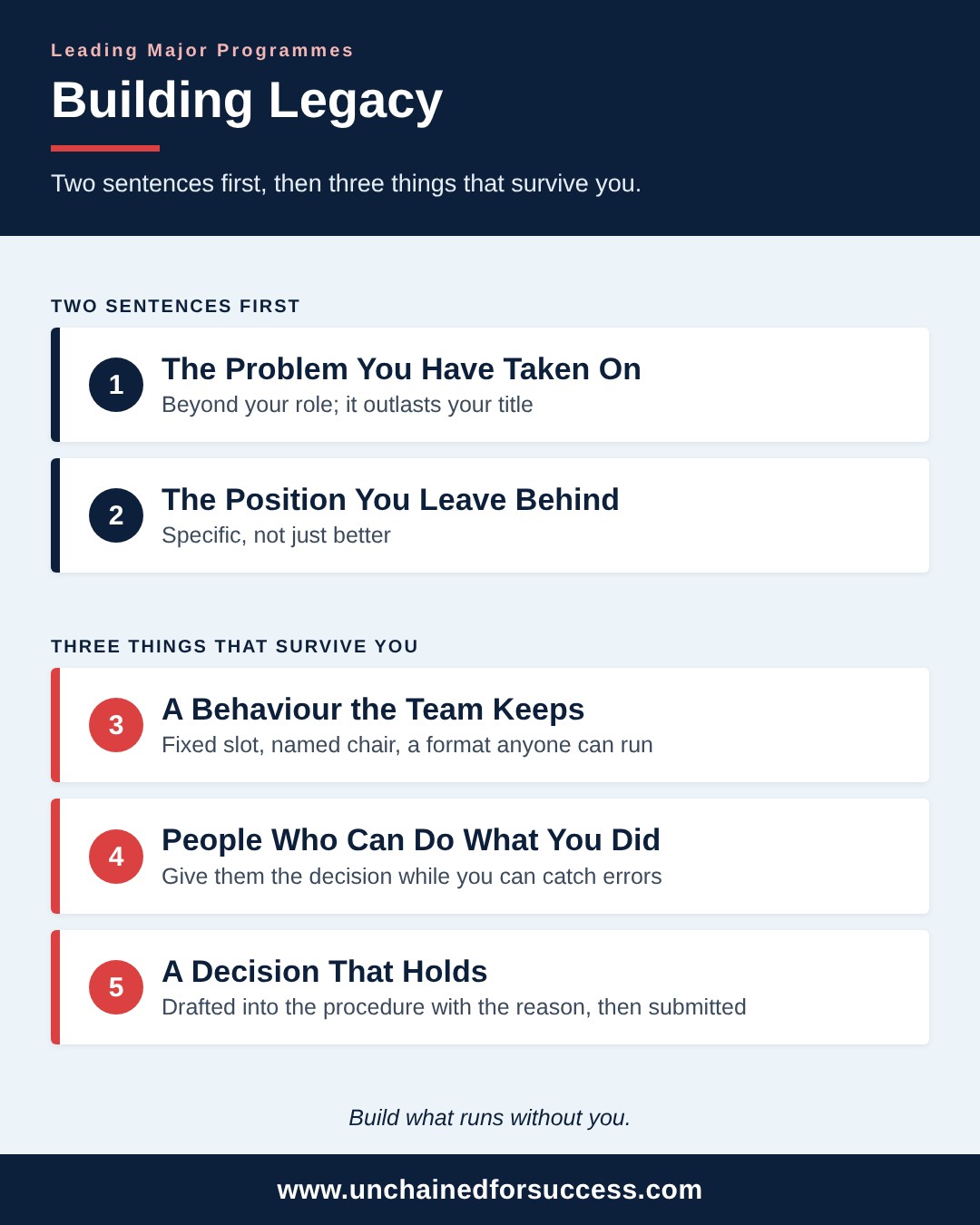
Write yours down in a sentence. Not the role, but the problem in your field that you have decided is yours to work on, and what that rules out. The Unchained Goals Framework calls this your Purpose, and building legacy starts there, because a problem outlasts any position you hold.
Then write the second sentence: the position you want the team or the programme to be in after you have left. Not "better", but specific. For the commercial lead it was a programme where every package had a trained commercial owner. Disputes would surface at the first early-warning notice rather than at final account. That is the direction, which the framework calls Vision, and she chose everything she built against it.
What Building Legacy Looks Like in Practice
In my own work on programmes, turnarounds often came from leaders who stepped up beyond their assigned duties, not from new systems. That is the shift this article is about.
Three kinds of thing can survive a leader's departure, and building legacy means designing each one.
A behaviour the team keeps. The first-Tuesday contract review survived because it had a fixed slot, a named chair who was not the commercial lead, and a one-page format anyone could run. She built it to run without her from the second month.
People who can do what you did. She gave two package managers commercial decisions to make, within agreed decision limits, while she was still there to catch the errors. That is the kind of mentoring I would build: letting people make the decision, with you there to catch errors, rather than advising them on it.
The research on mentoring in general is honest about the size of the effect. Eby and colleagues (2008) pooled 112 studies across youth, academic and workplace settings. Mentored people did slightly better on performance and in their working relationships. The effects were small throughout, the authors cautioned against overestimating them, and many of the studies were cross-sectional, so they cannot show cause.
Allen and colleagues (2004) reached the same conclusion for career outcomes, with small effects on objective measures. A small association is still a reason to build it, and building legacy through people is the part that compounds.
A decision that holds. She drafted the early-warning rule into the programme's commercial procedure with the reason recorded, submitted it, and the director adopted it. A decision that lives only in your head leaves with you.
What a Speech About the Future Needs for Building Legacy
A leader who wants to leave something behind may reach for a vision speech. One study is worth knowing before you give it. Grant (2012) ran a quasi-experiment with call-centre employees. Transformational leadership, the kind that articulates a vision and appeals to values, raised short-term performance mainly when the employees had met the people who benefited from their work. "Rhetoric alone", in his words, "may not be sufficient".
That is one setting and a short-term measure. For a programme leader the practical reading is this: put the people doing the work in front of the people the work is for. On the same logic, a site team that has met the hospital staff who will use the building has a reason for the work. Drawings rarely give it that. Grant's employees were in a call centre, so treat this as my application, not a tested result.
The connection is something you can arrange while you are there, and nothing about it depends on you staying.
Leading Beyond Your Role Without Overreaching
Leading beyond your role is not doing other people's jobs, and it is not ignoring the authority you actually have. The test is the same one the framework applies to any goal. Is the result within your authority to govern, so that if it drifts you can act on its causes?
The commercial lead could set up the review, train the two managers and draft the procedure change. She could not adopt the procedure alone; that sat with the programme director. So her goal was the drafted change, submitted with the evidence, and the adoption was the hoped-for consequence.
In my experience, building legacy on things outside your authority tends to produce frustration, not legacy. Building it on the things inside your authority, and arguing well for the rest, is how the rest sometimes follows.
Protect your actual role while you do it. The contracts still needed managing. A leader who leaves a legacy at the cost of the job they hold has left a different kind of record.
One Question to Ask Every Week
Building legacy does not happen in a defining moment. It happens in the way ordinary weeks go. One question, asked at a fixed point each week, is my recommendation for keeping it in view. What did I do this week that will still be working when I am not here?
Some weeks the honest answer is nothing, and that is information about building legacy too. In my experience, after a few months the answers show you whether you are building anything or only delivering. The commercial lead kept the question in her Friday notes. Six months after she started asking it, the list had the review, the two managers and the procedure change on it, and not much else. That was enough.
If the answers keep coming back empty, the gap may sit in the design of your goals rather than in your intent. The Goals Readiness Score is 18 questions, about ten minutes, and it points to the weakest part of your goal design.
Building Legacy: Start Before You Need To
The best time to start is well before you leave, years if you can. The things that survive need time to become the team's rather than yours.
1. Write the problem you have taken responsibility for, beyond your role.
2. Write the position you want the team or programme in after you have gone.
3. Choose one behaviour to build so that it runs without you.
4. Give one person a decision to make, within agreed limits, while you are still there to catch errors.
5. Record the reason behind the decisions you want to hold.
Building legacy is leading beyond your role in the one way that lasts: by making yourself unnecessary to the things that matter most.
Write down the one thing you are building that should still be running after you leave.
What would still be working in your team a year after you left it?
Further Reading
Three related posts from this series: Why Ownership Changes Everything, Taking Responsibility: Five Practices to Help You Grow and Long-Term Thinking in a Short-Term World. The framework page sets out Purpose and Vision in the build sequence.
Frequently Asked Questions
Can you work on building legacy without a senior role?
Yes. The three things that survive a departure are all available to a team leader of four: a behaviour the team keeps, a person who can do what you did and a decision that holds. What changes with seniority is the scale, not the method.
Is leading beyond your role the same as overstepping?
No. The test is authority. Build what is yours to build, submit what is not with the evidence, and keep doing the job you hold while you build.
How do I know whether what I am building will last?
Try to step out of it while you are still there. Hand the review to someone else to chair, let the person you trained make the decision, and see whether the thing runs. If it needs you back before it has run a few cycles without you, it is not yet built.
Does Research Support Building Legacy This Way?
The sources below describe mentoring and vision-led leadership; none tests the method here, which comes from the framework's architecture and from programme practice.
Eby and colleagues (2008) pooled 112 studies and found small positive associations between being mentored and performance, helping others and working relationships, across youth, academic and workplace settings. Many of the included studies were cross-sectional, so the pooled result does not establish cause. Allen and colleagues (2004) reached a similar conclusion for protégés' career outcomes, with small effects on objective measures.
Grant (2012) combined a quasi-experiment with call-centre employees and a survey of government employees. Its finding concerns short-term performance when transformational leadership is paired with contact with beneficiaries, not legacy.
Sources
• Eby, L. T., Allen, T. D., Evans, S. C., Ng, T. and DuBois, D. L. (2008). "Does mentoring matter? A multidisciplinary meta-analysis comparing mentored and non-mentored individuals." Journal of Vocational Behavior, 72(2), 254-267. Available at: https://doi.org/10.1016/j.jvb.2007.04.005.
• Allen, T. D., Eby, L. T., Poteet, M. L., Lentz, E. and Lima, L. (2004). "Career benefits associated with mentoring for protégés: a meta-analysis." Journal of Applied Psychology, 89(1), 127-136. Available at: https://doi.org/10.1037/0021-9010.89.1.127.
• Grant, A. M. (2012). "Leading with meaning: beneficiary contact, prosocial impact, and the performance effects of transformational leadership." Academy of Management Journal, 55(2), 458-476. Available at: https://doi.org/10.5465/amj.2010.0588.
Continue Your Journey
Explore more resources from the Unchained Goals Framework: