Effort is the part everyone can see. Process goals are the part that decides whether the effort adds up to anything. Two people can work just as hard for a month and end it in different places. One of them repeated the right behaviour on a schedule. The other simply worked.
This post covers what process goals are and where they sit in the Unchained Goals Framework. It then shows how to write ones you will do, and how to track them without a dashboard nobody reads.
What Process Goals Are, and What They Are Not
Process goals are the behaviours you control and repeat. You set them at a fixed cadence. They produce the standards your result needs.
Two differences matter here, and both are easy to miss.
First, a process goal is a behaviour, not a quantity. "Draft proposals on Monday and Thursday mornings" is a process goal. "Four proposals a week" is a standard. That sounds like a small point. It is the gap between a thing in your calendar and a thing in a report.
Second, process goals are not a softer version of the result. They do not replace the outcome. They are the point where the goal is translated into directly executable behaviour, so they are where daily work becomes clear. Every Goal in the framework sits inside the owner's authority; process goals are simply the closest of them to what you actually do on a Tuesday.
Why Effort Alone Does Not Produce Results
Effort without a defined behaviour asks you to decide it again every morning. That means it competes, every morning, with whatever is loudest.
Under that set-up, the work that gets done is the work with the nearest deadline. Quiet work that builds over time loses out. Not because you chose against it, but because nobody chose for it.
There is a second problem. Effort with no standard gives you nothing to check. You can work hard all month, then still not know whether week two was on track. Why Being Busy Doesn't Mean Progress covers what that looks like from the inside.
Where Process Goals Sit in the Execution Spine
The Unchained Goals Framework places them inside the Directional Execution Spine, which runs in four stages.
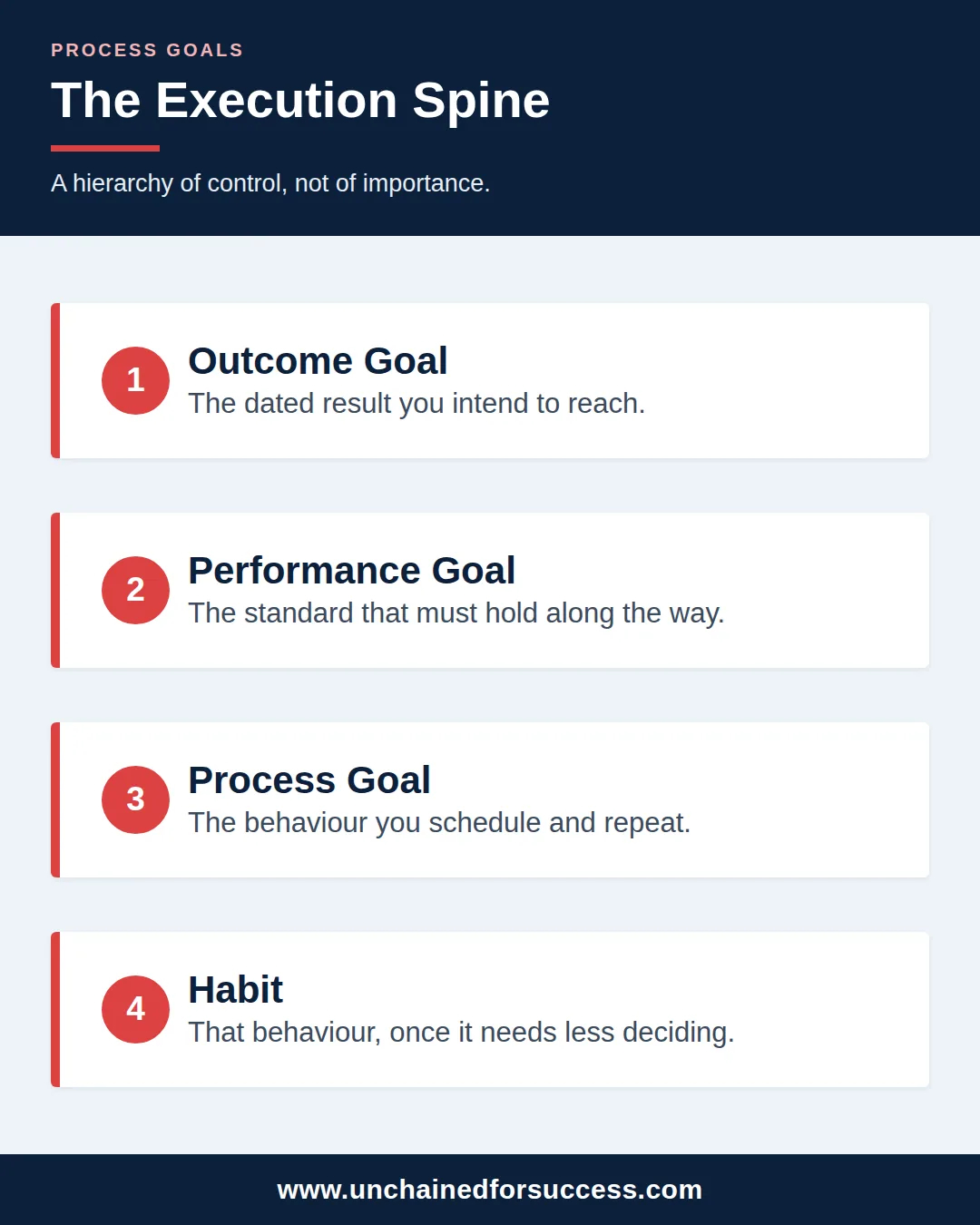
An Outcome Goal is the dated result you want to exist. Every Goal in the framework must be Stretched, Specific, Measurable, Time-bound and Under your control, the five conditions shortened to SSMTC. Within the spine, though, each type of Goal does a different job.
Test the Outcome against the five first. The last one asks whether you hold enough authority over the main causes to steer the result. If you do not, the framework calls it a dream and asks you to turn it into something you can steer.
Performance Goals set the standards and ranges that show whether you are on track before the result arrives. They are your early warning. Standards Define Outcomes goes further into how to choose them.
Process Goals are the behaviours you control that produce those standards. Habits are those same behaviours once repeating them makes each one need less deciding.
The framework calls this a hierarchy of control rather than importance. Every Goal sits inside the owner's authority; each step down simply brings you closer to something you can execute directly. So process goals are where a goal stops being a statement and starts happening on a Tuesday.
How to Write Process Goals People Actually Do
A complete process goal names the behaviour and says when it happens, or what will trigger it. Two further choices then make it easier to keep. Write all five lines down before you start, not after the first week fails.
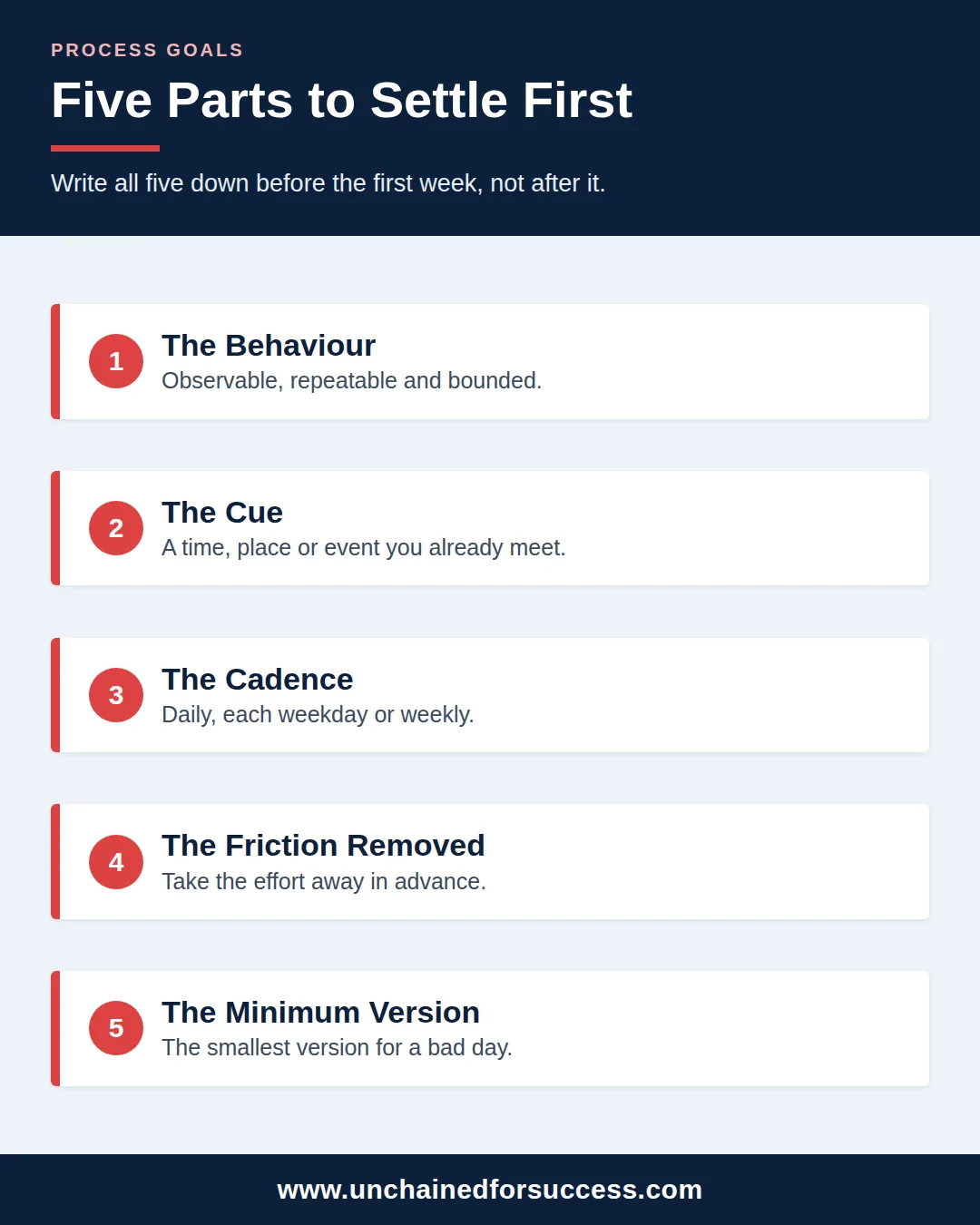
The behaviour. You can see it, repeat it and say where it ends. "Communicate better" cannot settle, because nobody can tell whether it happened. "Send the client a written update by 16:00 on Friday" can.
The cue. A stable time, place, preceding event or condition. Without one, the behaviour relies on memory and goodwill, and both run out.
The cadence. Daily, each weekday or weekly. Pick the lowest one that still produces the standard. Work out the arithmetic between the behaviour and the standard deliberately, rather than assuming it.
What Habit Design Adds to Your Process Goals
Those three are the process goal. A quantity can sit inside them, specifying how long the behaviour runs or how often, but it cannot replace the behaviour. The next two are what the framework calls habit design, and they decide whether the behaviour survives a hard week.
The friction removed. Name what currently makes it effortful and take that away in advance. Papers gathered the night before. A template already open. A recurring calendar hold nobody can book over.
The minimum version. Decide now what the smallest version is on a bad day. Fifteen minutes instead of an hour. A short checkpoint instead of a full review. It protects continuity, which matters more than intensity, but it may not produce the full standard, so repeated use is a reason to look again at the plan.
That last part matters more than it looks. A behaviour with no smaller version tends to disappear on a bad week rather than shrink, and some people push harder instead, past what they can keep up. Either way the pattern breaks.
What the Evidence Says About Plans and Progress
Three findings matter here, and each has limits.
Specific and difficult goals beat "do your best" instructions. Edwin Locke and Gary Latham's 35-year review draws on well over 100 tasks and more than 40,000 participants, though it synthesises earlier work rather than reporting a new experiment.
Goals paired with feedback also beat goals on their own. Our reading of that, for this post, is that it argues for pairing the behaviour with a standard you actually check, not for the behaviour on its own.
A plan that names a cue appears to work better than one that names only a time. Peter Gollwitzer's work on implementation intentions describes the format "when situation x arises, I will perform response y".
A 2025 review by Paschal Sheeran, Olivia Listrom and Gollwitzer pooled 642 tests. The benefit was smaller than earlier reviews had reported, and smaller again once the authors allowed for the tendency of positive results to reach publication. It held, though, and plans tied to something that already happens did better than plans tied only to the clock.
That is worth knowing when you choose the cue.
What Tracking Adds, and What It Does Not
Checking progress helps, within limits. Benjamin Harkin and colleagues pooled 138 studies covering 19,951 people. Prompting people to track progress raised goal success by a modest but consistent margin, and writing progress down did better than keeping it in your head. Almost all of that work sits in health behaviour, so using it for work goals is our reading.
One caution sits in the same paper. Tracking rose a great deal while success rose only a little.
Process Goals in Practice
The people and teams below are illustrations, not clients. Each shows an Outcome Goal, a standard, and the process goals that produce it.
An Individual Studying and Caring at Once
Priya works four days a week. She spends Tuesday and Thursday evenings with her father, who needs help after an operation. She is also halfway through a diploma that keeps slipping.
Her Outcome Goal is to submit her four remaining modules by 31 December. The standard she holds is one module finished every six weeks, checked against the published marking criteria before she submits it, so the standard never waits on a tutor's timing. Her process goals are 45 minutes of writing before work on Monday, Wednesday and Friday, and a two-hour block on Sunday afternoon.
The caring evenings are fixed first. Her minimum version on a difficult morning is fifteen minutes with the draft open, which keeps the rhythm rather than the word count. If she is reaching for it week after week, that is a signal to reopen the plan, not to quietly accept a slower module.
A Consultancy Rebuilding Its Pipeline
A four-person consultancy wins work by referral and has no pipeline it can see.
Their Outcome Goal is £240,000 of signed work for the year beginning 1 July. Before adopting it they test it against what the framework calls the Control Boundary. Do they hold enough authority over the main causes of that result to steer it and correct it when it drifts?
They decide who they approach, what they offer, the price, the quality of each proposal and how they follow it up, so they do. No client is obliged to sign, and the framework does not ask for that certainty.
Two assumptions make the goal governable, and both are written down. Their last two years converted between one in three and one in four qualified proposals, and their average signed value was £20,000.
At four qualified proposals a month, the bottom of that range meets £240,000 exactly and the top of it clears the goal comfortably. If conversion falls below one in four for two months running, the correction is theirs to make: raise the qualifying bar, change the offer, or reprice.
The standard they set is four qualified proposals a month, each priced at £20,000 or above and issued only where a scoping call has already happened. Issuing a proposal is theirs to decide; signing one is not.
Their process goals are a Monday morning writing block for the lead partner, and a Thursday afternoon hour in which two others each make three follow-up calls. Both go in the calendar as recurring holds, and neither is booked over.
A Project Team Under Schedule Pressure
A delivery team keeps missing interface decisions, and the schedule is slipping quietly.
Their Outcome Goal is to have every handover deliverable complete, reviewed and submitted by 14 December. That wording is deliberate: acceptance rests with the client, so the team governs what it submits and when, not the signature on the other side.
The standard they hold is every open interface action given a written position and a named owner within ten working days, kept inside an agreed range, because issuing the position is theirs to decide and the other party's reply is not. Their process goals are a 45-minute interface review every Tuesday at 10:00 with a standing agenda, and a Friday update of the action log by a named owner.
Under delivery pressure the review shrinks to twenty minutes rather than disappearing. That is the minimum version, agreed in advance. It keeps the pattern alive, and it may not clear the same volume of actions, so they also agreed in advance that two or three weeks of running short reopens the plan rather than relaxing the standard.
Tracking Process Goals Without Building a Dashboard
Here the framework is specific, and the specificity is worth having.
Performance measures are the main operating signals on the dashboard. The Control System does not watch intention or effort, and it does not run a tracker of every behaviour. It watches measured Performance, because that is the early sign of whether the Outcome will arrive, and it confirms the Outcome itself less often.
That does not mean the behaviours go unrecorded. Keep light evidence that the process goals happened, because that is where diagnosis starts when a below-range result meets its agreed trigger. A tick against a repeating calendar entry does it. The consistency of a behaviour is promoted to a dashboard measure only where you judge it a material early signal and define it deliberately as a Performance standard.
Agree two things in advance, before any pressure arrives. The range is the band of results you will treat as normal variation. The trigger is the point at which a result below that band stops being noise and needs action: how far below, how often, and with what consequence. Only when a below-range result meets that trigger do you start working back through the behaviours.
That rule stops two mistakes. One is measuring nothing, then having no idea why the result missed. The other is measuring everything, then mistaking a full tracker for progress.
Four Mistakes That Weaken Repeatable Behaviour
Writing a quantity and calling it a behaviour. "Ten calls a week" tells you nothing about when they happen, so the week decides for you.
Leaving out the cue. A behaviour with no trigger competes with everything else at the moment it should start, and it loses more often than it wins.
Starting too many at once. Each new behaviour draws on the same capacity. Cut the load until it holds, then add. Capacity Before Goals covers why this order matters.
Breaking the link to the standard. A behaviour that produces nothing you can measure is just activity. Trace every behaviour to a standard, and that standard to the dated result.
Frequently Asked Questions About Process Goals
How many should I have at once? Enough to produce the standard and no more. A small set you can keep through a difficult month is worth more than a long list you drop when the month turns, because every new behaviour draws on the same capacity.
What if I keep the behaviour and still miss the standard? That is useful to know. The framework checks in a fixed order rather than guessing.
Did the behaviour actually happen? Can the process produce the standard even when it does? Is the standard measuring the right thing? Only if those three hold do you look beyond them, at the plan, then the beliefs you hold about yourself and the goal, then the cost and consequences you accepted, then why the goal is still worth that cost. Whether the result was ever yours to govern comes last, not first. Why Consistency Fails walks through that sequence.
Do process goals ever become automatic? They get easier to start. Repeating them in the same setting cuts how much deciding each one needs, which is what Habit Conversion describes. How to Build Habits That Stick covers the design that makes it happen.
Write One Set of Process Goals Before the Diary Fills
Effort you can see is not the same as effort that adds up. Process goals turn one into the other.
Take one result that matters. Date it, check it is yours to govern, and write the standard it needs. Then write the behaviour, the cue, the cadence, the friction you will remove, and the minimum version for a bad day. Put it in the calendar before the week fills.
For the full method, read the Unchained Goals Framework overview, and the glossary explains the individual terms. The Goals Readiness Score is a short self-assessment if you want one: 18 questions, under five minutes. The resources page has the design templates, and Why Focus Drives Results covers choosing which result to carry first.
Which behaviour would you protect first if your week went badly? Share it in the comments.
Sources
• Building a Practically Useful Theory of Goal Setting and Task Motivation: A 35-Year Odyssey by Edwin A. Locke and Gary P. Latham, American Psychologist, 57(9), 705 to 717, 2002
• Implementation Intentions: Strong Effects of Simple Plans by Peter M. Gollwitzer, American Psychologist, 54(7), 493 to 503, 1999
• The When and How of Planning: Meta-Analysis of the Scope and Components of Implementation Intentions in 642 Tests by Paschal Sheeran, Olivia Listrom and Peter M. Gollwitzer, European Review of Social Psychology, 36(1), 162 to 194, 2025
• Does Monitoring Goal Progress Promote Goal Attainment? A Meta-Analysis of the Experimental Evidence by Benjamin Harkin, Thomas L. Webb, Betty P. I. Chang, Andrew Prestwich, Mark Conner, Ian Kellar, Yael Benn and Paschal Sheeran, Psychological Bulletin, 142(2), 198 to 229, 2016
Continue Your Journey
Explore more resources from the Unchained Goals Framework: