

A year plan written in one optimistic sitting tends not to survive the first few weeks. Plan your 2026 goals that way and February will quietly undo them. The lists are not the problem. What fails is everything underneath them, and that part you can fix. This is a practical sequence to plan your 2026 goals so the work still happens in a bad week.
Nothing here depends on willpower or on feeling inspired on the day you write it. Where a step rests on research, the post says what the research found and where it stops. Where it rests on how the framework orders the work, it says that instead. The sequence works from whatever point in the year you start it.
Plan Your 2026 Goals From the Problem You Have Taken On
Before any target, answer a narrower question than the one usually asked. What problem have you accepted responsibility for? Plan your 2026 goals from that answer, not from a blank list.
That is what the Unchained Goals Framework means by Purpose, and it is deliberately restrictive. Purpose defines a domain and rules other pursuits out. If your statement rules nothing out, it is not yet doing its job.
Purpose is not a description of who you are, and it is not your reason for doing a particular thing. Get this step right and everything you plan afterwards has something to answer to.
Write one sentence. Keep it where you will see it, because every later decision refers back to it. The framework glossary sets out each term as you meet it.
Then Decide Where You Are Going
Purpose says which problem is yours. Vision says what you are building inside it, over a horizon long enough to steer by.
Here is the test that makes this real rather than decorative. A vision you can recognise will make you refuse something otherwise attractive. If you decline nothing, you have a direction of travel rather than a committed position.
Write a short paragraph describing what good looks like by the end of 2026, concrete enough that you would know it if you saw it. This is the reference point you will plan your 2026 goals against.
How to Plan Your 2026 Goals So They Are Yours to Deliver
Now the targets. One test decides whether each is usable, and it is the test most people skip when they plan your 2026 goals from a blank page.
The framework applies five conditions to a proposed result: Stretched, Specific, Measurable, Time-bound and Under your control. Three of those overlap with SMART. Stretch is a familiar idea too, although the framework requires it rather than asking whether a target is attainable. The fifth condition does the work, because nobody can fairly hold you to a result you cannot govern.
That does not mean controlling every factor. Nothing serious is free of outside influence. It means holding enough authority over the main causes, and over the corrective decisions when things drift.
Where a result fails that test, do not delete it. Translate it into the largest version beneath it that you can actually deliver, and let the original keep shaping direction. It is common to find a dream or two sitting among the goals, untranslated.
Plan Your 2026 Goals at Three Levels
This is where most plans stop too early, and it is the step that changes the most. Plan your 2026 goals at one level only and you have written a wish list.
The result. What must be true by when. This is the Outcome Goal, and naming a result is correct. The fault is stopping there.
The standard. A level you could meet or miss inside the current cycle, and which moves before the result does. This is where standards define outcomes. This is the Performance Goal, and its job is early warning.
The behaviour. What you will actually do, when and where. This is the Process Goal. It has to sit inside what you can execute, and it has to serve the standard above it.
A number can appear at either of the lower levels without confusing them. "Two sessions a week" is a standard, because it names what you measure. "Forty-five minutes at 7.00 am on Tuesday and Thursday" is still a behaviour, because the number describes what you do. Read them together and they agree, which is the test that the standard and the behaviour belong to each other.
Why Specific and Hard Beats Vague and Ambitious
This is among the best-tested findings in the field, and it has an important limit.
Across thirty-five years of research, specific and difficult goals consistently outperformed urging people to do their best (Locke and Latham, 2002). The advantage is substantial. Two conditions attach. People need to believe they can influence the outcome, and they need feedback along the way.
The limit is worth knowing before you plan your 2026 goals around it. On complex tasks where nobody yet knows the right method, a hard outcome target can produce worse results than simply telling someone to do their best, because attention goes to the target rather than to working out how. On that kind of work, set a learning goal first.
This is also why the control condition earns its place. The belief that you can influence the outcome is not positive thinking. It is easier to hold when the result is one you have the authority to move, which is what the fifth condition checks.
Decide When, Where and How Before You Start
One of the cheapest changes you can make costs about ten minutes.
Researchers pooled 94 independent tests of specifying in advance when, where and how you will act (Gollwitzer and Sheeran, 2006). The effect on follow-through was substantial.
"I will get fitter this year" leaves every decision to a future version of you who is tired and running late. "I will swim at 7.00 am on Tuesday and Thursday, bag packed the night before" has already made them.
Attach each behaviour to something that already happens reliably. A time works. So does a place, a preceding event, or a condition you can recognise. Do this for every behaviour before you call the plan finished.
Rehearse the Work, Not the Win
Here the popular advice is not just weak. It points the wrong way.
Students who spent a few minutes a day imagining how they would study before a midterm studied more and scored higher. Students who imagined getting the grade did not benefit (Pham and Taylor, 1999).
Worse, dwelling on the pleasant fantasy of a finished goal predicted lower effort and less success, across job seekers, students, exam candidates and surgery patients (Oettingen and Mayer, 2002). The same studies found the opposite for expectation. Judging that you probably can do it predicted better outcomes. It is the daydream of having done it that costs you.
So when you plan your 2026 goals, rehearse the Tuesday evening rather than the trophy. Picture the specific awkward part: the cold start, the empty page, the conversation you are avoiding.
Expect Repetition to Take Longer Than You Think
Someone will have told you that a habit takes 21 days, or 66. Almost everyone handles both numbers badly.
The best real-world study tracked people forming everyday habits and found the time to reach near-automatic performance ranged from 18 days to 254 (Lally, van Jaarsveld, Potts and Wardle, 2010). The often-quoted 66 is a median drawn from the subset whose data fitted the model well, not a rule.
One finding from the same study is more useful than the headline. Missing a single opportunity did not materially affect the process. A broken day is not a broken pattern, and treating it as one is how plans get abandoned.
Build In the Review Before You Need It
A plan without a scheduled look back is a wish with dates on it, and handling setbacks depends on catching them early.
A meta-analysis of 46 samples covering 2,136 people found that structured debriefs, deliberately reviewing what happened and what to change, improved performance by roughly 25 per cent over groups that did not debrief (Tannenbaum and Cerasoli, 2013). It held for individuals as well as teams.
Decide now what you will look at, how often, and what result would make you investigate rather than push harder. The point of a review is not encouragement. It is catching a problem while it is still cheap. Plan your 2026 goals with those dates already in the diary.
How to Plan Your 2026 Goals This Week
Work top down once, then bottom up for the rest of the year. That order is what makes the difference when you plan your 2026 goals.
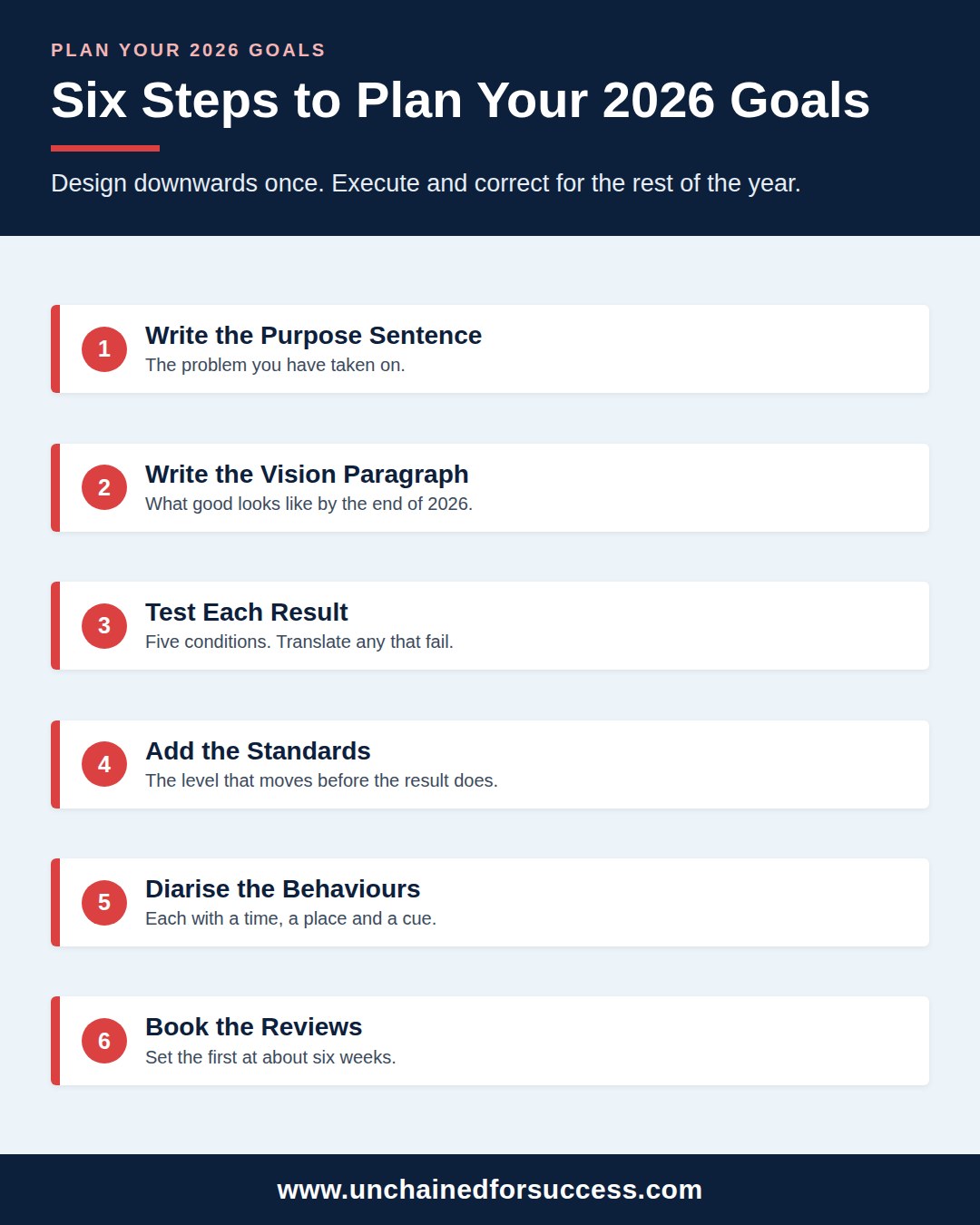
Write the purpose sentence. Write the vision paragraph. Choose a small number of results for the year, fewer than you want to, and test each against the five conditions, translating any that fail. Give each surviving result at least one standard, and give each standard at least one behaviour. Then put the behaviours in the diary with a time, a place and a cue. That is the whole method to plan your 2026 goals, and it fits in an afternoon.
The resource library has planners and canvases if you want a template. Finally, book the reviews now, while it is easy. Set the first at about six weeks. That is late enough for the behaviours to have had a fair run, and early enough to fix a design fault while the year still has room to absorb it.
Frequently Asked Questions
How many goals should I set? Fewer than you want to. Every goal draws on the same limited capacity, so the real constraint is not ambition but what your weeks can carry alongside work, family and the commitments you already made. Count the hours the behaviours would need in an ordinary week, compare that against the hours you actually have spare, and cut until the two agree.
What if I am already behind? Then you are in the ordinary case. Lally's participants lost nothing measurable from missing a single opportunity, and while that study says nothing about longer gaps, it gives no reason to wait for a clean week before restarting. Restart the behaviour at the next scheduled slot.
Should I tell people about my goals? Be careful with this one. Telling someone who will simply approve is not the same as telling someone who will ask you about the work in a fortnight. Only the second creates anything you have to answer to.
So plan your 2026 goals once, properly, then spend the year executing and correcting rather than rewriting. Correcting is not the same as rewriting: the reviews are where it happens, and they are the part that keeps the plan honest.
Share one result you are going to translate into a standard and a behaviour this week, in the comments.
For an outside view of how your goals hold up, the Goals Readiness Score scores each of the nine components separately and names the weakest one.
Which of your 2026 goals would survive a fortnight where nothing goes to plan?
Sources Used to Plan Your 2026 Goals
- Locke, E. A., and Latham, G. P. (2002). Building a practically useful theory of goal setting and task motivation: a 35-year odyssey. American Psychologist, 57(9), 705 to 717. https://doi.org/10.1037/0003-066X.57.9.705
- Gollwitzer, P. M., and Sheeran, P. (2006). Implementation intentions and goal achievement: a meta-analysis of effects and processes. Advances in Experimental Social Psychology, 38, 69 to 119. https://doi.org/10.1016/S0065-2601%2806%2938002-1
- Pham, L. B., and Taylor, S. E. (1999). From thought to action: effects of process versus outcome-based mental simulations on performance. Personality and Social Psychology Bulletin, 25(2), 250 to 260. https://doi.org/10.1177/0146167299025002010
- Oettingen, G., and Mayer, D. (2002). The motivating function of thinking about the future: expectations versus fantasies. Journal of Personality and Social Psychology, 83(5), 1198 to 1212. https://doi.org/10.1037/0022-3514.83.5.1198
- Lally, P., van Jaarsveld, C. H. M., Potts, H. W. W., and Wardle, J. (2010). How are habits formed: modelling habit formation in the real world. European Journal of Social Psychology, 40(6), 998 to 1009. https://doi.org/10.1002/ejsp.674
- Tannenbaum, S. I., and Cerasoli, C. P. (2013). Do team and individual debriefs enhance performance? A meta-analysis. Human Factors, 55(1), 231 to 245. https://doi.org/10.1177/0018720812448394
Continue Your Journey
Explore more resources from the Unchained Goals Framework: