


An accountant running her own small practice looks at her list in the second week of November. Three goals for the year. None of them finished. Seven working weeks left before the office closes for the holidays. The temptation is to write the year off and promise herself a better January. She can still finish the year strong, and it does not depend on finding more motivation.
To finish the year strong, decide which goals can still move, set a standard for the weeks that are left, and do the scheduled work each week.
That is the whole method. The rest of this article shows how to do it, and what the evidence says about the two things readers are told to try instead: gratitude and a fresh start.
A strong finish is a design decision made in November, not a feeling that arrives in December.
Finish the Year Strong by Choosing What Can Still Move
Seven weeks will not rescue every stalled goal, and the number they can carry depends on the size of each one. Choose the goals whose remaining work fits the time and capacity you have. That is the first job, and it takes three questions.
1. Which goals can still produce a result by the end of the year, given the weeks left and the other commitments in them?
2. For each one, what result sits within your authority to deliver? Submitting the application is yours. The decision on it is not.
3. What would that result need from you each week between now and the end of December?
The accountant's three goals were a new client-onboarding process, a professional qualification, and a bookkeeping backlog. Her exam was in March, so the result that mattered in December was coursework submitted, not the award. Clearing the backlog was hers to do. Her onboarding process, though, depended on a software supplier who had gone quiet.
She chose the backlog and the coursework. The onboarding process went on a list for January, with the supplier chased once and the dependency written down. That is not giving up. It is refusing to spend scarce weeks on a result that could not land before January: the one corrective decision left, the supplier's delivery date, was not hers to make, and no replacement route fitted the weeks she had.
Family care, paid work, essential administration and rest all count as commitments when you answer the first question. A goal that fits only if everything else gives way does not fit.
Set the Standard for the Weeks That Are Left
A chosen goal is still only a result. To finish the year strong it needs two more things: a standard that tells you each week whether you are on track, and a scheduled behaviour that produces the standard.
The accountant's backlog was twelve months of unreconciled accounts. Reconciling two months of accounts each week would clear it in six weeks, leaving the seventh week as cover. That became her standard: two months cleared by every Friday. The behaviour that produced it was a reconciliation block from 7.30 to 9.00 on Monday, Wednesday and Friday mornings, before client calls started.
The coursework had its own standard, one section drafted by each Sunday, in a Saturday morning block, and both fitted beside client work.
Check the arithmetic in your own version. If the sessions you have scheduled cannot produce the weekly standard, either the sessions or the standard must change. Better to find that out in week one than in week six.
This chain of result, standard and behaviour is what the Unchained Goals Framework calls an Outcome Goal, a Performance Goal and a Process Goal. The Outcome Goal names the dated result. A Performance Goal states the level you must hit for the result to arrive. And a Process Goal names the executable behaviour, with its time, place or cue, that serves the standard.
Repeat the behaviour at its cue and it needs less and less deciding each time. Do not assume it will become automatic before year end, though. Give it a clear cue and protect the sessions rather than relying on the habit to carry them. The names matter less than the order. Start at the result and work down, and the week's work to finish the year strong designs itself.
Where Gratitude Fits When You Finish the Year Strong
Gratitude is sold as a source of resilience and clarity for the final weeks. The research is more modest than that, and more useful.
Emmons and McCullough (2003) asked undergraduates, and in a third study adults living with neuromuscular disease, to write down things they were grateful for, weekly or daily. The most consistent effect was on positive mood. Weekly gratitude lists in the first study came with better appraisal of life, fewer reported illness symptoms and more exercise, but the illness and exercise findings did not repeat in the second study.
The authors said plainly that not all findings replicated and that they did not know how long the effects lasted. Later meta-analyses found small benefits for wellbeing and for symptoms of depression and anxiety, and no clear advantage over other helpful psychological activities. None of them measured whether goals get finished.
So gratitude alone is not a method to finish the year strong. The use I recommend is narrower: turn it towards evidence of progress, which is useful when the unfinished list is loud.
Two months of accounts reconciled is real. Writing it down on Friday makes it visible. A short weekly note answers three questions: what moved this week, who or what helped, and what do I appreciate about that? Three lines, same time each week, beside the standard you are checking.
That keeps gratitude in its place: a record of what the work produced, not a substitute for the work.
Where Growth Fits When You Finish the Year Strong
Growth comes from what you learn and change at each weekly review when you finish the year strong. It is what each review produces: what the shortfall taught you, what you changed in the arrangements, and whether the change worked the following week. Seven reviews can leave you with a method that is better in January than it was in November. That is the growth that matters for the year ahead.
The New Year Is Not a Better Starting Line
The second thing on offer in November is deferral. Since the year is nearly over, why not start properly in January? Evidence on fresh starts shows that people start more in January, and why that is a trap for anyone who wants to finish the year strong.
Dai, Milkman and Riis (2014) tracked diet-related searches, gym visits by almost 12,000 members, and more than 66,000 commitment contracts. All three rose sharply after temporal landmarks: the start of a year, a month, a week, and after birthdays and holidays. Searches for diet rose by about four fifths at the start of a year, and new commitment contracts more than doubled.
The study measured starting, not finishing. It says nothing about whether January goals get completed, and it did not test why the effect occurs. People start more at landmarks. Whether they keep going depends on what they do afterwards.
That is the point for anyone trying to finish the year strong. The landmark will arrive whether or not you use it, and January may make starting feel easier. Spend that on something new. It cannot replace the work you could usefully do now, and a goal restarted in January has lost the weeks it had in December.
A Weekly Review to Finish the Year Strong
Selection and a standard carry you to the first Friday. A weekly review carries you to the last one, which is where you finish the year strong or quietly stop. It asks one question: did this week meet the standard?
If it did, note it in the three-line record and carry on. A week within the range you agreed needs no diagnosis. If results stay well above the agreed range, check that the improvement is genuine, repeatable and sustainable before raising the standard.
Decide now how many short weeks send you to diagnosis. For seven weeks, two in a row is a reasonable trigger, and review sooner if one shortfall puts the deadline at risk. When the trigger is met, work through the causes in order. First, did the scheduled behaviour happen at all? Second, if it happened, is it producing the standard? Third, is the standard the right measure of progress?
Only then look wider: the plan and its assumptions, the beliefs that shape how you read the shortfall, whether you still accept the cost and consequences and whether the expected benefits still justify them, and finally whether the result is still within your authority at all.
What the Diagnosis Found in Practice
In my experience, most December shortfalls stop at the first question. The accountant cleared about a month instead of two in week three, and about a month again in week four, because two of the three sessions kept going to an urgent client. Two short weeks met her trigger.
Her behaviour had not happened as scheduled. The sessions kept giving way to client work, so she moved them to seven o'clock with the phone off until nine, checked that the remaining weeks could still clear the backlog, and reviewed the next week's output. The repair started at execution, not at the goal, and the cover week absorbed the two months she had lost.
Hold the order. A missed week in November invites the thought that the goal was wrong. Check the behaviour first, because that is the cheaper repair.
Finish the Year Strong Without Carrying Everything Into January
Not every goal makes the cut, and that is the strength of this way to finish the year strong. For each one you did not choose, decide now what happens to it. Carry it forward with a date, as the accountant did with the onboarding process. Or retire it, because the year has shown it no longer serves the direction you are working towards. A goal left in limbo spends attention in December and guilt in January.
If several goals have stalled, the fault may sit in how they were set up rather than in the weeks available. The Goals Readiness Score is 18 questions, about ten minutes, and it points to the weakest part of your goal design so the coming year starts on firmer ground.
Finish the Year Strong: Start This Week
The weeks left are enough to finish the year strong on something, if you choose it and design the weeks. Nothing here waits for January.
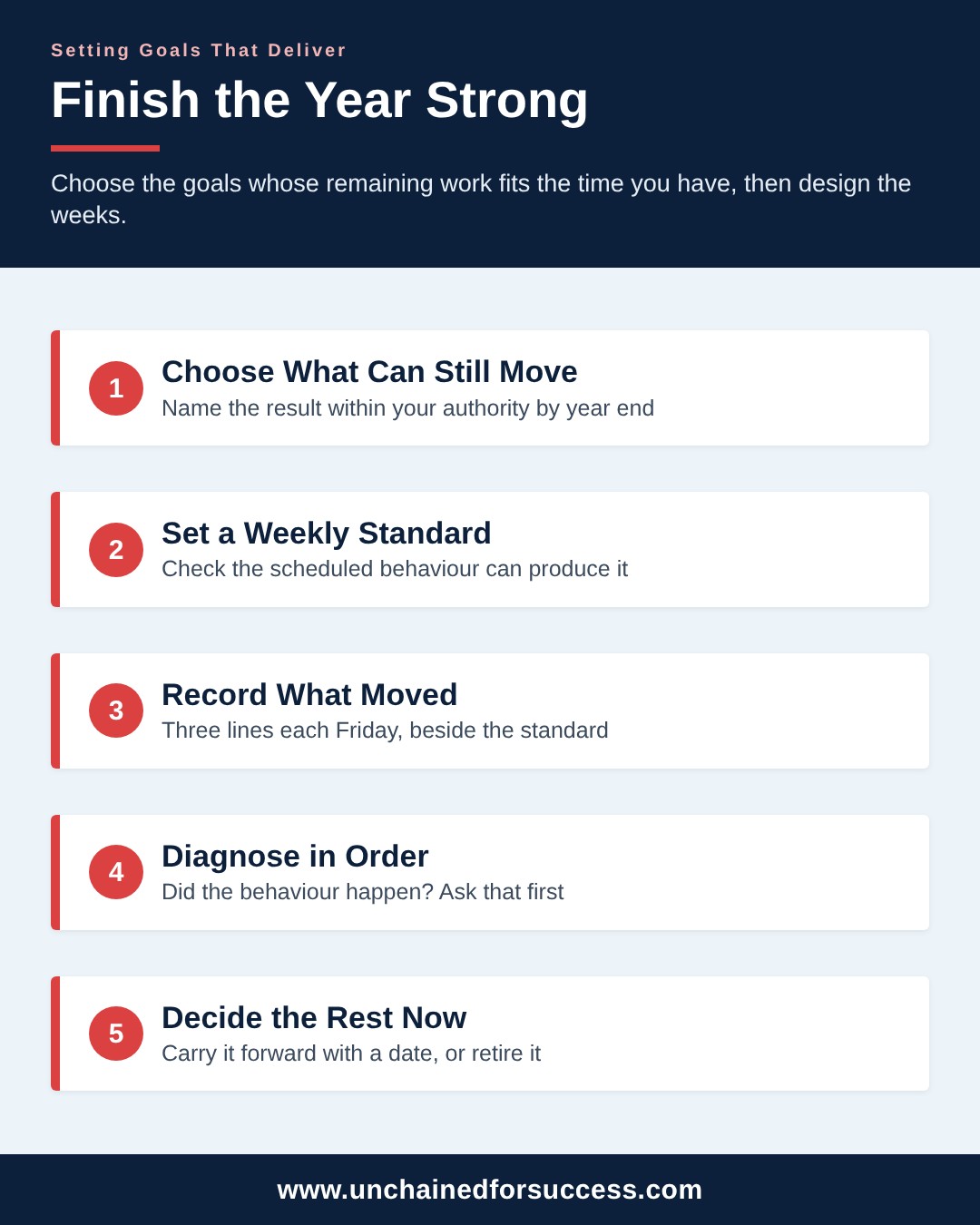
1. Choose the goals whose remaining work fits the time you have, and name the result within your authority.
2. Set a weekly standard and check that the scheduled behaviour can produce it.
3. Keep a three-line record each Friday of what moved.
4. Review against the standard every week, and diagnose in order when your trigger is met.
5. Decide now what happens to the goals you did not choose.
To finish the year strong is not to finish everything. It is to finish what you chose, on purpose, and to arrive in January with the weeks already used.
Write down the goal you have chosen to finish, and its weekly standard, where you will see it on Friday.
Which one goal will you finish the year strong on, and what is its weekly standard?
Further Reading
Three related posts from this series: Back on Track: How to Diagnose and Recover a Drifting Year, Mid-Year Goal Review: Persist or Change Direction and Standards Define Outcomes. The Framework Glossary explains the three goal types.
Frequently Asked Questions
How many goals should I try to finish the year strong on?
As many as the remaining weeks can carry at the standard you set. The test is arithmetic, not ambition: three small goals may fit, one large one may not. If the scheduled behaviour for a goal cannot fit around your other commitments, drop it.
Is it better to defer a goal to the new year?
Defer a goal when it depends on something outside your authority that will not resolve in time, or when it needs more weeks than remain. Do not defer a goal that could finish now. The fresh-start research shows people start more at the new year; it does not show they finish more.
What if I fall short of the standard in December?
Check whether the scheduled sessions happened. If they were repeatedly interrupted, adjust the arrangements so the work can happen, check that the remaining time is sufficient, and review the next week's output. Only if the behaviour happened and the standard still slipped do you ask whether the behaviour is producing the standard, and then whether the standard is the right measure.
Does Research Support This Method?
Two lines of evidence sit behind this article, and neither tests the selection method taught here, which comes from the framework's goal architecture.
On gratitude: Emmons and McCullough (2003) is the original listing study. Davis and colleagues (2016) found gratitude interventions had no statistically clear advantage over psychologically active comparison activities; Dickens (2017) found small to medium effects on wellbeing measures; Cregg and Cheavens (2021) measured depression and anxiety symptoms and found a modest effect. None measured goal completion or performance.
On fresh starts: Dai, Milkman and Riis (2014) used three archival datasets and found aspirational behaviour rose after temporal landmarks. The data measure initiation, not completion.
Sources
• Emmons, R. A. and McCullough, M. E. (2003). "Counting blessings versus burdens: an experimental investigation of gratitude and subjective well-being in daily life." Journal of Personality and Social Psychology, 84(2), 377-389. Available at: https://doi.org/10.1037/0022-3514.84.2.377.
• Davis, D. E., Choe, E., Meyers, J., Wade, N., Varjas, K., Gifford, A., Quinn, A., Hook, J. N., Van Tongeren, D. R., Griffin, B. J. and Worthington, E. L. (2016). "Thankful for the little things: a meta-analysis of gratitude interventions." Journal of Counseling Psychology, 63(1), 20-31. Available at: https://doi.org/10.1037/cou0000107.
• Dickens, L. R. (2017). "Using gratitude to promote positive change: a series of meta-analyses investigating the effectiveness of gratitude interventions." Basic and Applied Social Psychology, 39(4), 193-208. Available at: https://doi.org/10.1080/01973533.2017.1323638.
• Cregg, D. R. and Cheavens, J. S. (2021). "Gratitude interventions: effective self-help? A meta-analysis of the impact on symptoms of depression and anxiety." Journal of Happiness Studies, 22(1), 413-445. Available at: https://doi.org/10.1007/s10902-020-00236-6.
• Dai, H., Milkman, K. L. and Riis, J. (2014). "The fresh start effect: temporal landmarks motivate aspirational behavior." Management Science, 60(10), 2563-2582. Available at: https://doi.org/10.1287/mnsc.2014.1901.
Continue Your Journey
Explore more resources from the Unchained Goals Framework: