Capacity before goals is the rule that quietly separates ambition that delivers from ambition that burns out. A familiar pattern runs the other way: set the bigger goal first, then scramble to build the skill to carry it. Once the workload arrives, it shows the gap. Progress stalls, energy drains, and the goal that once inspired starts to feel like a burden. The failure is not the goal. The failure is the sequence.
Last week's post, Stretch Goals Must Stay Within Your Control, showed how ambition must sit inside a structure you can run. This week the focus moves one layer deeper. Before a structure can hold a goal, the person, team or company must have the capacity to carry it.
By the end of this article, you will know why capacity before goals matters and where capacity sits in the Unchained Goals Framework. You will also know how to design earlier goals that build what the bigger goal will demand.
Why Capacity Before Goals Matters
It is easy to treat capacity as a given, and to assume that if the goal is clear and the plan is sharp, delivery will follow. The research on execution suggests otherwise.
Donald Sull, Rebecca Homkes and Charles Sull surveyed 7,600 managers in 262 companies across 30 industries over five years. They reported the results in the Harvard Business Review. They open by citing earlier studies: two-thirds to three-quarters of large firms struggle to carry out their strategies.
In their own survey, only 9 per cent of managers said they could rely on colleagues in other functions all the time. Nearly a third said the hardest part of execution was adapting when the market changed.
That is a survey of what managers see rather than a measure of results. Our reading is that the strain sits in the ability to work across teams, adapt and carry a plan, not in the quality of the ideas. Many teams hold plans they cannot yet carry.
When leaders ignore this, three patterns are worth recognising. Some start strong and stall. Some deliver one goal and burn out before the next arrives. Others grow their ambition without growing the systems, skills or stamina it needs. When the failure looks like a goal problem, the capacity problem beneath it goes unexamined.
The Core Idea: Build Capacity Before Goals Demand It
The principle is plain. Before you set a goal that demands more than you currently carry, design earlier goals that grow what the later goal will require. Capacity before goals does not lower ambition. It puts ambition in order, so that each stage builds the strength the next one will need.
Goal-setting research supports the ambition. Edwin Locke and Gary Latham summed up 35 years of studies, covering more than 100 tasks and more than 40,000 participants, in American Psychologist.pdf). Specific, difficult goals led to higher performance than urging people to do their best, they found. Performance levelled off or fell only when people reached the limits of their ability or their commitment lapsed.
Read that last clause carefully. A difficult goal beats a vague one right up to the limit of what the person can do. Our reading is that capacity before goals is about moving that limit before the goal arrives; Locke and Latham did not test that.
Audit Three Forms of Capacity Before Goals Are Written
For practical purposes, three forms of capacity matter most. This grouping is ours, a way to run the audit below, not a term the framework defines.
Skill capacity is the ability to do the work the goal needs.
Structural capacity is the systems, teams and tools that hold the work together.
Personal capacity is the energy, focus and recovery you can keep up without running dry.
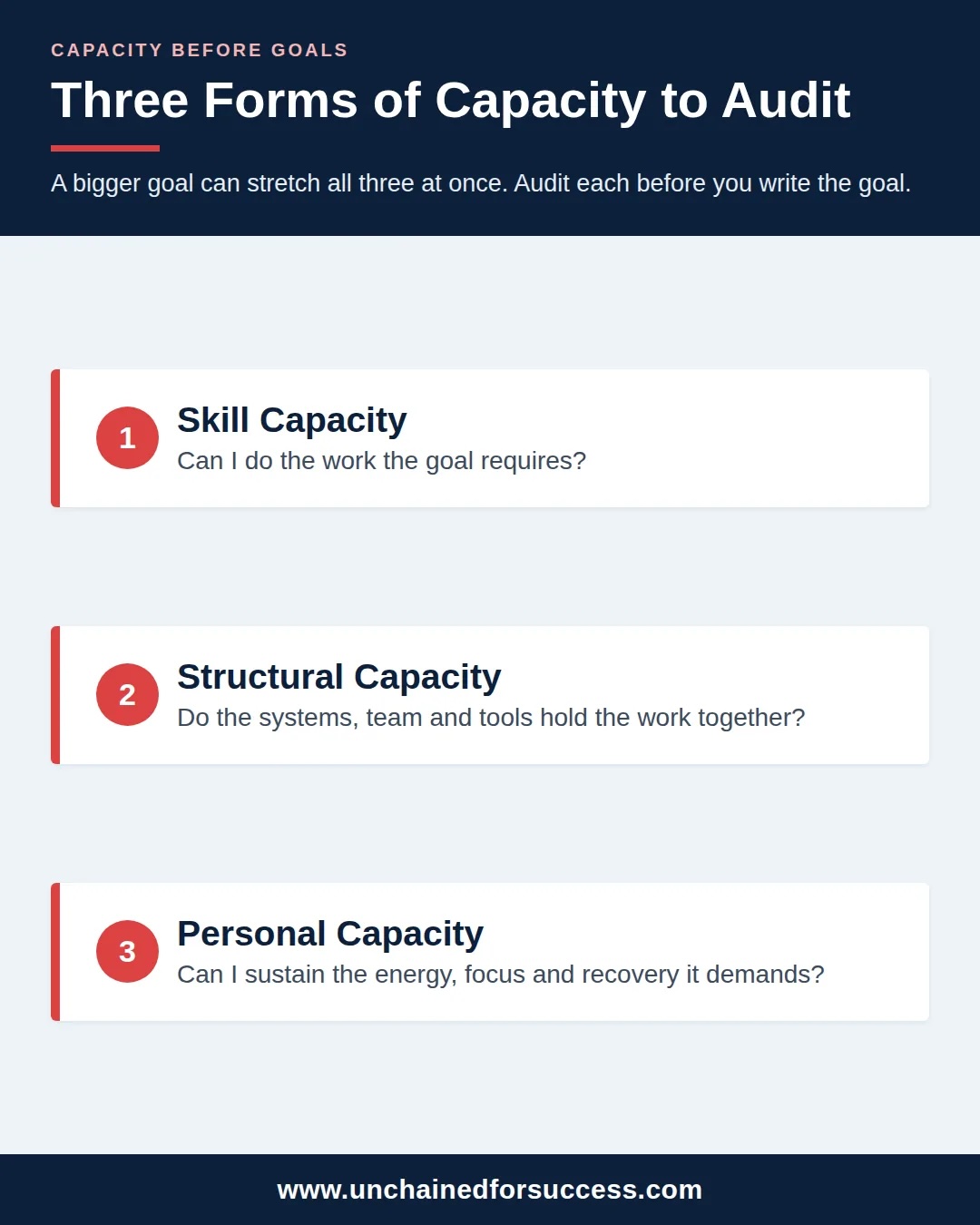
A bigger goal can stretch all three at once. When any one falls short, the goal shows the gap rather than closing it. That is why reaching a target can leave people feeling weaker, not stronger. They got there without building the structure to hold it.
Where Capacity Before Goals Sits in the Unchained Goals Framework
The Unchained Goals Framework has nine components: Purpose, Vision, Goals, Why, Ownership, Beliefs, Plan, Habits and the Control System. Capacity is not one of them, and that is on purpose. Capacity is what the Plan must work with, and what steady Habits protect by making each repeat cost less.
The Plan does two jobs here. First, once a goal has passed SSMTC, the Plan tests whether there is a credible path to carry it within sustainable capacity. That is the pace you can hold without breaking down, rather than the peak you could reach for a short time under ideal conditions. The Plan weighs the goal next to every other goal and commitment that draws on the same capacity over the same period.
If no credible path exists, the goal does not go ahead in that form. You redesign it, sequence its stages, or build the capacity first, which is the second job.
The Plan Can Build Capacity Before Goals Need It
Second, the Plan may build, acquire, free or release capacity before you need it. That is the rule this whole post rests on. Future capacity counts only if it has a credible route, a timing and an owner. A vague intention to "get better at delegating" is not capacity. A named goal to have a deputy running the weekly review by 30 June is.
Habits are where the cost of each repeat comes down. Habit Conversion turns the behaviours in a Process Goal into routines that need less deciding each time. Our reading is that a routine which runs on less effort leaves more capacity for the next job.
The Control System then keeps the whole thing honest. When a Performance measure falls below its range and meets your trigger, the fixed diagnostic order checks Habit consistency, Process validity and the measure itself first. Only then does it ask whether the Plan's capacity assumptions still hold, before moving on to Beliefs, Ownership, Why and finally the control boundary. Outside diagnosis, you reassess the Plan whenever another goal is introduced or a material capacity assumption changes.
Capacity Before Goals Means Declaring Trade-Offs
Capacity before goals also connects to How Trade-Offs Create Progress, because building capacity means declaring what you will not do while you build it.
Practical Examples of Capacity Before Goals
The people in these examples are illustrations, not clients.
An Individual Who Put Capacity Before Goals
Sarah, a senior project manager, wants a director role within two years. Her instinct is to apply for every senior opening that appears. Six months later she is worn out, has been turned down four times, and has lost confidence. The director role itself depends on someone else's decision, so it is the result she wants rather than a goal she can govern.
Applying capacity before goals, she keeps the ambition and designs the goals she can own. The framework calls the director role a dream until it is turned into results inside her authority, and that is what follows. She leads a project across two departments to its agreed handover by 30 September. Next, she takes two junior colleagues through a written development plan to its sign-off by 31 March. Finally, she completes a recognised executive programme by 31 December.
Each is an Outcome Goal inside her authority. Beneath each sits a Performance standard she can hold, such as every milestone reported on time with no open risk older than two weeks. Beneath that sits a Process Goal she can run, such as a Monday risk review and a fortnightly development conversation.
The first two goals grow the skill and the cross-team structure the role demands. The programme grows the skill and the judgement. When she next applies, she can show the capacity the role demands. The decision still belongs to someone else, which is why it was never her goal.
A Consultancy That Put Capacity Before Goals in Year One
A growing consultancy wants to triple revenue in three years. The instinct is to push the sales pipeline at once. Its leaders apply capacity before goals and treat year one as a building year. By 30 June the way they run delivery is written down and in use on every project. Two new principals are in post by 30 September. By 31 December every consultant works to a written quality standard, with a named owner for each goal.
Tripling revenue stays the three-year result the leadership team is working towards. The Outcome Goals it governs in year one are the capacity it builds.
The Performance standards it reviews sit beneath those goals: every live project run the written way with no deviation open longer than a fortnight, every delivery scoring at least four out of five on the quality review, and every new consultant fully onboarded within 30 days. Beneath those sit the Process Goals that produce them: the weekly delivery review and the monthly quality audit.
Ranjay Gulati and Alicia DeSantola make the same argument in the Harvard Business Review, drawing on case studies and earlier research rather than a new study. Start-ups that want to last, they say, must hire specialists, add management structure, set up a framework of plans and goals and sustain the founding culture. Without that, they say, improvising may amount to what they call aimless riffing.
A Programme That Put Capacity Before Goals in Phase One
A digital programme commits to cutting the time it takes to fix a customer issue from 48 hours to four. It has twelve months. The pull is to launch fast and sort things out under pressure.
Applying capacity before goals, the programme leader makes phase one a capacity phase. Its Outcome Goal is readiness by the end of month four, put so anyone can check it: the team in post, the steering meeting running to its terms of reference, every system passed through its tests and every user trained.
Beneath it sits a Performance standard the leader can hold: every system test passed first time or on one retest, and every user trained at least two weeks before go-live. Beneath that sits a Process Goal: a weekly readiness review that checks each of the four conditions against the date.
A programme that skips this phase carries its untested systems and untrained users into phase two, where every fault costs more to put right.
How to Apply Capacity Before Goals
Four steps, in order.
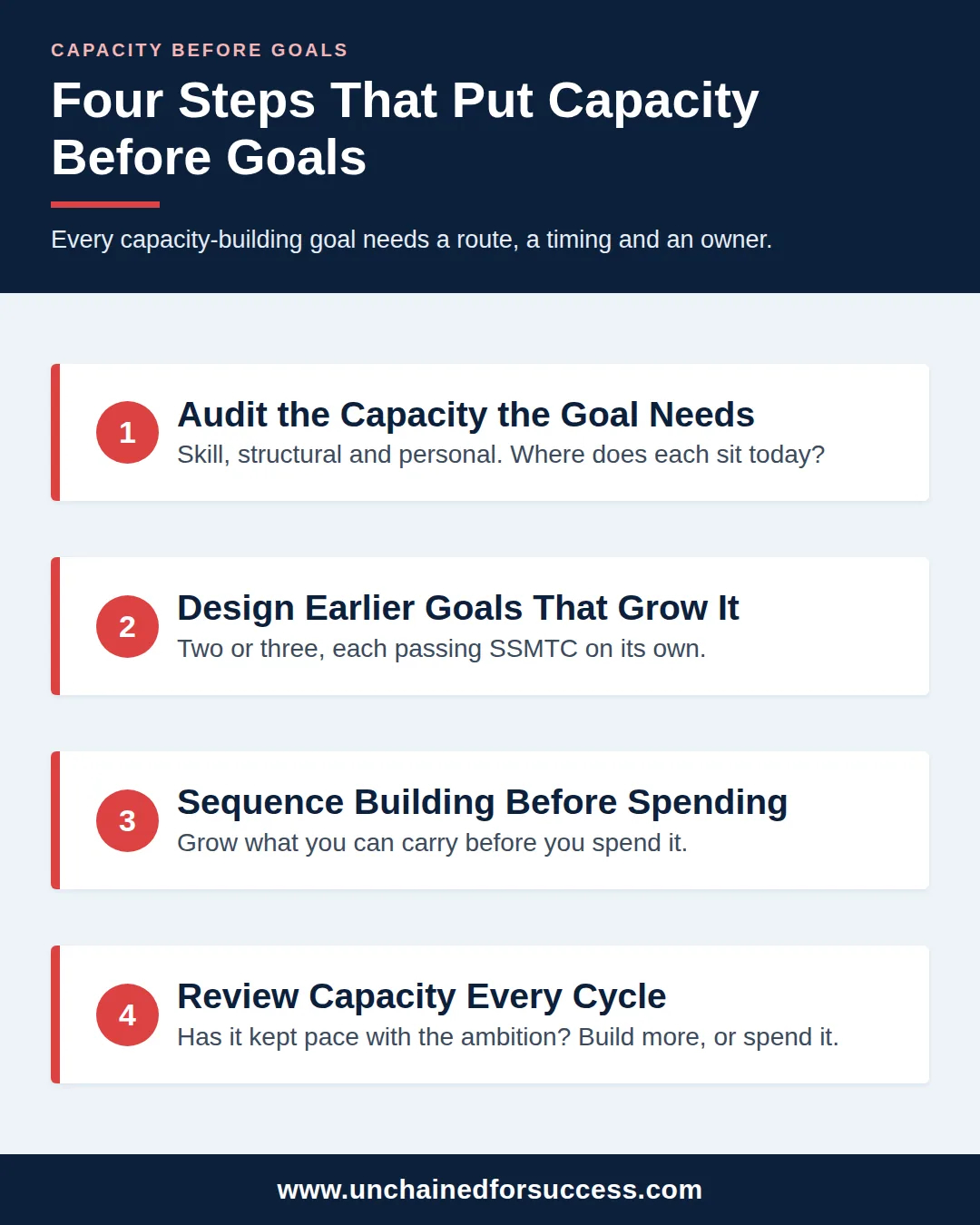
1. Audit Capacity Before You Write the Goal
Before you write the bigger goal, list the skill, structural and personal capacity it will demand. Be honest about where each sits today. The gap between what you have and what the goal needs is not a weakness. It is the design brief for the goals that come first.
2. Design Earlier Goals That Grow Capacity
Once the gap is clear, design two or three earlier goals to close it. Each must pass SSMTC in its own right: Stretched, Specific, Measurable, Time-bound and Under your control. They should not feel like the destination. They should feel like the base, and each should produce a measurable rise in the capacity the bigger goal will need.
3. Sequence Capacity Before Goals That Spend It
The order is not optional. We find it useful to separate two kinds of goal, though the framework does not name them. A capacity-building goal grows what you can carry. A capacity-spending goal uses what you already carry to produce a result. Set the first type before the second, on purpose and in the open, and declare the trade-offs that protect the building phase. This is where the practice of saying no strategically earns its keep.
4. Review Capacity Every Cycle
Capacity does not stand still. It grows when routines settle and shrinks when systems decay or demands change. At the end of each execution cycle, the 60 to 90 day window the framework works in, review whether capacity is keeping pace with ambition. This is a Plan reassessment, not a Control System reading, because capacity was never one of your Performance measures.
If the bigger goal still sits beyond current capacity, the next cycle includes another capacity-building goal. If the evidence shows the new capacity is genuine, repeatable and sustainable, the next cycle can spend it.
Common Mistakes That Undermine Capacity Before Goals
Mistaking ambition for capacity. Wanting a bigger goal badly enough does not give you the capacity to deliver it. Motivation speeds up effort. It does not build skill, structure or stamina. Ambition is the engine; capacity is the chassis.
Squeezing the timeline. A leader who feels behind is tempted to squeeze the building stages and jump straight to spending. What they deliver arrives without the systems to hold it, and the cost of putting it right can be more than the gain.
Treating capacity as personal only. Working on yourself while ignoring the systems and teams around you leaves the structure as it was. Mark Mortensen and Heidi Gardner surveyed more than 500 managers for the Harvard Business Review. Of those working on teams, 81 per cent worked on more than one at the same time. They describe the stress, fatigue and weaker cohesion that can follow, as observations from their survey and interviews rather than a controlled study.
Personal capacity without structural capacity is heroics, not leadership. The two must grow together, which is why Grow Faster Without Losing Control argues for a capacity-building goal in the Plan whenever growth is the aim.
Building capacity you never spend. The opposite failure is a building phase that never ends. Capacity is there to be spent on a goal that serves your Purpose. Step 4 is there to move you from building to spending once the evidence says you can.
Capacity Before Goals: Frequently Asked Questions
Is capacity a component of the Unchained Goals Framework? No. The nine components are Purpose, Vision, Goals, Why, Ownership, Beliefs, Plan, Habits and the Control System. Capacity enters through the Plan, which must rest on sustainable rather than peak capacity and may build capacity ahead of need. It also enters through Habits, which reduce the effort each behaviour takes as routines settle in.
How do I know whether the gap is capacity or the wrong goal? Test the goal first. If it still serves the problem you have taken on and still passes SSMTC, the gap is capacity, and the four steps apply. If it fails either test, reshape the goal before you build anything for it.
Does this apply to a small personal goal, or only to leaders? It applies at every scale. A first-time author who wants a finished manuscript in a year needs the writing routine, the protected time and the rest to keep it going. Only then does the word count mean anything. The steps are the same; only the size of the capacity changes.
Capacity Before Goals, Then Goals That Deliver
Capacity before goals is not a slowdown. It is the order that lets speed last. Without it, ambition burns hot and dies young. With it, bigger goals stop being a gamble and become a plan. Building first is what lets a leader last.
This week, take the biggest goal you hold and list the capacity it demands under the three headings. Then write one capacity-building goal with a route, a timing and an owner. If you want an outside view of how your goals are designed, executed and governed, the Goals Readiness Score is an optional next step: 18 questions, under five minutes.
Share the one capacity you need to build before your next big goal in the comments.
Which goal are you carrying that your capacity was never built for?
Sources
• Why Strategy Execution Unravels and What to Do About It by Donald Sull, Rebecca Homkes and Charles Sull, Harvard Business Review, March 2015
• Building a Practically Useful Theory of Goal Setting and Task Motivation: A 35-Year Odyssey.pdf) by Edwin A. Locke and Gary P. Latham, American Psychologist, 57(9), 705 to 717, 2002. DOI 10.1037/0003-066X.57.9.705
• Start-Ups That Last by Ranjay Gulati and Alicia DeSantola, Harvard Business Review, March 2016
• The Overcommitted Organization by Mark Mortensen and Heidi K. Gardner, Harvard Business Review, September to October 2017
Continue Your Journey
Explore more resources from the Unchained Goals Framework: