

Consistent high performance can slip even when you have the skill and the time, because the energy behind the work runs down. Under pressure, the energy management habits that protect it are easy to let go: sleep, breaks, movement and a proper end to the working day.
The answer is not more discipline. It is design: a plan that fits the energy you can keep up, and a few energy management habits, each with a standard you check every week.
If your plan only works when you sleep six hours and skip every break, change the plan.
Why Energy Management Habits Slip Under Pressure
When a deadline approaches, something gives. Look at what went last time: the hour of sleep, the lunch break, the walk, the evening without email? Each one felt optional on the day. Together they can cost you next week's energy, which makes the work take longer and eats further into rest.
Step 1: Fix the Plan Before You Add a Habit
A plan can quietly assume every week is your best week. The framework distinguishes what you can manage in a short burst from what you can keep up week after week, which it calls sustainable capacity. Build the plan on the second.
Take an illustrative case. A freelance designer wants to launch a portfolio website with twelve new pieces by 30 September, at one piece a week. Five weeks in, she has three. She had held every planned work block, so the work was happening. But by 10 am she was flat: client work ran to midnight and she was sleeping about six hours.
No habit would fix that. The plan had to change first. She declined one new project and paused rush jobs, cutting client work from about 42 to 32 hours a week, which fitted before 7 pm. She added a Friday morning block to catch up.
Step 2: Give Each Energy Habit a Standard
"I will sleep more" is an intention. You cannot check it. A standard says how often the behaviour must happen.
She chose three energy management habits:
1. Sleep. Lights out by 11 pm on weeknights; at least seven hours on five nights a week, as a first step towards the recommended seven or more every night.
2. Breaks and movement. A 15-minute break away from the screen at 11 am every weekday, and a 25-minute walk at lunch on Monday, Wednesday and Friday.
3. Switching off. Laptop closed at 7 pm on four weeknights out of five.
Meeting the standard shows she is doing the behaviour. Her portfolio count shows whether the revised plan as a whole is delivering.
Step 3: Add a Cue and a Fallback
Each habit needs a reliable cue. Hers are simple: a 10.30 pm alarm to wind down, the end of her morning block for the break, lunch for the walk, and a 6.45 pm alarm to close the day.
Each also needs a fallback for bad days: lights out by 11.30 pm when a deadline cannot move, a five-minute walk on a day of calls. A fallback makes it easier to return to the full habit tomorrow. It does not meet the standard, and if she needs it often, the plan needs another look.
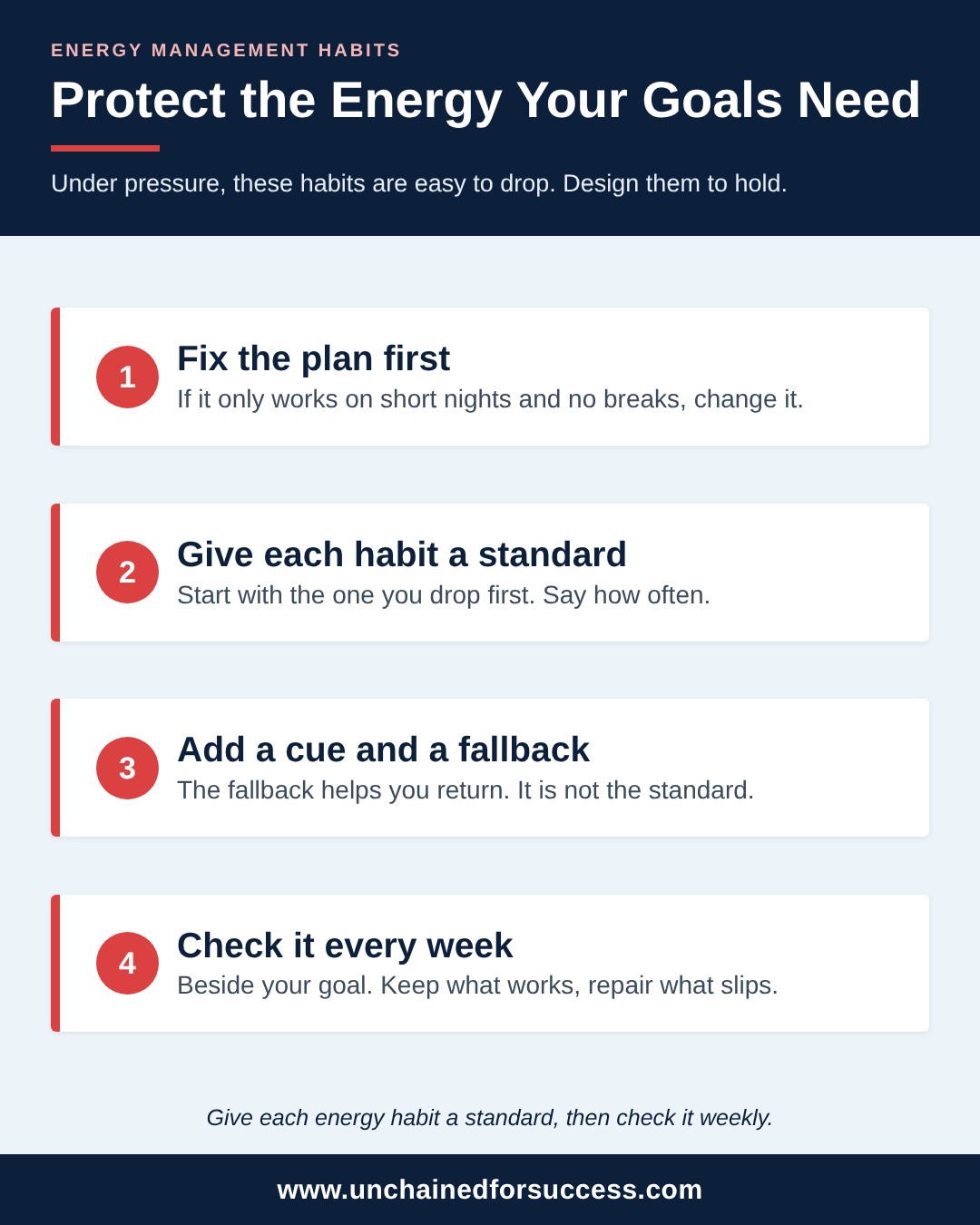
Step 4: Check Your Energy Management Habits Every Week
Each Sunday she checked the three standards and her portfolio count. When a standard slips, look at what pushed it out before you blame yourself. When a late Thursday client call cost her a night's sleep, she asked the client to move it to Wednesday, and they agreed. By the end of week nine she had nine pieces, with five weeks left for the last three.
She cannot know which change did it: the lighter workload, the extra block and the habits all arrived together. What she has is a plan she can keep up. For a deeper look at when your energy peaks, see Energy Management Beats Time Management.
What the Research Says About Energy Management Habits
The research supports the ingredients. Sleep experts recommend that adults sleep seven or more hours a night on a regular basis. Short breaks of ten minutes or less give a small lift in energy and reduce fatigue, though no clear effect on performance was found (Albulescu and colleagues).
Regular exercise raises feelings of energy, in trials where many participants had long-term health conditions (Wender and colleagues), and mentally letting go of work after hours is linked with less fatigue (Bennett and colleagues).
Energy Management Habits: Frequently Asked Questions
How many energy management habits should I start with?
As few as your plan can carry. The designer started three because all three were breaking at once. Add another only once the current ones meet their standards.
What if my work makes regular sleep impossible?
Shift work, young children and caring for others can all make a fixed bedtime unworkable. The recommendation is still seven or more hours on a regular basis. Set a first standard you can protect, work towards it, and plan your hardest work for after your best sleep.
Build Your Energy Management Habits This Week
• Check that your plan fits the energy you can keep up.
• Choose the energy habit you drop first.
• Write a standard for it you can check.
• Give it a cue and a fallback.
• Check it every week, alongside your goal.
To see how well your goals are set up to hold under pressure, try the Goals Readiness Score: 18 questions, about ten minutes, with your results after the contact details step.
What would your next month look like if your energy habits held?
Further Reading
These ideas draw on the Unchained Goals Framework. Related posts: Sustain High Performance by Protecting Your Health, Sustainable Success: What Pushing Too Hard Really Costs and How to Build Habits That Stick. See also the habits glossary entry.
Sources
• Albulescu, P., Macsinga, I., Rusu, A., Sulea, C., Bodnaru, A. and Tulbure, B. T. (2022). "'Give me a break!' A systematic review and meta-analysis on the efficacy of micro-breaks for increasing well-being and performance." PLOS ONE, 17(8), e0272460. Available at: https://doi.org/10.1371/journal.pone.0272460.
• Bennett, A. A., Bakker, A. B. and Field, J. G. (2018). "Recovery from work-related effort: a meta-analysis." Journal of Organizational Behavior, 39(3), 262-275. Available at: https://doi.org/10.1002/job.2217.
• Watson, N. F., Badr, M. S., Belenky, G., Bliwise, D. L., Buxton, O. M., Buysse, D., Dinges, D. F., Gangwisch, J., Grandner, M. A., Kushida, C., Malhotra, R. K., Martin, J. L., Patel, S. R., Quan, S. F. and Tasali, E. (2015). "Recommended amount of sleep for a healthy adult: a joint consensus statement of the American Academy of Sleep Medicine and Sleep Research Society." Journal of Clinical Sleep Medicine, 11(6), 591-592. Available at: https://doi.org/10.5664/jcsm.4758.
• Wender, C. L. A., Manninen, M. and O'Connor, P. J. (2022). "The effect of chronic exercise on energy and fatigue states: a systematic review and meta-analysis of randomized trials." Frontiers in Psychology, 13, 907637. Available at: https://doi.org/10.3389/fpsyg.2022.907637.
Continue Your Journey
Explore more resources from the Unchained Goals Framework: