

Take an illustrative case. A project engineer has to write a monthly risk report. He knows the content and he has the time. Every month he writes it on the last afternoon, badly, after three weeks of opening the file and closing it again. He has tried willpower, which worked for one month, and overcoming procrastination has started to look like a character problem.
It is not. Overcoming procrastination for high performance is not about wanting it more. High performance here means a standard met month after month, reviewed rather than rushed, and that is a design question. It is about changing what the task looks like at the moment you meet it, and what happens next.
This article explains what the research says procrastination is and why willpower alone is not enough. It then sets out a design that takes most of the deciding out of the moment.
You do not beat procrastination at the moment of avoidance. You beat it the week before, by changing what that moment contains.
What Overcoming Procrastination Actually Involves
Steel's (2007) meta-analysis pooled 216 works and 691 correlations. Several things went consistently with procrastination: low conscientiousness and low self-control, how unpleasant the task felt, how far away its payoff was, how little the person believed they could do it, and how impulsive and distractible they were. All of it is correlational, so it cannot show cause.
Sirois and Pychyl (2013) propose the mechanism in plain terms. When a task feels bad, putting it off makes you feel better now. The cost lands on a future version of you who is not in the room. Procrastination is mood repair with a delayed bill.
That reframes overcoming procrastination. The engineer was not lazy or disorganised. The report felt large and unpleasant, the deadline was weeks away, and his phone was on the desk. In this example, every one of those was something he could change: the size of the task, the starting cue and access to distractions.
Why Willpower Alone Is Not Enough for Overcoming Procrastination
Willpower is asked to do its work at the worst possible moment for overcoming procrastination. The task is in front of you and feels bad. It works on a good day. On a tired day there may be nothing to stop the old answer, which is what happened to the engineer's willpower plan after one month.
The research on planning points the other way. Sheeran, Listrom and Gollwitzer (2025) pooled 642 tests of plans that specify when, where and how a person will act. Plans worked, with a modest effect overall and a smaller one after correction for publication bias. These tests covered many kinds of behaviour, not procrastination specifically, so what carries over is the shape of the plan, not a figure.
The useful detail is in the comparison. Plans written in an if-then form did better than plans written as a schedule. Among cue types, a task juncture (the end of a meeting, for instance), a critical stimulus, and a specific time and place all did well. A loosely specified time and place did less well than any of those.
So the lever for overcoming procrastination is not resolve alone. A clear plan reduces how much resolve the difficult moment needs: a cue that carries the task, and a first step small enough that the next action is clear.
Overcoming Procrastination by Design: Four Moves
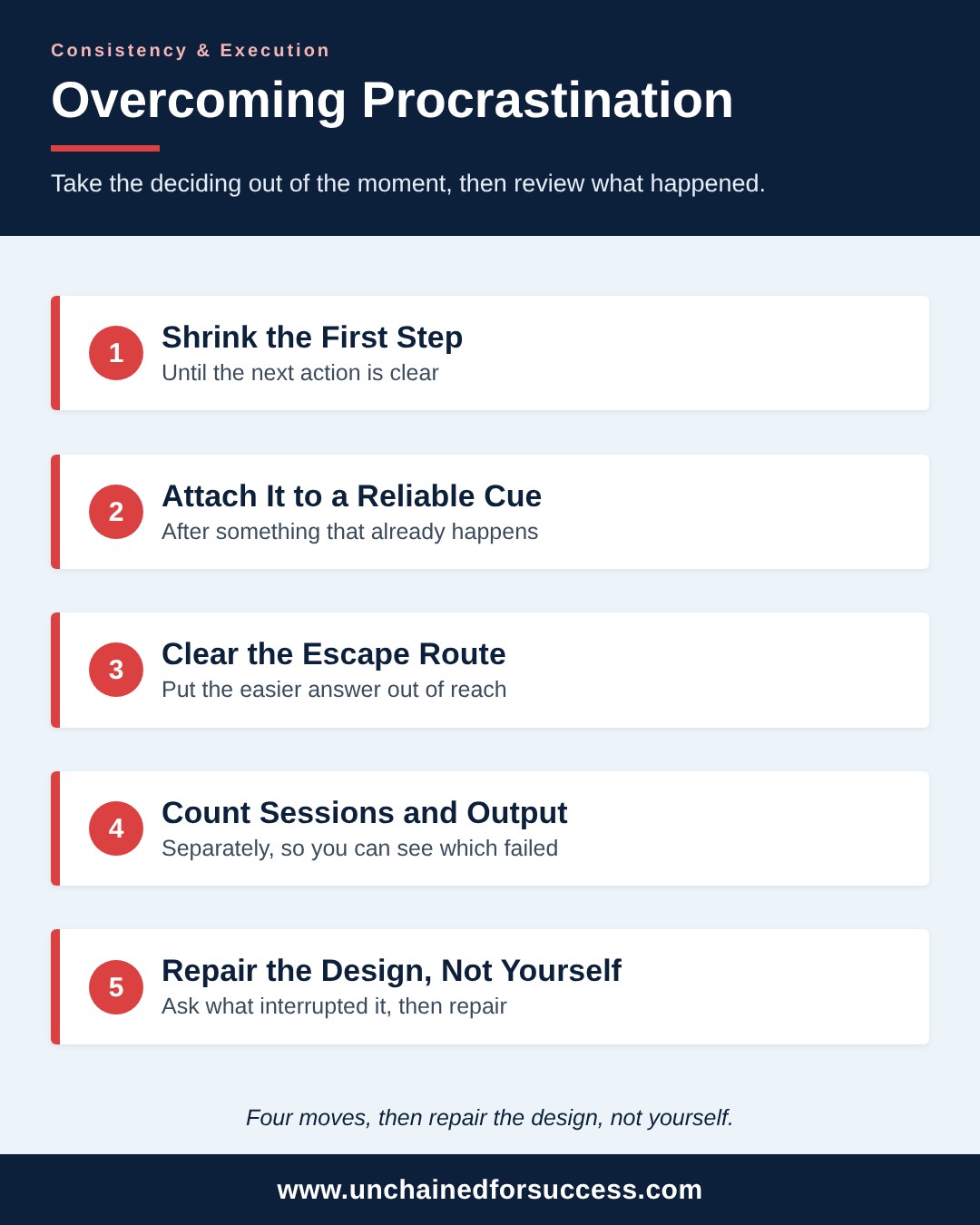
Shrink the first step until the next action is clear. "Write the risk report" is a decision about where to start, and that decision is the thing you avoid. "Open the register and write the three items that changed this month" is not. The whole report still needs writing, but the first step is now bounded and known.
Attach it to a reliable, specific cue. The engineer's plan became: after the Monday nine o'clock team call ends at half past nine, before I open email, open the risk register and write the three changed items. Then work the report until a quarter past ten, forty-five minutes in all.
The call already happened every week; the plan borrowed its cue. Cues of several kinds have research behind them, and a specific time and place that is reliably free works too. He chose the end of a meeting because "at two o'clock" would have competed with whatever two o'clock held.
Remove the easier answer from reach. Phone in the drawer for the session, email closed. Avoidance is easier when the escape route is nearer than the task, so put it further away. This costs nothing and protects the plan while it is weak.
Count What Happened
Count sessions and output separately. Three columns: the start made, the session run for its forty-five minutes, and what it produced. The first month showed three full sessions produced the draft with a Monday to spare, which turned the last-afternoon scramble into forty-five minutes of checking.
The report that used to be written badly in one afternoon was now drafted over three sessions and reviewed in the fourth week. On time and checked, which is what the title means by high performance.
Why Overcoming Procrastination Needs a Standard Above It
The Monday session is a behaviour you can execute, at a cue, serving a standard above it. That is what the Unchained Goals Framework calls a Process Goal. The engineer's standard was a draft report by the end of the third week of each month. Above that sat the result, a risk report submitted on time every month for the year.
Once the Monday session had run for a few months it needed less and less deciding. That is what the framework calls a Habit: a Process Goal that has become progressively less dependent on deciding. Overcoming procrastination, in this sense, is the work of moving a Process Goal in that direction.
When the Standard Slips
The chain matters for overcoming procrastination because of what happens when the standard slips. He had decided at the start that one month below the standard was the trigger that would open a diagnosis, because each report has a fixed issue date. In the fourth month the draft was not ready by the end of the third week. The temptation was to conclude that the method had failed.
The diagnosis said something else. Two of the three sessions had not run their forty-five minutes, because the Monday call had overrun both weeks into the time the session needed. The behaviour had not happened as scheduled, and the question was what had interrupted it, not what was wrong with him.
First the current month, because overcoming procrastination does not suspend the deadline: the report still had a fixed issue date. He ran two sessions in the fourth week, Tuesday and Thursday, and checked the draft the morning it was due. It went out on time, reviewed in one morning rather than over the fourth week, but not late.
The Repair
Then the repair, which was to the design, not to the man, and that is what overcoming procrastination comes down to in this method. He moved the forty-five minutes to after the Tuesday stand-up, which ended on time. He checked that three Tuesday sessions could still produce the draft by the end of the third week, and reviewed the next month's output. It held.
In the months that met the standard he noted two things: which session did most of the work, and what the sessions had cost. That way the design could be kept rather than changed.
Had the starts not happened at all, the question would have been the cue: did the call end, and was he at his desk when it did?
Had the sessions run their full length and the draft still not followed, the question would have been different again. Can three sessions of that size produce a draft at all? And if they can, the question moves up a level, to whether the standard and the plan behind it are the right ones.
What the Research Does Not Promise
Researchers have tested interventions for procrastination. The summary is encouraging but mixed in size. Van Eerde and Klingsieck (2018) pooled 24 studies and found a large reduction in procrastination that held at follow-up. Approaches based on cognitive behavioural therapy worked best.
Rozental and colleagues (2018), restricting the pool to 12 randomised trials against inactive controls, found a small overall benefit. The two reviews used different inclusion rules and comparisons, so their different sizes answer different questions rather than contradicting each other.
The Pomodoro method, work in fixed bursts with short fixed breaks, is tested here through one small study of a close variant. Biwer and colleagues (2023) gave students fixed breaks, 24 minutes on and 6 off or 12 on and 3 off.
Those students reported less fatigue and distraction than students who chose their own breaks. Effort and the amount completed did not differ. The difference in time taken was not clear enough to count, and the authors describe any efficiency gain tentatively.
Use it as a tool for overcoming procrastination if it suits you. The study did not measure procrastination, so it is no evidence that timed bursts cure it.
None of this research tested the four-move design above, which is the practical conclusion drawn here. What the research does support is the shape of it. Make the task less aversive at the first step. Plan the cue rather than the intention. The pooled effect is real but partial, so do not expect the design to remove avoidance on its own.
If procrastination keeps returning across several goals, the fault may sit in the design of the goals rather than in the sessions. The Goals Readiness Score is 18 questions, about ten minutes, and it points to the weakest part of your goal design.
Overcoming Procrastination for High Performance: One Task This Week
Overcoming procrastination for high performance is not the absence of avoidance. It is a design that makes the avoided task start anyway, most weeks, and a review that repairs the design when it does not.
1. Choose one task you keep putting off and write a first step so small that the next action is clear.
2. Attach it to a reliable cue, such as a meeting that already happens each week.
3. Put the easier answer out of reach for the session.
4. Count sessions that ran as planned and their output, separately.
5. When the standard slips, check whether the sessions happened and what interrupted them, then repair the design, not yourself.
For the engineer, overcoming procrastination for high performance came down to a better task design, which gave him a practical way to reduce delay. He did not become a different person. He changed what the forty-five minutes after a team call contained.
Write down the one task you are putting off, the first step whose next action is clear, and the cue you will attach it to.
What is the task you keep opening and closing, and what already happens each week that you could attach it to?
Further Reading
Three related posts from this series: Reset Your Loops: Rewire Your Brain for Breakthroughs, How to Build Habits That Stick and Why Habits Matter More Than Motivation for Success. The framework page sets out Process Goals and Habits in the build sequence.
Frequently Asked Questions
Is overcoming procrastination a matter of discipline?
The research says discipline-related traits do predict procrastination, but the practical lever is design rather than character. A first step whose next action is clear, attached to a cue that already exists, is built to run on days when discipline is low. That is what the engineer changed, and he did not change himself.
Does a timer like the Pomodoro method help with procrastination?
It can help some people, and one small study found fixed breaks reduced reported fatigue and distraction. That study did not measure procrastination, so it is not evidence that timed bursts cure it. Treat it as one way to bound a session, not as the method.
What if I set up the plan and still avoid the task?
Check first whether the cue arrived and the session ran. If the cue was unreliable, move it to one that is. If the start happened but the session did not run its length, ask what interrupted it before you change anything. Only if the sessions ran and the output still does not follow do you question whether the sessions are the right behaviour for the standard, and after that the standard itself.
Does Research Support Overcoming Procrastination This Way?
The sources below describe what predicts procrastination, what planning does, and what interventions achieve.
Steel (2007) is a meta-analysis of 216 works measuring what goes with procrastination, not what causes it; its predictors are reported here without ranking. Sirois and Pychyl (2013) is a conceptual review of the mood-repair account. Sheeran, Listrom and Gollwitzer (2025) pooled 642 tests of implementation intentions across many behaviours. They found a modest overall effect, smaller after correction for publication bias. If-then plans outperformed schedule-format plans, and precisely specified cues outperformed loose ones.
Van Eerde and Klingsieck (2018) and Rozental and colleagues (2018) are meta-analyses of interventions against procrastination. The first reports a large reduction that held at follow-up; the second a small benefit. Both found cognitive behavioural approaches did best. Biwer and colleagues (2023) is a single-session experiment with 87 students measuring reported fatigue, distraction, concentration and motivation, with no difference in the amount completed and no clear difference in time taken.
Sources
• Steel, P. (2007). "The nature of procrastination: a meta-analytic and theoretical review of quintessential self-regulatory failure." Psychological Bulletin, 133(1), 65-94. Available at: https://doi.org/10.1037/0033-2909.133.1.65.
• Sirois, F. and Pychyl, T. (2013). "Procrastination and the priority of short-term mood regulation: consequences for future self." Social and Personality Psychology Compass, 7(2), 115-127. Available at: https://doi.org/10.1111/spc3.12011.
• Sheeran, P., Listrom, O. and Gollwitzer, P. M. (2025). "The when and how of planning: meta-analysis of the scope and components of implementation intentions in 642 tests." European Review of Social Psychology, 36(1), 162-194. Available at: https://doi.org/10.1080/10463283.2024.2334563.
• van Eerde, W. and Klingsieck, K. B. (2018). "Overcoming procrastination? A meta-analysis of intervention studies." Educational Research Review, 25, 73-85. Available at: https://doi.org/10.1016/j.edurev.2018.09.002.
• Rozental, A., Bennett, S., Forsström, D., Ebert, D. D., Shafran, R., Andersson, G. and Carlbring, P. (2018). "Targeting procrastination using psychological treatments: a systematic review and meta-analysis." Frontiers in Psychology, 9, 1588. Available at: https://doi.org/10.3389/fpsyg.2018.01588.
• Biwer, F., Wiradhany, W., oude Egbrink, M. G. A. and de Bruin, A. B. H. (2023). "Understanding effort regulation: comparing 'Pomodoro' breaks and self-regulated breaks." British Journal of Educational Psychology, 93(S2), 353-367. Available at: https://doi.org/10.1111/bjep.12593.
Continue Your Journey
Explore more resources from the Unchained Goals Framework: