


A plan can exist on paper and still go nowhere. Mastering execution means closing the gap between that plan and work that happens, week after week, until the result arrives.
On the programmes I have worked on, more effort did not close that gap, and neither did a longer plan. Five checks did.
A plan on paper is not yet a plan anyone can work.
When a Recovery Plan Sits Unworked
I once created a recovery plan for a large infrastructure programme. It was a solid plan, but for weeks it gathered dust. The client team did not follow it through.
That programme had missed several milestones on the way to a final milestone its regulator required. The client, the contractor and the regulator's team had all lost confidence. Morale dropped. Most believed it was too late.
I was called back in. I updated the plan and implemented the framework in full. A solid plan gives you a route. It still has to be turned into work people can do. Mastering execution there came down to five things.
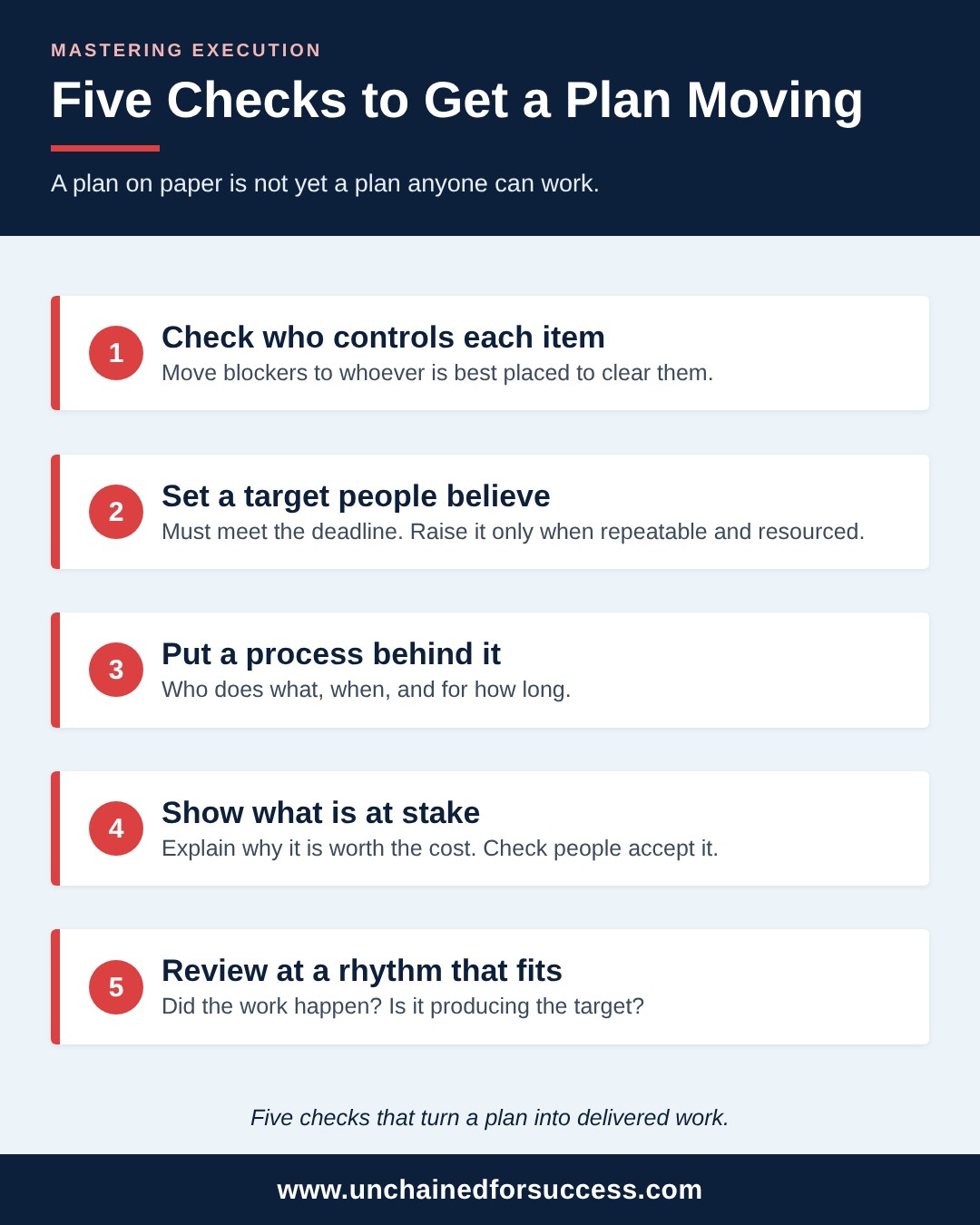
1. Check Who Controls Each Item
First, I checked whether the contractor could deliver everything on its list. It could not. Some blockers sat with the local council, and the client had handed them to the contractor. The client was better placed to clear them, so the client took them back. The contractor could then focus on the work it did control.
Ask this of every item in your plan: does its owner hold enough authority over the main causes of the result, and over the decisions needed to correct it? The framework calls this the control boundary.
Where the answer is no, move the item to whoever is best placed to clear it. Moving it does not give them control of an outside body's decision, so manage that decision as a dependency, with a date and a fallback. A plan that gives work to people who cannot deliver it looks like a delivery problem. It may be a design problem.
2. Set a Target People Believe
People did not believe the team could meet the final target. So we agreed weekly targets. As the team met them and belief grew, we made them more aggressive.
I have seen distant targets that nobody believes produce careful reporting and little pace. A near target people can hit gives them evidence. But a believable target must still add up: check that the weekly rate, held to the deadline, delivers everything that remains. Raise it only when results repeat and capacity allows.
3. Put a Process Behind the Target
There was no proper process in place to deliver the milestone, so we put one in.
The framework calls this layer the Process Goal: the behaviour someone controls, with its time or cue, that produces the target above it. A milestone tells you where you are going. A process tells you who does what, and when, this week.
4. Make Sure Everyone Knows the Stakes
We made sure everyone understood why the milestone mattered, from the project managers to the client and the contractor. If the programme missed it, the client risked prosecution.
The framework calls this the Why: the reason a goal is worth its cost. When the work gets hard, people ask whether the effort is worth it. Explain why the result is worth its cost, then check that the people carrying the cost accept it. Repeat the reason when the work is hardest.
5. Review at a Rhythm That Fits the Work
We held daily reviews. A good review asks two questions first. Did the planned work happen? If it did, is it producing the target? Fix the first problem you find. If both answers are yes and the result still slips, look further up, in order: the measure, the plan, belief, whether people still accept the cost, whether the reason still justifies it, and whether the result is still within the owner's authority.
Review what went well, too. When a target is met, ask what made it possible and keep it.
The team met the targets. The programme delivered the milestone with all its requirements, and the regulator's team were pleasantly amazed.
Mastering Execution on a Plan of Your Own
The same checks work for one person. Take an illustrative case. A trainee accountant must submit her qualification portfolio by 30 June. By mid-April she has finished two of six sections, about twelve hours each.
1. Control. One section needs a signed statement from her employer. She asks her manager now, with a date.
2. Target. One section a fortnight: four sections in eight weeks, with two to spare.
3. Process. If it is Tuesday or Thursday at 7 pm, she drafts until 9 pm. If it is Saturday at 9 am, she drafts until noon. Seven hours a week covers the six she needs.
4. Stakes. She writes down the cost, two evenings and a Saturday morning a week, and the reason: the qualification and the pay review behind it.
5. Review. Each Sunday she checks the hours and whether the section is on pace.
In week three a work trip removes a Thursday. She moves those two hours to a free Sunday afternoon, so the fortnight's section still lands. Mastering execution is that simple, and that easy to skip.
What the Research Says About Mastering Execution
The gap is real. A meta-analysis by Webb and Sheeran found that a medium to large change in what people intended produced only a small to medium change in what they did.
Two of the five checks have research behind them. Tracking progress improved goal attainment across 138 experiments, more so when progress was written down or reported to others (Harkin and colleagues; mostly health goals). And specific if-then plans improved goal attainment in a 2025 review of 642 tests, though the effects shrank after correcting for publication bias. None of these studies tested the five checks; the rest comes from practice.
Mastering Execution: Frequently Asked Questions
How often should I review progress?
Match it to the pace of the work. Daily suited a programme under heavy pressure. Weekly suits most personal plans. Decide in advance, and review sooner if one miss puts the deadline at risk.
Does mastering execution work for one person?
Yes. The checks are the same. For one person, the control check can mean asking early for what you need from others.
Start Mastering Execution This Week
• Check that every item sits with someone who can deliver it.
• Set a near target that adds up to the deadline.
• Put a process behind it, with names and times.
• Write down what is at stake.
• Review at a set rhythm, including what went well.
To see where your own goals are weakest, try the Goals Readiness Score: 18 questions, about ten minutes, with your results after the contact details step.
Which plan of yours exists on paper but is not being worked?
Further Reading
These ideas draw on the Unchained Goals Framework. Related posts: Why Clear Goals Don't Get Executed, Standards Define Outcomes and Why Ownership Changes Everything. Terms: control boundary and Process Goal.
Sources
• Harkin, B., Webb, T. L., Chang, B. P. I., Prestwich, A., Conner, M., Kellar, I., Benn, Y. and Sheeran, P. (2016). "Does monitoring goal progress promote goal attainment? A meta-analysis of the experimental evidence." Psychological Bulletin, 142(2), 198-229. Available at: https://doi.org/10.1037/bul0000025.
• Sheeran, P., Listrom, O. and Gollwitzer, P. M. (2025). "The when and how of planning: meta-analysis of the scope and components of implementation intentions in 642 tests." European Review of Social Psychology, 36(1), 162-194. Available at: https://doi.org/10.1080/10463283.2024.2334563.
• Webb, T. L. and Sheeran, P. (2006). "Does changing behavioral intentions engender behavior change? A meta-analysis of the experimental evidence." Psychological Bulletin, 132(2), 249-268. Available at: https://doi.org/10.1037/0033-2909.132.2.249.
Continue Your Journey
Explore more resources from the Unchained Goals Framework: